Insurance and Company Structure for Sellers
Two questions every seller reaches at about the same point, and the answers are less complicated than the forums make them.


Loading Article banner
Two questions arrive together, usually a few months in, and both get answered badly on forums by people describing a different country's rules.
This is the general shape of both. It is not legal or financial advice, and the specifics depend on where you are and what you sell, so the last step is always somebody qualified in your own jurisdiction.
The insurance requirement
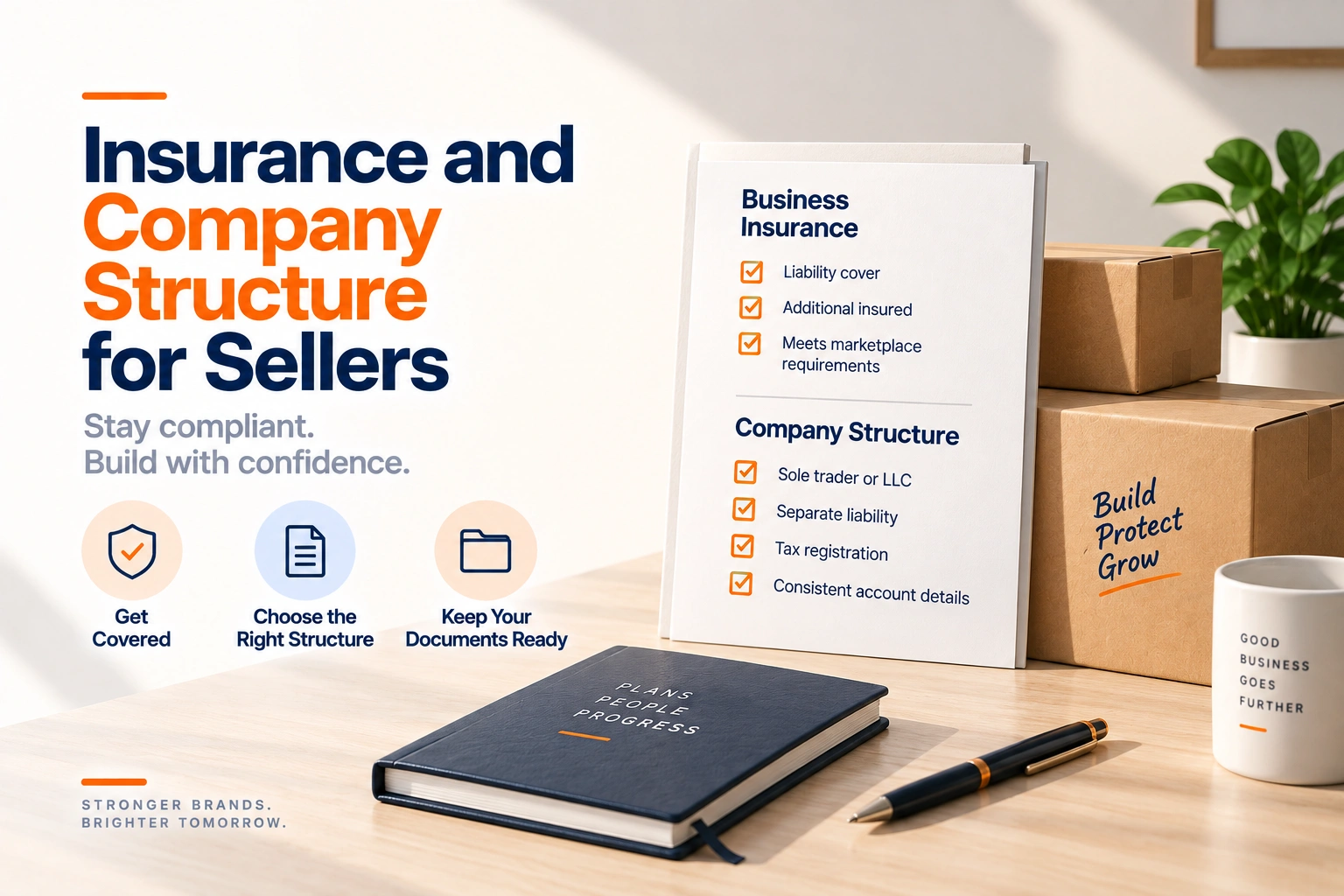
Amazon's business solutions agreement requires commercial liability cover once an account passes a monthly gross proceeds threshold. The figures have been stable for years, and they are in the agreement rather than in a blog, so check the current version before buying anything.
Two things are worth knowing beyond the number. The policy has to name Amazon as an additional insured, and Amazon has to be able to verify it, so a policy that satisfies your own risk assessment may still be refused for a paperwork reason.
And it is triggered by the account's sales, not by the category. A seller who crosses the threshold in a month is expected to have cover whether or not the products are risky.
What changes on 2 November 2026
Amazon has announced two changes to its insurance requirement, effective 2 November 2026, and restated the rule underneath them. That rule is unchanged: sellers must "obtain and maintain commercial liability insurance within 30 days if gross proceeds from Amazon.com sales exceed USD 10,000 in any month, with minimum coverage of USD 1 million per occurrence and in the aggregate."
The first change removes the threshold for riskier products. Sellers listing in what Amazon calls safety-enhanced categories must carry cover "with a minimum coverage of USD 1 million per occurrence and in aggregate, regardless of whether they meet the USD 10,000 gross proceeds in a month threshold." Amazon names children's products, cosmetic and ingestible products, and lithium battery products, and its list is not exhaustive, so a seller near any of those should check the category page for their own products rather than assume they are outside it.
The second applies to sellers based in mainland China: "Starting November 2, 2026, we will reject newly submitted insurance policies that are not obtained through AIA," the Amazon Insurance Accelerator. A valid policy submitted before that date can run to its expiry, and its renewal then has to come through the Accelerator.
For a small seller in one of those categories, this is the change that matters: the cover used to become compulsory only once sales passed the threshold, and from 2 November it is required from the first listing. Price the policy into the product before launch, not after the first good month.
What the cover is actually for
Product liability: somebody is harmed by something you sold. That is the risk Amazon is insisting on, and it is a real one for anybody putting their own brand on a manufactured product, because a private label seller is the responsible party in a way a reseller is not.
It is worth having before the threshold makes it compulsory if you sell anything that goes in, on or near a person: food, supplements, cosmetics, children's products, anything electrical.
Do you need a limited company?
You can sell as an individual or a sole trader on Amazon, and plenty do. The question is not whether Amazon requires a company, because it does not, but whether you want the liability separated from your personal finances.
The general argument for incorporating is that it puts a boundary between the business's obligations and your own. The arguments against are administration and cost, and in some jurisdictions tax treatment that is worse at low profits.
That trade-off changes by country and by how much you are making, which is exactly why the honest answer here is a shape rather than a recommendation.
What Amazon does care about
That the details match. The name on the account, the name on the bank account, the name on the tax registration and the name on the utility bill you upload all being the same thing is the difference between a smooth verification and weeks of it.
Changing structure later means updating the account, which is a verification event. Doing it while trading is possible and it is not the week to also be launching something.
The rest of the paperwork
Tax registration where you are selling, which for cross-border sellers is its own subject and one where getting advice early is much cheaper than getting it late.
Product compliance for the category: safety marking, testing documents, ingredient declarations. Amazon asks for these on inspection, and an account with the documents ready answers in a day, which is the whole of the difference between a request and a suspension.
Invoices are the other half of that. Amazon asks for supply invoices to prove authenticity, and it asks for them from the supplier rather than from a retailer, dated within a set period and matching the business name on the account. Sellers who buy from wholesalers on informal terms discover this at the worst possible moment, which is why the paperwork is worth insisting on at the point of purchase rather than at the point of inspection.
None of this is difficult. All of it is slow if it starts on the day it is requested, and the request usually comes with a deadline measured in days.
What we do with this
We do not give legal or tax advice, and the reason this sits alongside Amazon account management is that the paperwork is an account health matter: the accounts that survive an inspection are the ones that had the documents before they were asked for.
The same is true wherever else you sell. Walmart and eBay each have their own verification and their own compliance requests, and they ask for the same underlying documents.
If you are approaching the threshold or thinking about restructuring, it is worth sequencing it with whatever else is happening on the account.
Frequently asked questions
The questions that come up most often on this subject.
Yes. Amazon requires commercial liability insurance within 30 days once gross proceeds from Amazon.com sales exceed USD 10,000 in any month, with at least USD 1 million of cover per occurrence and in the aggregate. From 2 November 2026, sellers in safety-enhanced categories such as children's products, cosmetics and ingestibles, and lithium batteries need that cover whatever their sales.
Commercial general liability, which covers product liability. Amazon has to be named as an additional insured and has to be able to verify the policy, so a policy that satisfies you can still be refused on a paperwork point.
Not to satisfy Amazon. You may well want it anyway if you put your own brand on anything that goes in, on or near a person, because a private label seller is the responsible party in a way a reseller is not.
No. Amazon accepts individual and sole trader accounts. Incorporating is about separating the business's liabilities from your personal finances, and whether that is worth the administration depends on your jurisdiction and your profits.
Yes, and it is a verification event: the account details have to be updated and re-verified. It is doable while trading and it is not the week to also be launching a product.
The account, the bank account, the tax registration and any document you upload. Verification delays are almost always a mismatch somewhere in that list rather than a judgement about the business.
No. It is the general shape of two questions, and the specifics depend on where you are and what you sell. The last step is somebody qualified in your own jurisdiction, and it is much cheaper before a problem than after one.
It depends on the category: safety marking, test reports, ingredient or material declarations, and supply invoices for authenticity. The accounts that survive an inspection are the ones that had them ready rather than the ones that went looking.
No. Liability insurance covers harm caused by a product, not commercial losses from a policy decision. Nothing insures against a suspension, which is why account health is managed rather than covered.
Each sets its own terms, and the underlying documents are the same, so a seller organised for Amazon is usually most of the way there for Walmart and eBay. Read each agreement rather than assuming the thresholds match.
Sellers listing children's products, cosmetic and ingestible products, lithium battery products and other safety-enhanced categories must carry USD 1 million of commercial liability cover regardless of the USD 10,000 monthly threshold, and sellers based in mainland China must obtain new policies through the Amazon Insurance Accelerator.