ASINs, Barcodes and Product Identifiers
Four different codes, and sellers routinely confuse them. Which one you need depends on whether the product already exists on Amazon.


Loading Article banner
Four codes come up in the first week of selling and they do different jobs. Getting them confused is how a seller ends up with a listing on the wrong product, or no listing at all.
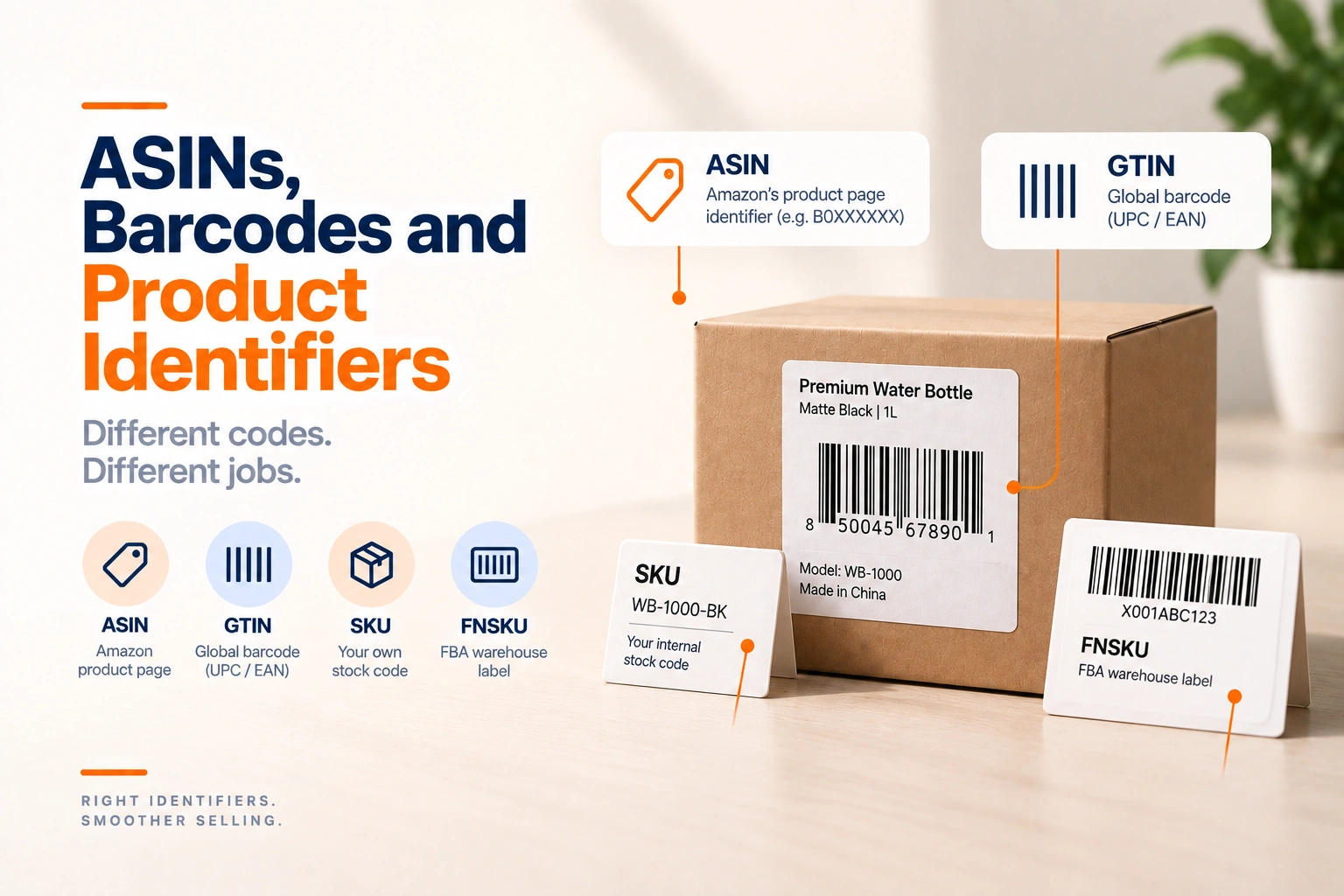
The short version: a barcode identifies the product in the world, an ASIN identifies the page on Amazon, and an SKU identifies the stock in your own account.
The four codes
ASIN. Amazon's own identifier for a detail page. Ten characters, assigned by Amazon, not by you. Every offer on that page shares it, which is the whole point: one product, one page, however many sellers.
GTIN. The family name for the barcode standards. A UPC is the twelve digit version common in North America, an EAN is the thirteen digit version common in Europe, and an ISBN is the one books use. They are all GTINs.
SKU. Yours. A code you invent to identify your own stock, and it never leaves your account. Two sellers on the same ASIN have different SKUs and neither knows the other's.
FNSKU. The label FBA puts on a unit so Amazon knows whose it is in the warehouse. It matters when stock is commingled and it matters when a return comes back.
When you need a barcode
When the product does not already exist on Amazon. Creating a new detail page means proving the product is a real product, and a GTIN is how that is done.
When the product does exist, you do not need one. You add your offer to the existing ASIN, which is the correct behaviour and the one new sellers most often get wrong by creating a duplicate page for something already listed.
Buy barcodes from GS1, the body that issues them, rather than from a reseller. Amazon checks the number against the GS1 database, and a cheap barcode registered to somebody else's company name is refused, sometimes months after it was used.
GTIN exemption
Some products legitimately have no barcode: handmade goods, private label lines that are genuinely new, parts and accessories sold by a brand that does not barcode them.
Amazon grants an exemption for those, per brand and per category, on evidence: usually images of the product and its packaging showing the brand, with no barcode present. It is a real route and it is slower than buying a barcode, so it is worth starting early if you need one.
Where it goes wrong
A duplicate page for an existing product. Splits the reviews, splits the sales history, and eventually gets merged by Amazon or reported by the brand. Search the catalogue before creating anything.
A barcode registered to another company. The listing works until it does not, and then the listing is removed and the stock is stranded.
Reusing an SKU. Your own code, your own problem, and it is a bad one: sales history, stock and returns all attach to the SKU, and reusing one for a different product makes the account's own records untrue.
Assuming an ASIN belongs to you. It belongs to the product. Even a private label ASIN you created can carry other sellers' offers, which is what reselling allows.
Other marketplaces
The same GTIN travels. Walmart and eBay both accept the standard barcodes, and both use them to match your offer to their own catalogue, so a product properly identified once is easier to list everywhere afterwards.
What does not travel is the ASIN. It is Amazon's, it means nothing anywhere else, and a catalogue keyed to ASINs rather than to GTINs is a catalogue that is hard to take to a second channel.
What we do with this
Getting identifiers right at the start is unglamorous and it is the difference between a catalogue that can be moved to another marketplace and one that cannot, which is why it is part of setting up an Amazon account properly.
It is also the first thing we check when a listing on Walmart or eBay will not match: nine times out of ten the barcode on the carton is not the barcode in the feed.
Keep reading
If your catalogue grew by hand and nobody is sure which codes are right, an audit is the cheap version of finding out later.
Frequently asked questions
The questions that come up most often on this subject.
Amazon's own ten character identifier for a detail page. Amazon assigns it, not the seller, and every offer on that page shares it: one product, one page, however many sellers.
A barcode, a GTIN, identifies the product in the world and is issued by GS1. An ASIN identifies the page on Amazon and is issued by Amazon. The barcode is how Amazon matches your product to the right page in the first place.
Only to create a new detail page. If the product is already listed, you add your offer to the existing ASIN and no barcode is needed, which is the step new sellers most often skip before creating a duplicate.
You can, and it is a false economy. Amazon checks the number against the GS1 database, and a barcode registered to another company's name gets the listing removed, sometimes months later with the stock already in a warehouse.
Permission to list without a barcode, granted per brand and per category, for products that genuinely have none: handmade goods, some private label lines, parts sold by brands that do not barcode them. It is granted on evidence, usually images showing the brand on the product and packaging.
Your own code for your own stock. You invent it, it never leaves your account, and two sellers on the same ASIN have different ones. Never reuse an SKU for a different product: sales history, stock and returns all hang off it.
The label FBA puts on a unit so Amazon knows whose it is inside the warehouse. It matters most when stock would otherwise be commingled and when a return needs to come back to the right seller.
Length and geography. A UPC is the twelve digit form common in North America and an EAN the thirteen digit form common in Europe. Both are GTINs and Amazon accepts both.
Yes. Walmart and eBay use the same standards to match your offer to their catalogues, so a product identified properly once is easier to list everywhere afterwards. The ASIN is the part that does not travel, because it is Amazon's.
The reviews and sales history split across two pages, and eventually Amazon merges them or the brand reports it. Neither outcome is under your control, so search the catalogue thoroughly before creating anything new.