Reselling on Amazon: What Is Actually Allowed
You do not need a brand's permission to resell its products. You do need several other things, and the difference is where most accounts get into trouble.


Loading Article banner
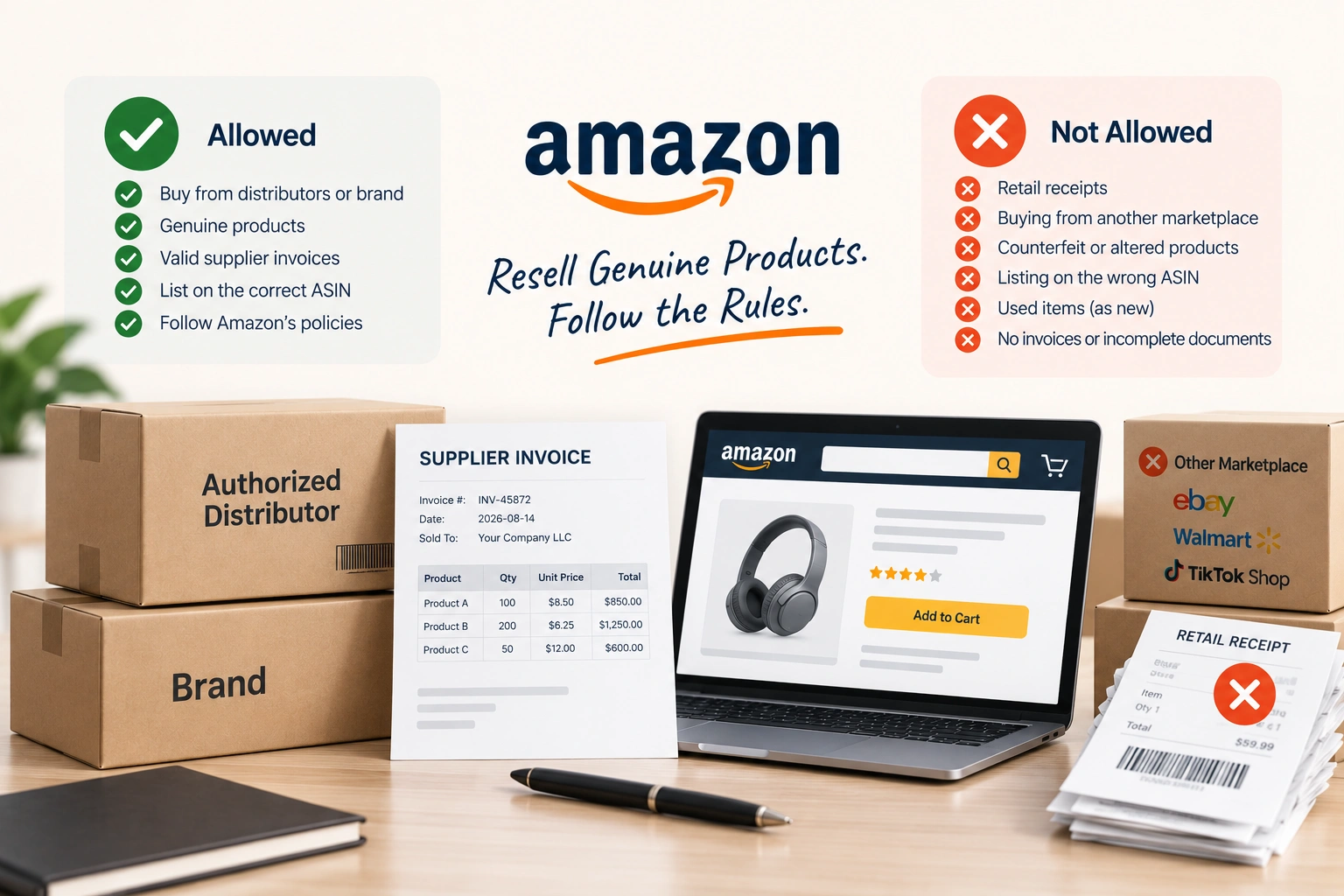
Reselling on Amazon sits on a rule most people find counterintuitive, and a set of practical requirements most people underestimate. The rule is that you generally do not need a brand's permission to resell genuine goods you have legitimately bought. The requirements are what Amazon asks of you regardless.
Between those two facts is where resellers get suspended.
The first-sale doctrine, and its limits
In the United States and in similar form elsewhere, the first-sale doctrine means that once a genuine product has been sold, the buyer may resell it. A brand cannot generally use trademark law to stop resale of its own genuine goods.
This is why "authorised reseller" is a commercial arrangement rather than a legal requirement. A brand may prefer authorised sellers, may restrict its distributors, and may make life difficult in various ways, but its trademark alone does not prevent resale.
The limits matter. Goods must be genuine, materially unchanged, and not in breach of a contract you separately agreed to. Products with warranty, safety or handling requirements carry their own rules, and the doctrine does not override those.
What Amazon requires, which is a different question
Amazon is a private marketplace and sets its own conditions on top of the law. In practice a reseller needs invoices from a legitimate supplier, in the seller's own registered name, dated recently and covering the quantity being sold.
That single requirement disqualifies most of what beginners are advised to do. Retail receipts are not supplier invoices. Buying from another marketplace does not produce documentation Amazon will accept. A wholesale account in a different name will not match.
Brand gating adds another layer. Many brands are gated, meaning approval is required to list at all, and approval usually rests on exactly the invoices above.
How resellers actually get suspended
Inauthentic complaints. Triggered by customer reports or brand complaints, and answered with invoices. Sellers who cannot produce compliant invoices lose the listing and sometimes the account.
Condition complaints. Goods arriving used, damaged or in different packaging than the listing describes.
Listing a product on the wrong ASIN. Matching a similar but not identical product to an existing listing is treated as a serious catalogue violation.
Intellectual property complaints. Some are legitimate, some are brands using Brand Registry to discourage resale. Both must be answered, and answering them well requires documentation prepared in advance.
What it takes to do it properly
Buy from distributors or the brand, not from retail. Keep invoices in the account's registered name, complete and available. Check gating before buying stock rather than after. Match products to the exact ASIN. Keep condition and packaging exactly as described.
None of that is complicated. All of it is boring, and the boring part is the business.
Whether it is a good business
Reselling is competitive by nature, because you are selling the same item as everybody else on the same detail page, which leaves price as the differentiator and margin as the casualty.
It works best where you have supply others do not, exclusive or semi-exclusive distribution, or an operational advantage in a category others avoid. It works badly where the only edge is being willing to price lower, because somebody always will.
Brands and resellers running at volume tend to arrive at the same conclusion: the money is in catalogue and account discipline rather than in finding one profitable product. That discipline is what our Amazon account management work provides.
The same question on other channels
Reselling rules are not uniform across marketplaces, and a catalogue that is fine on one can be blocked on another.
eBay is the most permissive of the large marketplaces on used, refurbished and open-box goods, which is why resellers with mixed-condition inventory often do better there than on Amazon.
Walmart applies its own approval process and weighs price competitiveness heavily, so a reseller priced above the wider market can be suppressed regardless of documentation.
Shopify imposes no marketplace gating at all, since it is your own store, but that removes the traffic a marketplace supplies along with the restriction.
TikTok Shop is content led, which suits products that demonstrate well and suits arbitrage inventory poorly, because promotion depends on consistent supply of the same item.
A reseller operating across several of these needs one view of which products belong on which channel, rather than listing everything everywhere and discovering the rules one suspension at a time. That view across Amazon, eBay, Walmart, Shopify and TikTok Shop is what we run for sellers on more than one of them.
Related reading: How to Start Selling on Amazon: The Account, the Product, the First Listing.
Keep reading
Frequently asked questions
The questions that come up most often on this subject.
Generally no. Under the first-sale doctrine, genuine goods that have been legitimately purchased can be resold, and a trademark alone does not prevent that. What you do need is documentation Amazon will accept if the listing is challenged, which in practice means supplier invoices in your registered business name.
An authorised reseller has a commercial arrangement with the brand or its distributor. It is a business relationship rather than a legal requirement for resale, though it makes supply, gating approval and defending complaints considerably easier.
Yes, and the rules differ. eBay is the most permissive on used and refurbished stock, Walmart applies its own approvals and weighs price competitiveness heavily in placement, and your own Shopify store has no gating at all but supplies no traffic either. A reseller across several channels needs to decide which products belong where.
Selling through Amazon Business changes quantity expectations, pricing tiers and documentation rather than the underlying rules about authenticity and invoices. The gating and complaint process is the same. What changes is that buyers may need quantity pricing and their own organisation may require internal approval.
Buy from distributors or the brand rather than from retail, keep invoices in your registered business name covering the quantity sold, match products to the exact ASIN, and keep condition and packaging exactly as the listing describes. Most complaints are answered with documentation, so the documentation has to exist before the complaint arrives.
Invoices from a legitimate supplier, in the seller's registered business name, dated within Amazon's stated recency window, and covering the quantity concerned. Retail receipts, screenshots and orders from other marketplaces are not accepted, which rules out most of what beginners are commonly advised to do.
Many brands and categories are gated, requiring approval before you can list. Approval usually rests on supplier invoices, and sometimes on documentation or authorisation letters. Gating should be checked before buying stock, not after the listing is refused.
It can be, where you have supply advantages, exclusive or semi-exclusive distribution, or an operational edge in a category others avoid. It is difficult where the only differentiator is price, because you are competing on the same detail page as everybody else selling the identical item.