GoodFirms Listings: What They Measure and How to Read One
GoodFirms ranks companies on more than reviews: the portfolio, the service range, the market presence, the maturity. What each criterion is really testing, and how to use a listing to shorten a shortlist.


Loading Article banner
A directory is only as useful as the thing it sorts by. GoodFirms sorts by more than the star rating, which is what makes its listings worth reading and also what makes them easy to misread: a company near the top of a category is not simply the one with the best reviews.
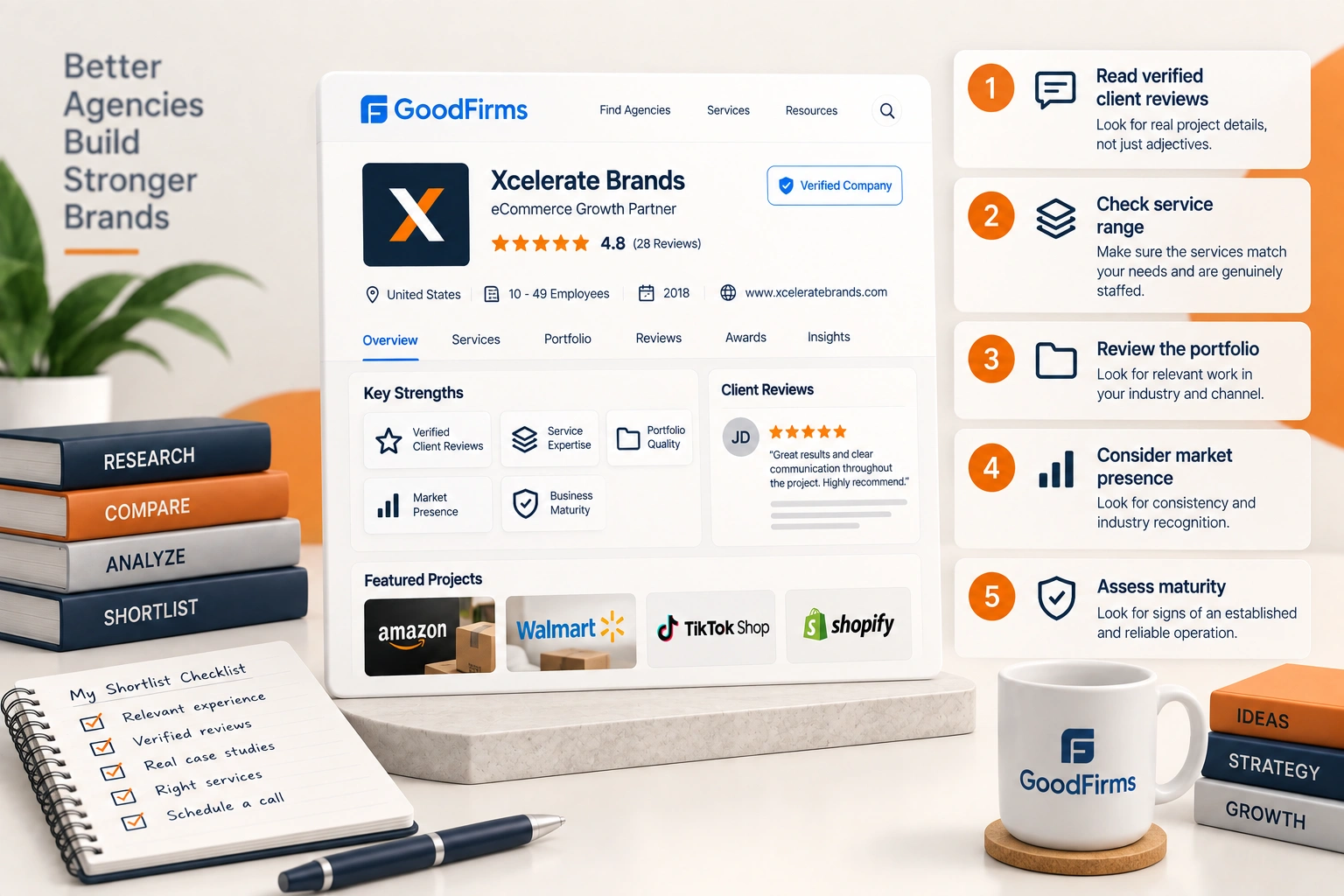
In its own words, from its announcement of the 2026 rankings on 16 June 2026, GoodFirms "applies a multi-factor evaluation methodology that combines qualitative and quantitative signals." Five criteria are named. Each is testing something a buyer actually cares about, and each can be checked on the listing in front of you.
The five criteria, and what each is really asking
"Verified client reviews collected directly through the platform." Collected directly matters: it means the review went through the platform's own process rather than being copied from a website. When you read one, read it for the specifics of the engagement, not the adjectives.
"Depth and breadth of service offerings within the category." This is a two edged test and the listing does not tell you which edge you are on. Breadth is valuable when your problem crosses channels, because one team that runs the advertising, the listings and the fulfilment settings is one conversation rather than three. It is a liability when a company lists forty services and staffs six of them. The check is to ask who does the work you are buying, and what else they do that week.
"Portfolio quality and evidence of relevant project delivery." Relevant is the word to hold on to. Read the portfolio for your channel and your category, not for the logos. A team that has grown a supplements brand on Amazon has met the compliance problems a supplements brand has; a team that has grown a furniture brand has met the size band and storage economics a furniture brand has. Both are experienced. Only one has your experience.
"Market presence and industry recognition." This is the softest of the five and the easiest to buy, so weigh it last. It is genuinely useful for one thing: continuity. A company with several years of presence is less likely to disappear halfway through your fourth quarter.
"Business maturity and operational reliability." This is the one that separates an agency from a group of freelancers with a website. It is also the one a listing cannot fully prove, so it is the one to test on a call: ask what happens when the person running your account is ill, and what happened the last time it occurred.
Where a directory beats a search engine
Search puts the companies best at being found at the top. A directory with a research methodology puts the companies best at being described at the top, which is a different bias and a more useful one when you are shortlisting rather than browsing.
The practical use is to build the shortlist from the directory and then leave it. Take four companies, then go and read what they have written: their case studies, their writing about the platforms, the specificity of it. An agency that cannot explain how the Featured Offer is won in public is unlikely to explain it to you in a meeting.
How to read the reviews on a listing
Reviews on a directory are longer than the ones on a consumer platform, because the form asks for more. Use that. The first thing to read is not the rating but the engagement: what was bought, over what period, at what size, and what changed. A review that says the communication was great, and nothing else, is a real review of nothing in particular.
The second is whose problem it describes. A brand selling twelve products through one channel and a brand selling four hundred across five are different companies with different failure modes, and the agency that suits one can be wrong for the other. You are looking for a reviewer whose sentences sound like your business.
The third is the dates. An agency's capability is a team, and teams change. A set of glowing reviews that all stop two years ago is a story about the agency's past. Recent reviews from long engagements are the strongest thing on any profile, because they mean somebody stayed.
And read what the company writes back. A reply that answers the specific point tells you what a monthly account review will feel like; a reply that thanks everybody equally tells you the same thing about a template. It is the test that works on a marketplace's own feedback too: the reply is the evidence, not the rating.
The three questions a listing cannot answer
Who runs my account, and what else do they run? Ask for the person, not the agency, and ask how many accounts that person holds.
What does month eight look like? Launches are pitched; the steady state is what you buy. On marketplaces month eight is the weekly advertising routine, the inventory arithmetic and the listings that drifted, which is unglamorous and is where the money is.
What do you do when it breaks? Suppressions, suspensions and stranded stock are not exceptional; they are Tuesday. The answer you want has names, hours and a first step in it.
Where we sit on it
Our listing is at goodfirms.co/company/xcelerate-brands. Read it the way this article describes: the reviews for the engagement details, the portfolio for your channel, the breadth for whether it is staffed, and then take the three questions above to a call. If marketplace management is what you are weighing up, that call will settle more in twenty minutes than an afternoon of listings.
And if you are still assembling the shortlist, the guide to choosing an agency covers the parts a directory leaves out: the contract, the access, the reporting, and the questions that separate an agency that manages from one that reports.
Frequently asked questions
The questions that come up most often on this subject.
By a multi-factor evaluation rather than reviews alone. In its own words the criteria are verified client reviews collected directly through the platform, the depth and breadth of service offerings within the category, portfolio quality and evidence of relevant project delivery, market presence and industry recognition, and business maturity and operational reliability.
GoodFirms names verified client reviews collected directly through the platform as one of its ranking criteria, which means the review goes through its own process rather than being reproduced from a company's website. As on any platform, read the individual review for whether it describes a real engagement in specifics.
It means a stronger profile across the five criteria, only one of which is client reviews. A company can rank well on breadth, portfolio and presence while being the wrong fit for your channel, which is why the listing is a way to build a shortlist rather than a way to choose from it.
Use it for the shortlist, not the decision. A directory with a research methodology surfaces companies that can be described and checked, which is a better starting point than a search result. The decision comes from reading what they have published about the work and asking who runs your account, what month eight looks like, and what happens when something breaks.
Both are business services directories with a review process, and they weight things differently: Clutch's profiles put the project details of each review in front of you, while GoodFirms names a broader set of ranking criteria including portfolio, service breadth and business maturity. Read both for the same thing, which is evidence of work like yours, recently, at your size.