Trustpilot for B2B Services: How to Read a TrustScore
A TrustScore is not an average of the stars, and that is the useful part. What the score responds to, why a young profile sits near the middle, and how to read one when you are buying a service rather than a sofa.


Loading Article banner
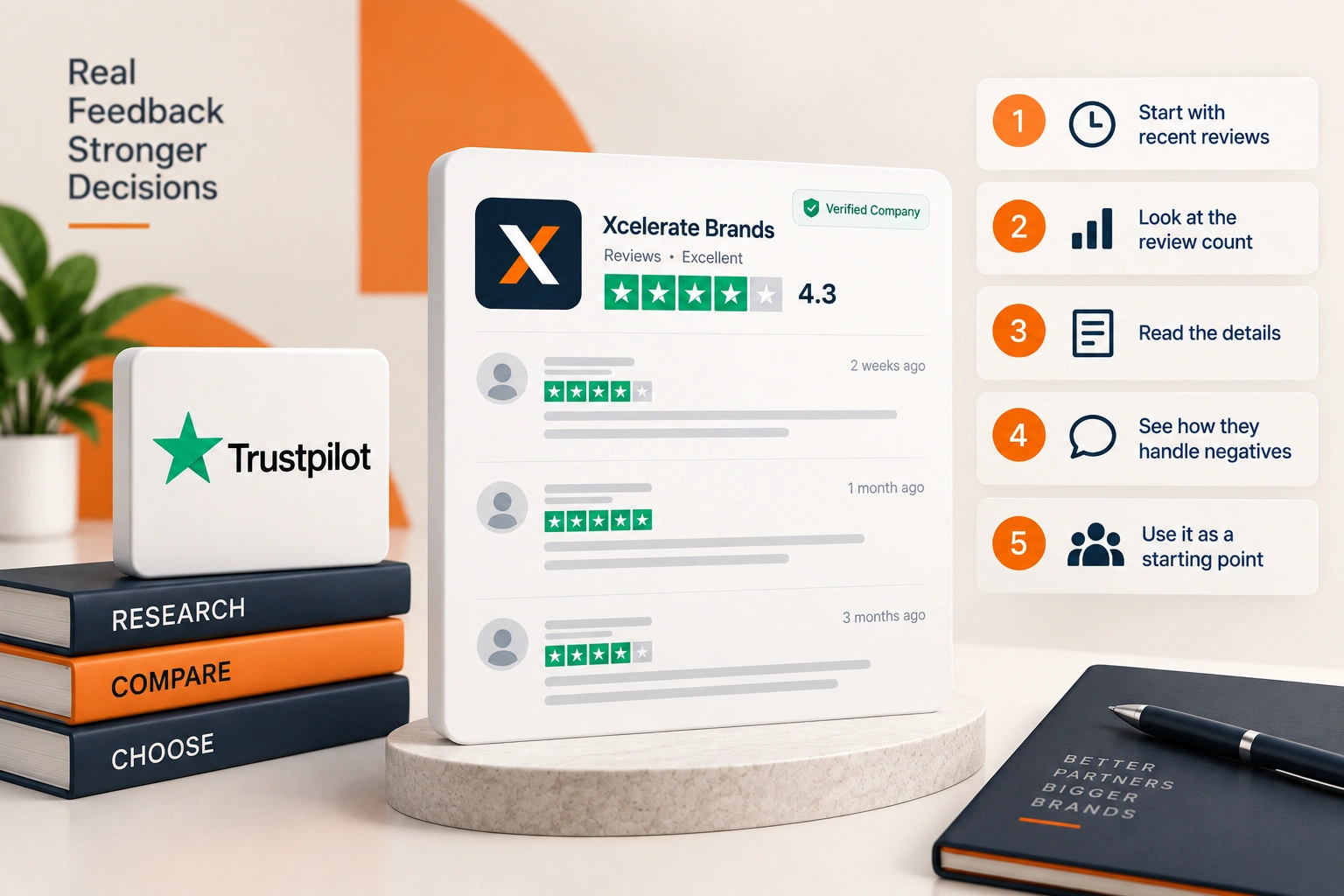
Trustpilot is where consumers argue about deliveries, and that is exactly why it is interesting for a service business. A platform built for high volume consumer complaints holds a company to a standard that a curated case study page never will: anybody can write, the company cannot remove what it dislikes, and the number on the profile moves.
Reading one for a business-to-business decision takes a small amount of care, because the score is not what most people assume, and the volume is not what most people expect.
The score is not an average
The single most useful thing to know about a TrustScore is that it is not the arithmetic mean of the stars on the page. It is widely reported to be a weighted calculation that leans towards recent reviews and pulls a profile with few reviews towards the middle of the scale until enough of them exist to say anything. Trustpilot publishes the mechanics in its own help centre, and that is the place to read them rather than any summary, this one included: the article did not render for us on 21 September 2026, so everything in this section is reported rather than quoted.
Two consequences follow, and they hold whatever the exact arithmetic is. A young profile with three perfect reviews will not show a perfect score, which is a feature rather than a fault: it is the platform refusing to let three reviews mean as much as three hundred. And an old profile carrying a bad year from three years ago recovers as newer reviews arrive, so a score is a statement about the company now rather than a permanent record.
For a buyer this changes what the number is good for. Do not compare a 4.3 against a 4.6 as though they measured the same quantity of evidence. Look at how many reviews each is built on, and when they were written.
Why a service business has fewer reviews, and what to do about it
A retailer has one customer per order and can ask for a review the day the parcel arrives. An agency has perhaps twenty clients in a year, each of whom is busy, and no equivalent moment to ask. So a service business's Trustpilot profile is measured in tens where a retailer's is measured in thousands.
That makes volume the wrong test, and content the right one. Five reviews that describe the work in sentences, from named roles, across different months, tell you more than two hundred one-line ratings would. Read for whether the reviewer knows what they bought: somebody who names the channel, the problem and the outcome was actually a client.
It also makes the negative reviews unusually informative, because on a low volume profile nobody is hiding behind the average. Read them, read the company's replies, and notice whether the reply engages with the specific claim or recites a paragraph.
What a review platform cannot settle, and what does
No review anywhere will tell you whether an agency can run your account, because your account is not the one in the review. What a good profile establishes is that the company is real, that clients exist, that complaints are handled like an adult, and that nothing systematic is going wrong.
The rest is settled in a conversation with numbers in it. Ask what the first ninety days would do and how it would be measured. Ask which metric they would refuse to be judged on and why, which is a better question than it sounds: an agency that says ACoS on its own understands what it is doing, because that metric can be made to look good by spending less and selling less.
And ask what happens when something breaks. An account health problem does not wait for a monthly report, and the honest answer to that question is a process rather than a reassurance.
Reading a profile in five minutes
Sort by most recent and read the last five, whatever they say. Then read every negative review on the profile and each reply, which on a service profile is usually a short list. Then check the dates: a profile whose reviews all land in one fortnight had a campaign, and a campaign tells you about the marketing rather than the work. Then check whether the reviewers describe the service you are buying. Then stop, because the sixth minute adds nothing that a call will not settle faster.
Where we sit on it
Ours is at trustpilot.com/review/xceleratebrands.com, and we would read it the same way: recent first, negatives and replies next, dates after that. If you are weighing marketplace management for Amazon, Walmart, eBay, TikTok Shop or Shopify, the profile is the beginning of the diligence rather than the end of it, and the guide to choosing an agency is where the rest of it lives.
Frequently asked questions
The questions that come up most often on this subject.
Trustpilot publishes the method in its own help centre, and that is where to read it. It is widely reported to be a weighted calculation rather than a simple average of the stars: recent reviews count for more than old ones, and a profile with very few reviews is pulled towards the middle of the scale until it has enough of them to be meaningful. We could not load Trustpilot's own article on the day this was written, so treat the mechanics here as reported.
Because a profile with a handful of reviews is reported to be weighted towards the scale's middle until more arrive, which stops three reviews carrying the same authority as three hundred. It is the platform limiting what a small sample is allowed to claim, not a penalty against the company.
Yes, with a change of expectation. An agency has tens of clients where a retailer has thousands of orders, so read the content rather than the volume: five reviews that name the channel, the problem and the outcome are stronger evidence than two hundred one-line ratings.
A business can report a review it believes breaches the platform's guidelines, and the platform decides. It cannot simply remove a review it dislikes, which is the reason a profile with visible negatives and specific replies is more informative than a page of curated testimonials.
The most recent five reviews, then every negative one with the company's reply, then the dates. Recency tells you what the company is now, the replies tell you how it behaves when something goes wrong, and the dates tell you whether the reviews arrived naturally or in one campaign.