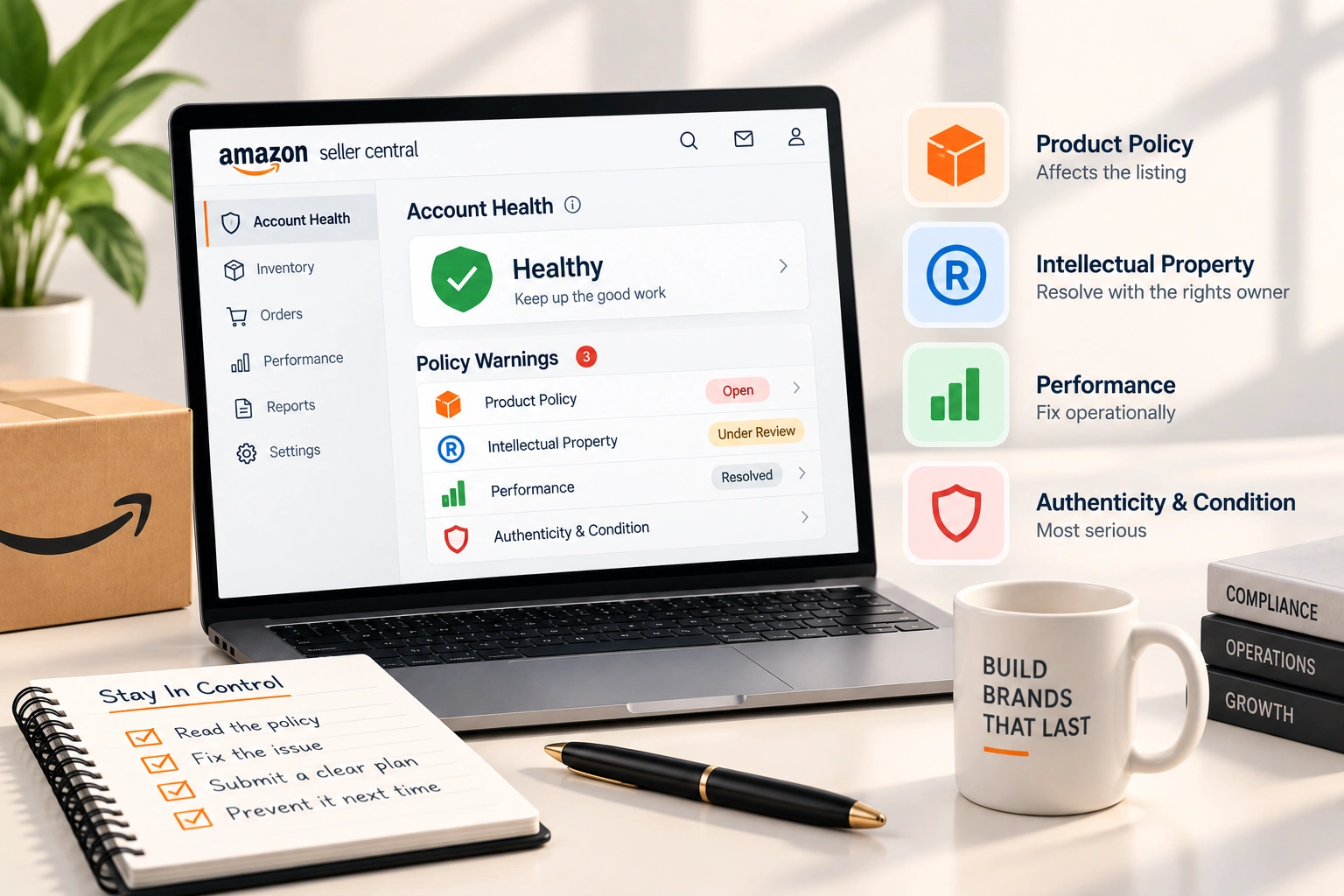
Amazon Account Health, and What Getting Reinstated Takes
Suspension is rarely a surprise to anybody reading the dashboard. The appeal that works is a plan, not an apology, and it is written about the cause.


Loading Article banner

Almost every suspended account was visibly heading that way for weeks. The dashboard reports the same handful of measures continuously, and the accounts that get into trouble are usually the ones where nobody had the job of reading it.
So this is two subjects that are usually treated as one: keeping an account healthy, which is operational, and getting a suspended one back, which is a writing exercise with rules.
The measures that actually matter
Order defect rate. The share of orders with a negative feedback, an A-to-z claim or a chargeback. It is the headline number and the one most closely watched.
Late shipment and on-time delivery. Whether you dispatched when you said you would, and whether it arrived when the buyer was told. Seller fulfilled accounts live and die here.
Pre-fulfilment cancellations. Orders you cancelled because the item was not really available, which is a stock accuracy problem wearing a customer service costume.
Policy violations. Listing rule breaches, intellectual property complaints, restricted product findings, review manipulation.
Valid tracking. Tracking uploaded, to a carrier Amazon recognises, in time.
The exact thresholds are published in Seller Central and change, so work from the figures on your own dashboard rather than from any article. What does not change is which things are counted.
Most trouble starts as an inventory problem
Cancellations come from stock that was not there. Late shipments come from handling times set optimistically or from a supplier who slipped. Negative feedback often comes from one of those two arriving at a customer.
That makes account health substantially a question of whether your stock figures are true across every channel you sell on, which is the same fault that produces defects on Walmart and eBay. One pool of stock offered in four places, synchronised occasionally, produces a cancellation the first time something sells quickly.
The second largest cause is the handling time nobody revisits. Set once during onboarding to something ambitious, met on a good week, missed on every other one.
Intellectual property complaints are a different animal
These arrive from a rights owner rather than from a metric, and they are resolved with them rather than with Amazon. A retraction from the complainant is worth more than any appeal.
Some are genuine: a counterfeit in the supply chain, or using a brand's images without permission. Some are competitive noise. Both look identical on the day they arrive, and the answer is the same: establish which it is with the rights owner before writing anything to Amazon.
Invoices are the evidence. Not receipts, not order confirmations, but invoices from a supplier the brand recognises, with the details matching the seller account exactly.
What a plan of action has to contain
Three parts, and the order is the point.
The root cause. What actually went wrong, specifically, without blaming the buyer, the carrier or Amazon. An appeal that argues the metric is unfair is an appeal that says nothing has changed.
What you have already done. Past tense, concrete: stock reconciled and the discrepancies found, handling time changed from one day to three, the supplier replaced, the listing corrected.
What prevents it recurring. A process with an owner and a frequency, not an intention. Weekly reconciliation by a named role beats a promise to be more careful.
Short, factual and specific reads better than long and apologetic. The person reading it is checking whether you understand the cause, and length is not evidence of that.
What sellers get wrong when appealing
Apologising instead of diagnosing. Contrition is not a plan.
Arguing. Even when you are right, an appeal is not the venue.
Generic templates. They are recognisable, and they say the writer did not investigate.
Sending repeatedly. Each submission is read. A second one that adds nothing wastes the reading.
Waiting to be told. The performance notifications name the cause. Reading them is faster than asking what went wrong after the account stops.
Keeping it healthy costs less than fixing it
Read the account health page weekly, before anything else, because it is the score that governs whether the rest of the work matters.
Set handling times to what you meet on a bad week, and revisit them when suppliers change.
Reconcile stock across channels on a schedule and treat every discrepancy as a symptom rather than something to correct quietly.
Answer buyer messages quickly, because a large share of negative feedback is left by people who could not get a reply rather than by people who got a bad product.
That routine is ordinary, continuous work rather than a project, which is why it usually belongs with a team: our account reinstatement runs it, and the back office capacity behind it is our BPO service.
How the models differ
Private label. Fewer intellectual property complaints against you, more of them made by you. Account health is mostly a stock and supplier question.
Wholesale. Gating and authenticity complaints are the main exposure, and invoices are the whole defence.
Arbitrage. The hardest to defend, because retail receipts are not the invoices Amazon accepts.
Dropshipping. Late dispatch and cancellations belong to somebody else's operation and count against yours.
B2B. Larger orders mean each defect is a larger share of a smaller number, so a single bad transaction moves the rate more than it would elsewhere.
Keep reading
- Policy warnings, and what each one actually means
- What you can do about a bad review
- What approval needed means on an order
- Closing or Pausing a Seller Account
- Amazon Account Health Assurance: What It Is and Who Qualifies
Related reading: our Amazon account health, policy and risk service page and Seller Support Cases That Actually Get Resolved.
Related reading: How to Sell Food on Amazon: Grocery Approval, Shelf Life and the Meltable Window, Amazon Brand Approval, Gating and Ungating: How to Get Approved to Sell, Amazon Sales Stopped Suddenly: How to Tell an Outage From a Listing Problem, Insurance and Company Structure for Sellers and Brand Registry: What It Actually Protects.
Frequently asked questions
The questions that come up most often on this subject.
A dashboard of the measures Amazon uses to decide whether an account is selling responsibly: order defect rate, late shipment and on-time delivery, pre-fulfilment cancellations, valid tracking and policy violations. The thresholds are published in Seller Central and change, so use the figures on your own dashboard.
Usually a metric that had been drifting for weeks, and usually one that started as an inventory problem: cancellations from stock that was not there, or late shipments from a handling time nobody revisited. Policy and intellectual property matters are the other main route.
The root cause, specifically and without blaming anybody; what you have already done, in the past tense and concrete; and what prevents it recurring, as a process with an owner and a frequency. Short and specific reads better than long and apologetic.
It varies with the cause and with how well the first submission is written, which is the part you control. A well diagnosed appeal answered once beats several vague ones, because each submission is read and a repeat that adds nothing wastes the reading.
Invoices from a supplier the brand recognises, with details matching your seller account exactly. Receipts and order confirmations are not invoices. A retraction from the rights owner is worth more than any appeal, so establish with them whether the complaint is genuine before writing to Amazon.
Yes, and each one is read. Send a second only when it contains something the first did not: new evidence, a better diagnosis, or a process you have since put in place.
Yes. Performance feeds buy box eligibility and how much of your catalogue Amazon is willing to show, so an account with drifting metrics is quietly selling less long before anything is suspended.
Weekly, before anything else. It is the score that governs whether the rest of the work matters, and every problem it reports is cheaper to fix in the week it appears.
For a complex or repeated suspension, experience with what these submissions are read for is worth paying for. For a first suspension with an obvious cause, a carefully written plan of action from somebody who understands the operation is usually enough.
Stop producing defects, then wait. The rate is measured over a rolling window, so it improves as the bad period ages out rather than because of anything you can do today. That is also why protecting it before a difficult season matters more than reacting during one.