Amazon Policy Warnings: What Each One Means
A policy warning is not a suspension and it is not nothing. What it is depends entirely on which policy, and most sellers appeal before reading that far.


Loading Article banner
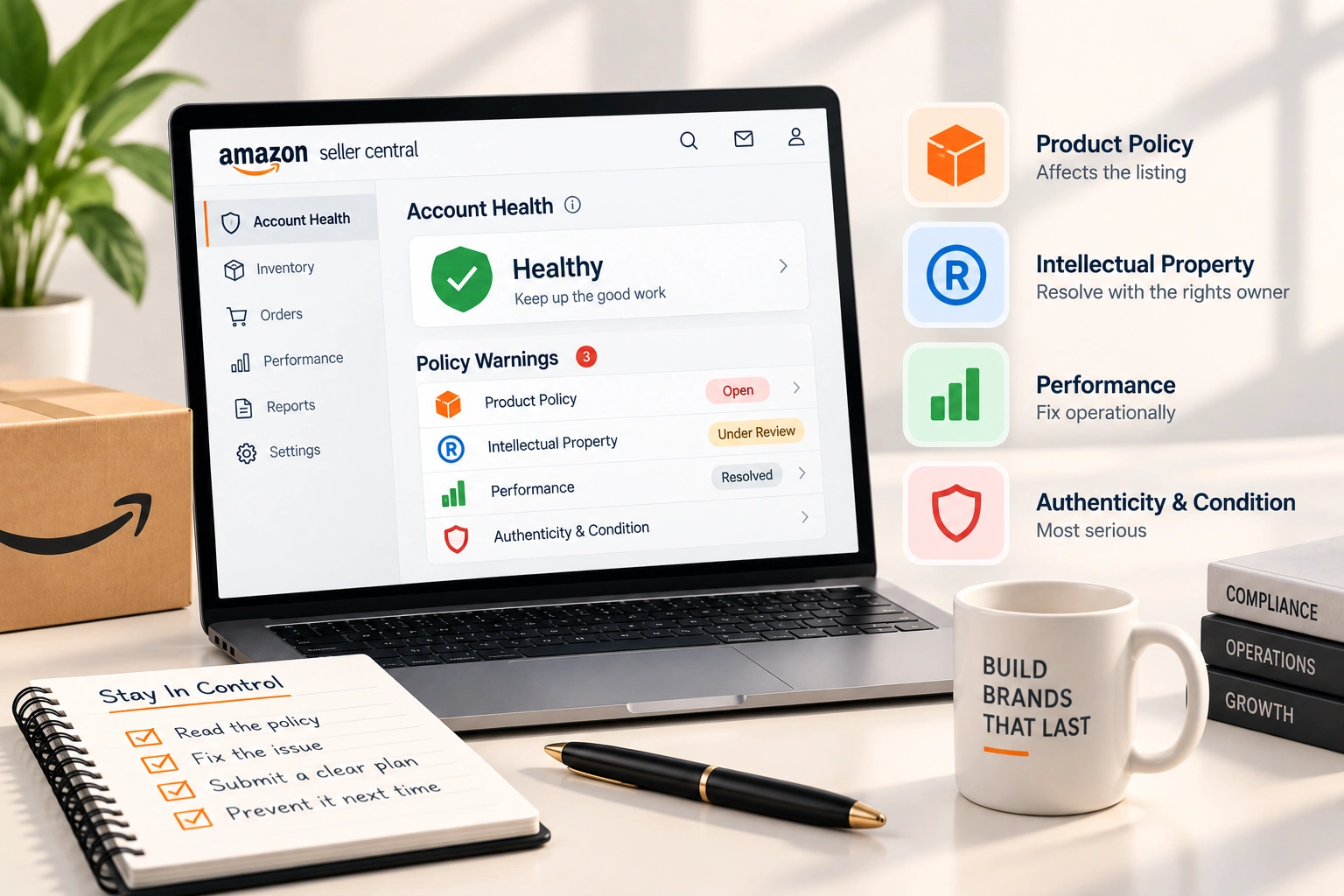
Account health notices arrive in the same tone whether the problem is a mislabelled box or something that will close the account. That flattening is the reason sellers either panic at everything or ignore everything.
They are not equivalent. Reading which policy has been cited is the first thing to do, and it is the step most appeals skip.
The four kinds
Product policy. A listing that breaches a category rule, a restricted claim, or a compliance requirement. Usually the listing is affected rather than the account, and the fix is the listing.
Intellectual property. A rights owner has complained. This one is different from the rest, because the party to satisfy is the complainant rather than Amazon, and a retraction settles it faster than any appeal.
Performance. Late shipments, cancellations, defect rate. These are measured rather than judged, so the fix is operational and the metric recovers over time rather than on appeal.
Authenticity and condition. Customers reporting items as not as described or inauthentic. The most serious of the four, because it goes to whether your supply chain is what you say it is.
What the account health rating is telling you
It is a rolling summary rather than a verdict on today. A single old violation weighs less than a recent pattern, and a rating that is falling matters more than the number itself.
The useful reading is the trend and the composition: three of one kind is a process problem, one of each is bad luck, and a rising performance metric is a warehouse conversation rather than a policy one.
What an appeal is actually for
An appeal is not an argument that the violation was wrong. It is a plan of action that shows what caused the problem, what you have done about it, and what stops it happening again.
The commonest failure is a plan that describes intentions rather than actions taken. Amazon reads a great many of these, and one that says what was changed, when, and how it is verified reads differently from one that promises to be careful.
Where the violation genuinely was wrong, say so briefly with evidence, and still include the prevention section. An appeal that only disputes leaves the reviewer nothing to accept.
Intellectual property, which is its own process
A rights owner complaint is resolved by the rights owner retracting it, and Amazon's role is to record that. Time spent appealing to Amazon before approaching the complainant is usually time wasted.
Reselling is where most of these arise, and the rules are narrower than sellers assume. We cover them in what reselling on Amazon actually allows.
The account health team is a real option
Where the account offers it, a call with an account health specialist is worth more than another written appeal. They can say what the reviewer is looking for, which is information the notice does not contain.
Prepare for it the way you would prepare for an audit: the invoices, the dates, the changes made, in order.
Preventing the next one
Most repeat violations come from the same three places: listings created quickly and never checked against the category rules, suppliers whose paperwork does not meet the invoice standard, and a customer service process that lets a defect metric drift.
Fixing those is unglamorous and it is the whole job. An account with a clean history has more room the day something genuinely goes wrong, which is the real reason to care.
The wider recovery process, when it has already gone wrong, is covered in the article on what is allowed and in what getting an account reinstated involves.
What we do with this
Account health is part of marketplace compliance rather than a service you call in an emergency, because by the time it is an emergency the options are narrower and slower.
The same discipline applies wherever the account is the asset: Walmart and eBay both suspend sellers, on different rules and with different appeal processes.
If you are holding a notice and are not sure how serious it is, send it to us.
Related reading: our Amazon account health, policy and risk service page and Seller Support Cases That Actually Get Resolved.
Related reading: What You Can Do About a Bad Review.
Keep reading
Frequently asked questions
The questions that come up most often on this subject.
A notice that something on the account has breached a policy, ranging from a listing that broke a category rule to a report that an item was not authentic. They arrive in the same format whatever the severity, which is why the first step is reading which policy has been cited rather than reacting to the tone.
Rarely on its own. Suspensions usually follow a pattern, an unanswered notice, or a category of violation serious enough to act on immediately, which in practice means authenticity and safety. A single product policy notice is a listing problem, not an account one.
Three parts: the root cause, what you have already done about it, and what prevents it recurring. Write actions taken with dates rather than intentions, and keep it specific to this violation. A plan that promises to be more careful is the commonest reason an appeal is rejected.
Days rather than hours, and longer where documents are being verified. Submitting a second appeal while the first is in review does not speed it up and frequently resets the queue, which is why the first one should be the considered one.
High enough that a single incident does not put the account at risk, and trending in the right direction. The composition matters more than the number: three violations of one kind is a process problem you can fix, one of each is noise.
By getting the rights owner to retract it. Amazon records the retraction; it does not adjudicate the dispute for you. Approaching the complainant politely, with the invoices that show a legitimate supply chain, resolves more of these than any appeal does.
The weight of an old violation falls over time, so an account with a clean recent history recovers. That is why the trend is worth watching rather than the total, and why a run of small violations matters more than one old serious one.
It depends what was actioned. A suppressed listing stops selling; a warning on the account usually does not. Where selling privileges are suspended, funds are typically held as well, which is the part that turns an appeal into a cash flow problem.
Where the account offers it, yes, and prepare for it. They can tell you what the reviewer is looking for, which is information the notice itself does not contain, and that is worth more than another written attempt.
Three things. Listings created quickly and never checked against the category rules, suppliers whose invoices do not meet the standard Amazon asks for, and customer service processes that let a defect metric drift. All three are operational rather than clever, and fixing them is the whole of prevention.