How to Sell Food on Amazon: Grocery Approval, Shelf Life and the Meltable Window
Food is the category with the most rules and the most dates in them. The approval, the labelling the law requires, the 90 day shelf life FBA insists on, the 50 day disposal line, the six months of the year chocolate cannot go in, and the fulfilment choice that decides whether the rest is workable.


Loading Article banner
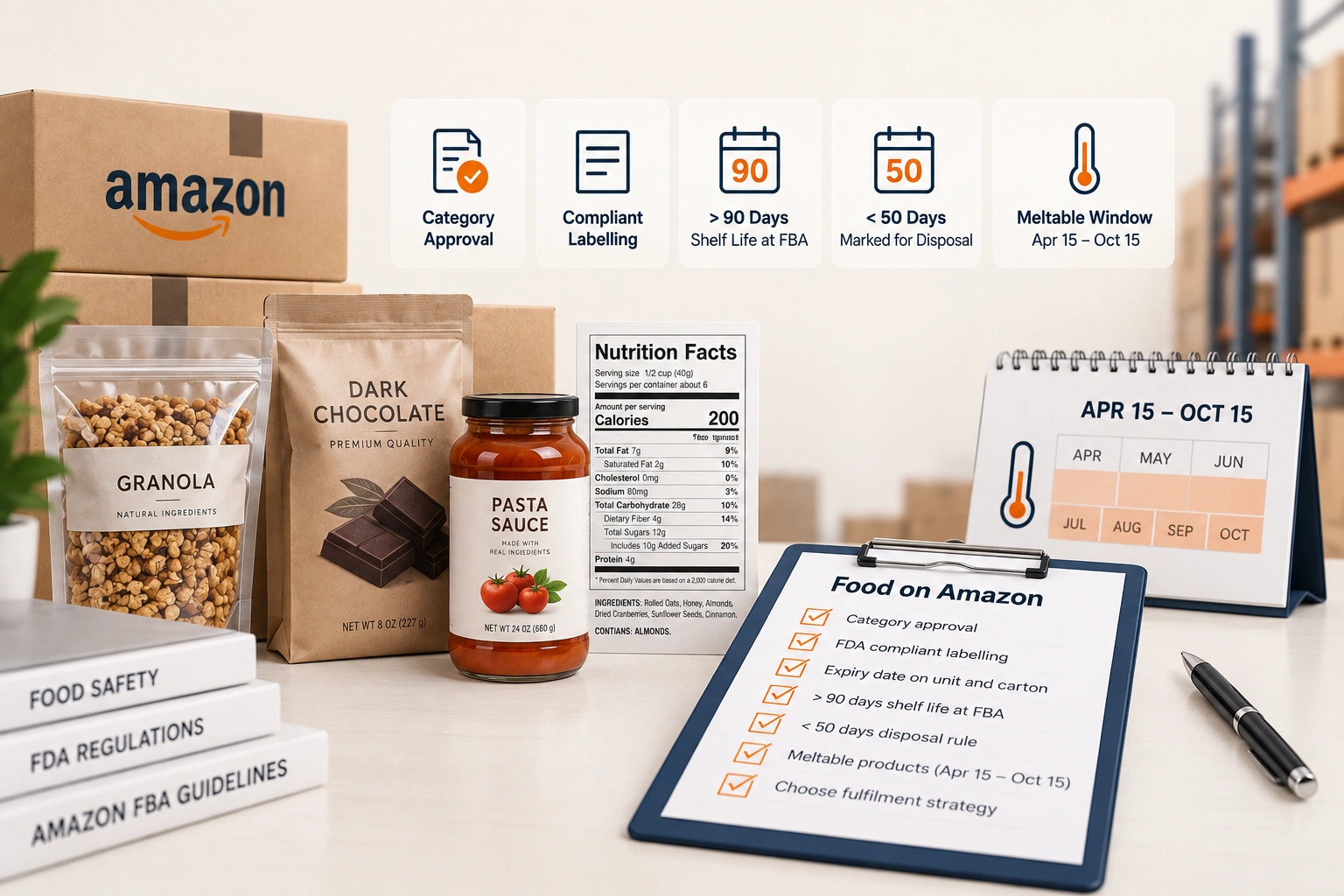
Food sells on Amazon in enormous volume and most of the sellers who try it stop within a year, not because the customers were not there but because the rules were. A category gate, federal labelling law, a shelf life rule with a number in it, a disposal rule with another, and a six month window in which half the category cannot be shipped to a warehouse at all. None of it is secret. All of it has to be known before the first purchase order.
This is the rule set, with Amazon's own figures where they exist, and the one decision that makes the rest manageable.
The approval
Grocery and gourmet food is a gated category. An application is made through the listing workflow when the first product is listed, and it takes the same evidence as any category gate: invoices from a manufacturer or distributor within the last 180 days showing ten or more units, matching the account's name and address, or, for a brand's own product, the documents that show the seller makes it. Some sub categories, and some products within open ones, carry their own approval on top: anything with a health claim, anything for infants, alcohol where it is permitted at all. The reselling article covers what a seller may list at all; food's applications are the same forms as any gate, with a stricter reading.
The approval is also a promise. Food sold on Amazon must meet the state and federal requirements of where it is sold, and the seller is the one who promised it did. A product that is not compliant is not made compliant by being approved.
The label
Packaged food sold in the United States carries what the Food and Drug Administration requires: the statement of identity, the net quantity, the ingredient list in descending order of weight, the nutrition facts panel in the prescribed format, the allergen declaration for the major allergens, and the name and place of business of the manufacturer, packer or distributor. Where a product is made for the seller by a co packer, the co packer's registration and the label's compliance are the seller's to check, because the listing is in the seller's name.
On top of the legal label, Amazon requires the expiry date to be on the unit in a form its centres can read and, for FBA, on the outer carton as well, so that a receiving associate can check the shelf life without opening the box. Products that ship as a set share the earliest date. A unit whose date cannot be read is a unit that cannot be received.
The two numbers: 90 days and 50 days
FBA's rule for food and drink, and for anything shipped with food or drink, is that the product must be lot controlled and have a remaining shelf life of more than 90 days when it arrives at the fulfilment centre. Amazon's second rule is the one that costs money: units within 50 days of their expiry date at the time of arrival are marked for disposal, and inventory subject to disposal cannot be returned to the seller. A shipment that arrives with 49 days left is not refused; it is destroyed, at the seller's expense, and the sale it was meant for is lost with it.
Between the two numbers is the whole logistics of the category. A product with a twelve month shelf life has nine months of sellable life from the day it is made if it ships immediately, and every week between production and receipt comes off that. Stock that sits in FBA is removed by Amazon as it approaches expiry, before a customer can receive an expired unit, which is the right rule and also a loss that the forecast has to prevent: a food seller's inventory plan is a shelf life plan, and the inventory management article has the forecasting method it is built on.
The meltable window
Every year Amazon's fulfilment centres refuse meltable inventory from 15 April to 15 October. Amazon defines it as heat sensitive products that melt during prolonged exposure to temperatures of 155 degrees Fahrenheit, and names chocolate, gummies and some jelly and wax based products. Meltable stock still in a centre after 15 April can be marked unfulfillable and disposed of for a fee, from the start of May. The window is announced each spring with a request to remove the stock before it opens, and it is the same six months every year.
For a chocolate or gummy brand that means FBA is a six month channel, and the other six months are merchant fulfilment with cold packaging, a third party warehouse that will handle it, or no summer sales. That decision is made in the business plan, not in April, because the removal orders in March take weeks and the summer's stock needs somewhere to be.
The fulfilment choice
Everything above is easier when the seller ships the food themselves: no 90 day receipt rule, no 50 day disposal, no meltable window, lot control in the seller's own hands. Everything else is harder: the Prime badge is gone unless the seller qualifies for Seller Fulfilled Prime, the delivery promise is the seller's carrier's, and the cost of fulfilment is the seller's warehouse and staff. Most food brands of any size run both: FBA for the shelf stable core through the months it is allowed, merchant fulfilment for the meltables and the short dated, and the listing's fulfilment switched by season.
For the brands we run under marketplace compliance, food is the category with a calendar on the wall: the meltable dates, the shelf life of each product, the removal orders scheduled for March, and the label checked against the current federal rules before every production run. The fees that decide whether the category pays are the ordinary ones, set out in Amazon seller fees explained, plus the disposals the calendar prevents.
Frequently asked questions
The questions that come up most often on this subject.
Yes. Grocery and gourmet food is a gated category, applied for through the listing workflow with manufacturer or distributor invoices from the last 180 days showing ten or more units, or a brand's own documents. Some sub categories and products carry their own approval on top.
More than 90 days remaining when the product arrives at the fulfilment centre, for lot controlled food and drink and anything shipped with them. Units within 50 days of expiry on arrival are marked for disposal and cannot be returned.
Not through FBA. Fulfilment centres refuse meltable inventory from 15 April to 15 October every year, defined as products that melt with prolonged exposure to 155 degrees Fahrenheit, and stock left after 15 April can be disposed of for a fee from May. Summer chocolate is merchant fulfilled or held elsewhere.
The federal label: statement of identity, net quantity, ingredients in descending order, the nutrition facts panel, the allergen declaration and the responsible business's name and address, plus an expiry date Amazon's centres can read on the unit and, for FBA, on the carton.
Usually both: FBA for shelf stable products through the months it is allowed, merchant fulfilment for meltables and short dated stock, with the listing's fulfilment switched by season. Merchant fulfilment removes the shelf life and meltable rules and gives up the Prime badge unless the seller qualifies for Seller Fulfilled Prime.