Amazon Inventory Management: The Numbers That Matter
Most stockouts are not forecasting failures. They are lead time arithmetic nobody did, on a product that was selling exactly as expected.


Loading Article banner

A stockout on Amazon costs more than the sales it misses. The listing loses velocity, the ranking follows the velocity, and getting both back takes longer than the stockout lasted.
Almost none of them are surprises. The product was selling at a rate somebody could have measured, and the replenishment took a lead time somebody could have counted. What was missing was the arithmetic that joins the two.
Cover, not stock level
The number on the screen is units. The number that matters is days of cover: units divided by the daily rate of sale. Two thousand units is comfortable for a product selling ten a day and a crisis for one selling four hundred.
Cover is also the only number that compares across a catalogue. It is what tells you which of two hundred products to reorder this week, and it is the column most sellers do not have.
Lead time is longer than the manufacturing
The lead time that matters runs from the moment you decide to reorder to the moment a unit is sellable on Amazon. That is production, quality checks, freight, customs, receiving at your prep partner or warehouse, the inbound shipment to Amazon, and the check-in at the fulfilment centre.
Sellers routinely count the first two and forget the last three, and the last three are the ones that vary. Check-in is not instant, and it slows down exactly when everybody else is also sending stock in.
Measure your own, from your own records, and measure it as a range rather than an average. The reorder point is set by the bad end of that range, not the middle of it.
The reorder point
Reorder point equals daily rate of sale multiplied by lead time in days, plus safety stock. Safety stock is the buffer for demand being higher than the forecast or the lead time being longer than the plan, and it should be bigger for products with erratic demand and long lead times.
Once that number exists for each product, replenishment stops being a judgement and becomes a list: everything below its reorder point, ordered by how much revenue it earns.
The discipline is not in the formula. It is in updating the rate of sale when demand changes, which is where a promotion or an advertising push quietly invalidates last month's numbers.
Restock limits and capacity
Amazon limits how much you can send in, and the limit moves with your performance and with the network's own capacity. That turns inbound space into something to allocate rather than something to assume.
When capacity is tight, the products that should get it are the ones earning the most per unit of space, not the ones with the highest revenue. A high volume, low margin, bulky line can consume a quarter of the allowance and return very little.
Sellers who plan for this a quarter ahead spend their peak season selling. Sellers who discover it in November spend it on removal orders and airfreight.
Forecasting without pretending
A forecast is not a prediction of what will sell. It is a plan you intend to act on, with an explicit statement of what would make you change it.
Build it from your own history, adjusted for the things you know are different: a price change, an advertising budget going up, a competitor that has gone out of stock, a season you have data for. Then write down the trigger that would make you reorder earlier.
Anything more elaborate than that is usually false precision. The value is in the rhythm of reviewing it, not in the sophistication of the model.
The stock you have and cannot sell
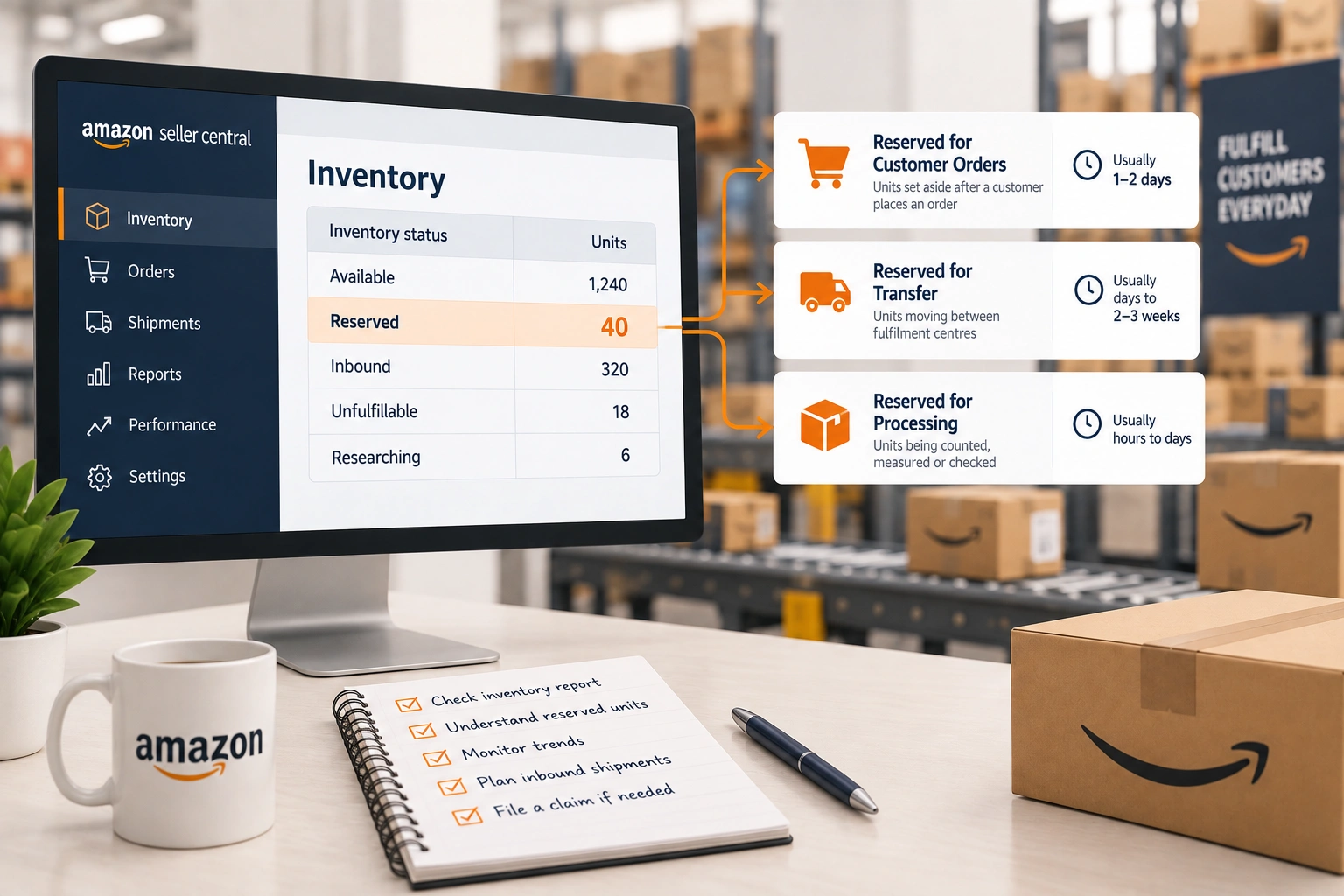
Not all inventory in the network is available. Reserved units are held for customer orders, transfers between fulfilment centres and processing, and stranded units are attached to a listing that is not currently sellable.
Both look like stock in the total and neither will fill an order today. An account that plans against the total rather than the available figure is planning against a number that is wrong in the direction that hurts.
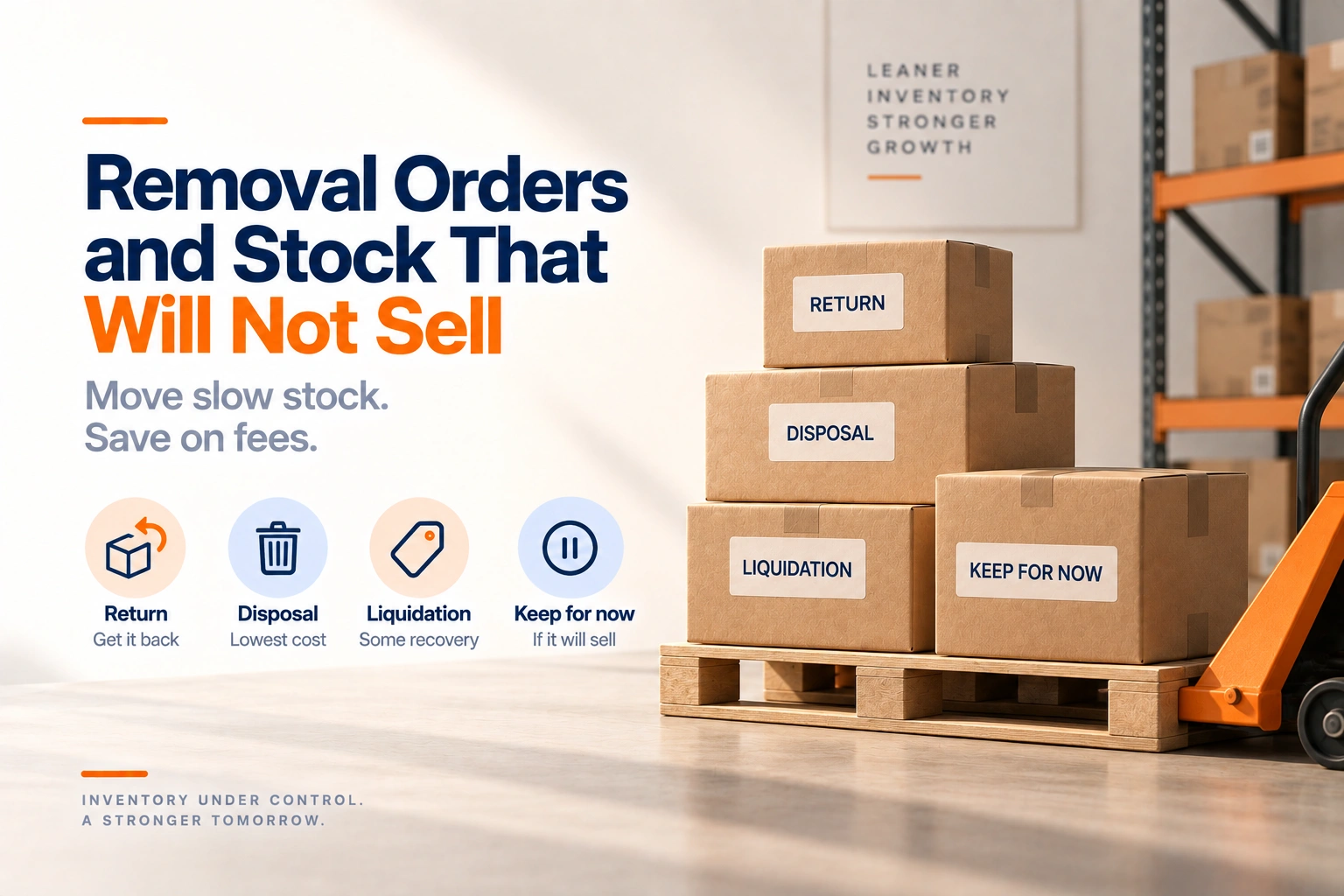
Aged stock is the other half of the problem, and it is the expensive half. Storage costs rise with time and a surcharge follows, so the decision to discount, remove or dispose is one to make deliberately rather than by waiting.
Inventory and advertising are one decision
Advertising a product into a stockout wastes the budget twice: once on the clicks that cannot convert, and again on the ranking that decays while the listing is unavailable.
The rule is simple enough to automate. Spend follows cover: as cover falls towards the lead time, the budget comes down, and it goes back up when the replenishment lands. Doing that by hand across a catalogue is exactly the kind of work that gets skipped, which is one of the arguments in the case for automating the routine parts of PPC.
Money Amazon owes you for units lost or damaged in the network belongs in the same review, and it is more than most sellers claim. We cover it in FBA reimbursements.
What we do with this
Inventory planning sits inside Amazon account management because it cannot be separated from pricing and advertising: the three decide each other week by week.
For brands selling across several marketplaces, the plan has to be one plan. Stock committed to Amazon is stock unavailable to Walmart or to a direct store, and the channel that should get a constrained unit is the one where it earns most after fees.
If the work itself is the constraint rather than the thinking, our outsourced marketplace teams run this as a weekly routine.
Where this goes next
The numbers here sit inside a fulfilment model, and how FBA works and what it costs is the model most of them assume. Stock that also serves other channels through multi channel fulfilment is one pool counted twice unless the plan says otherwise, and a rise in import duties changes the landed cost that every reorder quantity above was worked from.
Keep reading
Frequently asked questions
The questions that come up most often on this subject.
Enough to cover the lead time plus a buffer, expressed in days rather than units. For a product with a 60 day lead time and steady demand, that is roughly 75 to 90 days of cover. For erratic demand or unreliable lead times it is more, and for slow moving lines it is deliberately less, because storage and aged inventory charges make deep cover expensive.
There is no single number, because it is set by your lead time. The right question is whether cover is comfortably above the time it takes to replenish. A product with 30 days of cover and a 90 day lead time is already out of stock; it just has not happened yet.
Because some of it is reserved or stranded. Reserved units are committed to customer orders, moving between fulfilment centres or being processed. Stranded units belong to a listing that is not currently sellable. Both count in the total and neither will fill an order today, so plan against available inventory rather than the total.
Amazon caps how much inventory you can send in, based on your sales performance and the network's capacity. The limit moves, so it is worth checking before planning a large inbound shipment, and worth allocating deliberately when it is tight: the products that should get the space are the ones earning most per unit of space.
Once the catalogue is beyond a few dozen products, yes, because the arithmetic is repetitive and the cost of missing one line is a stockout. What software cannot do is decide the lead time buffer or which product deserves constrained capacity. It automates the counting, not the judgement.
Use the closest comparable product you have, discount it for being unproven, and order a first quantity you can afford to be wrong about. The first replenishment is the one that carries real information, so the plan should be to reorder early rather than to order deep.
Decide, rather than wait. The options are to sell it down with price and advertising, remove it to your own warehouse, or dispose of it. Every month of hesitation costs storage and moves the stock closer to a surcharge, and the discount that would have cleared it gets deeper the longer it sits.
Ranking follows sales velocity, so a listing that cannot sell loses position, and it loses review velocity at the same time. Recovery takes longer than the stockout did, which is why protecting cover on the top lines is worth more than the margin on the units it costs.
It should come down as cover approaches the lead time, and stop before the listing runs out. Clicks on an unavailable product are spend with no possible return, and the ranking damage continues while the campaign is still paying for traffic.
Weekly for the products that make most of the revenue, monthly for the long tail. The weekly review is short: what is below its reorder point, what has changed in the rate of sale, and what is aging. It is the rhythm rather than the depth that prevents stockouts.