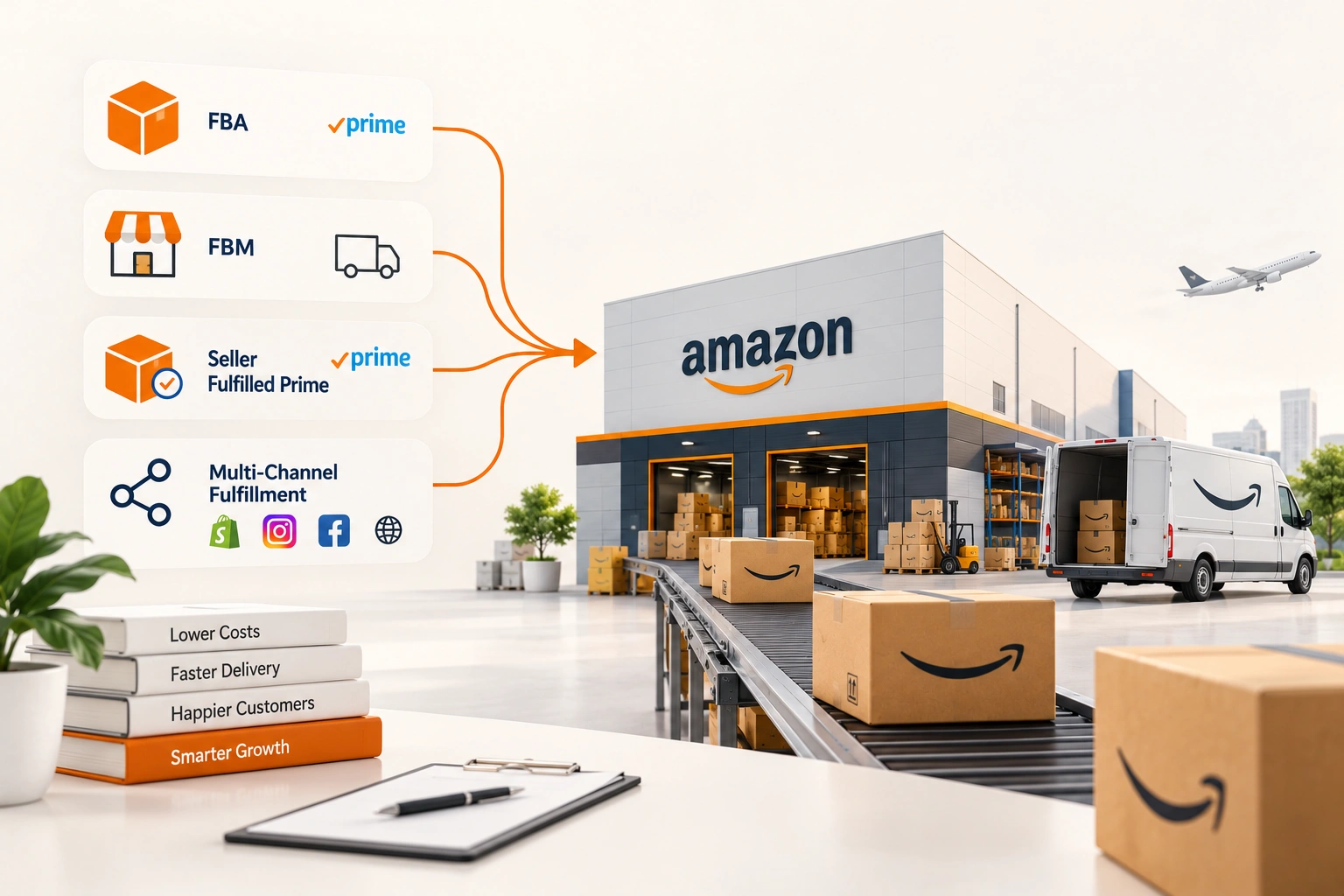
Fulfillment by Amazon is usually described as a service you switch on. It is more useful to think of it as one of four ways an order can reach a customer, each with its own cost, its own failure modes and its own effect on whether you win the buy box. Choosing between them product by product is worth more than optimising any one of them.
This is the map of those four routes. Where a decision has an article of its own, this piece says what the decision is and points at it rather than repeating the arithmetic.
You send stock to Amazon. Amazon stores it, picks it, packs it, ships it, answers the customer when something goes wrong, and processes the return. The product becomes Prime eligible, which is the part most sellers are really buying: a Prime badge changes conversion on a crowded results page more than almost anything else you can do to a listing.
The fee has two parts that behave differently. The fulfilment fee is charged per unit and is set by size and weight band, so it is predictable and it punishes packaging that pushes a product into the next band up. Storage is charged for time rather than for sales, monthly, and it rises in the last quarter of the year when every seller wants the same space. A slow moving line pays storage every month whether it sells or not, and that is the cost that quietly turns a product unprofitable while the unit economics on the listing still look fine.
For 2026, Amazon said fees would rise by an average of about eight cents per unit, effective 15 January 2026, with no new fee types introduced. That is a smaller change than most years, and it does not change the shape of the decision: what decides profitability is which size band a product falls in and how long it sits, not the annual adjustment.
Fulfilled by Merchant means you ship the order yourself. There is no fulfilment fee and no storage charge, and instead there is postage, packaging, the labour to pick and pack, the cost of handling returns, and the customer service that comes with them. None of that appears on an Amazon statement, which is why FBM is the route sellers most often think is cheaper than it is.
FBM wins where FBA's pricing works against you: large, heavy, slow moving or high value goods, anything with a short shelf life, and anything where you already run a warehouse that has spare capacity. It also wins where control matters, because branded packaging and an insert are possible under FBM and are not under FBA.
What FBM costs you on the listing is speed and the Prime badge, unless you qualify for Seller Fulfilled Prime. That is the trade, and it is the whole of the trade. The product level arithmetic is in our comparison of
FBA against dropshipping, where the same question is asked about a model that holds no stock at all.
Seller Fulfilled Prime lets you show the Prime badge on products you ship yourself. Amazon describes it as a way to display the badge for products you fulfil without Amazon, and the price of entry is performance rather than money: a trial period of thirty days that you have to pass, prequalification before that, a domestic US address, a Professional selling account, and continuing performance on late shipment, valid tracking and cancellation rates once you are in.
Performance is assessed by product size tier, so a seller can qualify for standard size and not for oversize, and can enrol in the tiers they can actually serve rather than all of them. That matters for a catalogue with a few heavy items in it: the heavy items do not have to cost you the badge on everything else.
It suits a seller who already ships quickly and nationally, and who has enough volume for the operational discipline to be worth it. It does not suit somebody hoping the badge will paper over a two day dispatch time, because the metrics are measured continuously and the badge goes when they slip.
Multi-Channel Fulfillment uses the stock you already hold at Amazon to fulfil orders placed somewhere else: your own store, another marketplace, a social platform. Amazon describes it as pick, pack and ship support for non-Amazon sales channels, running from a single inventory pool, with standard delivery inside three business days and expedited inside two.
Two things decide whether it beats a third party logistics provider. The first is packaging: MCF ships in unbranded packaging by default, so a direct to consumer brand that sells an unboxing experience is giving that up. The second is the fee, which is charged per unit by size, weight, units per order and speed, and which is discounted for eligible sellers under Preferred Pricing by up to fifteen percent alongside an FBA credit of up to one dollar per unit shipped.
The case for it is rarely the price on its own. It is that one pool of stock cannot go out of step with itself, which is the failure that costs a multi channel seller the most: two channels selling the same last unit, and one customer receiving an apology instead of a parcel.
The decision is not made once for the account. It is made per product, and four numbers make it. Size and weight decide the fulfilment fee band, and a product sitting just over a boundary is worth repackaging before it is worth repricing. Margin decides how much of that fee the product can absorb. Velocity decides what storage costs, because storage is rent and rent is charged by time. Seasonality decides whether that rent is charged at the worst possible moment.
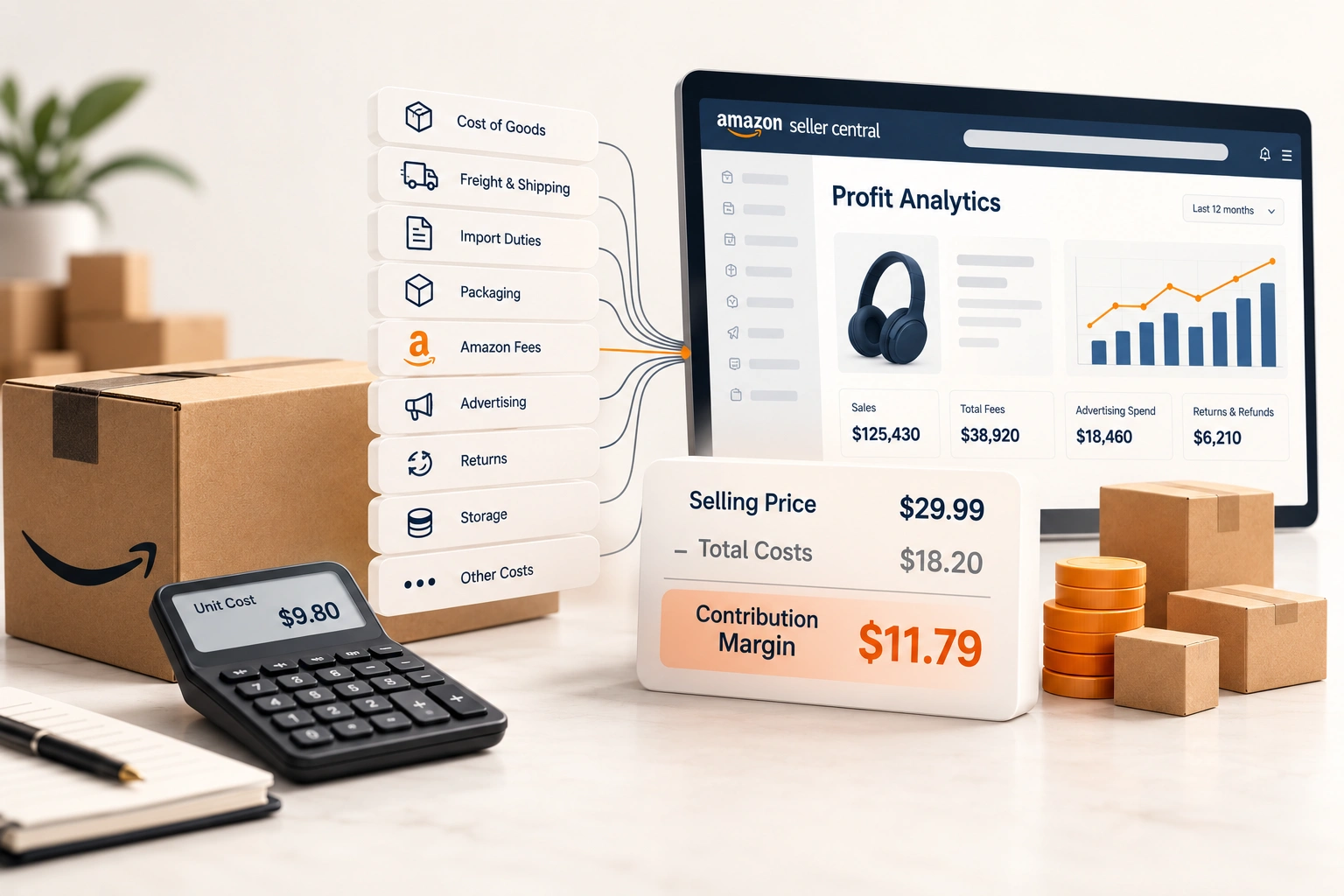
Run those four against every line rather than against the catalogue average, and a mixed answer is the normal result: the fast moving small items go to FBA, the heavy or slow lines stay with you, and a handful of borderline products get repackaged so they fall into a cheaper band. The full cost stack, including the fees that are charged whichever route you choose, is in
what it costs to sell on Amazon.
Pricing sits on top of all of it, because a floor built on the wrong fulfilment assumption is a floor that sells at a loss. That is the argument in
our piece on repricing, and it is the reason a fulfilment change should always be followed by a look at the floor.
Handing fulfilment over means handing over the evidence too. Units go missing, arrive damaged, are destroyed in error, or are returned by a customer and never put back into sellable stock. Amazon owes money in several of those cases and pays it when somebody claims, which is a job nobody owns by default. The cases and the claim that gets paid are in
FBA reimbursements and what Amazon owes you.
The second cost is attention. An FBA account fails quietly: stock that sits, a size band that moved, a removal order nobody processed, a shipment split across three centres. None of it announces itself, and all of it is visible in a report somebody has to read.
The third is advertising, which changes shape under FBA because the buy box and the Prime badge change what a click is worth. What that does to campaigns is covered in
what changes for FBA sellers in PPC.
For a small, light, fast moving product with a healthy margin, almost always. The fee is low against the price, the Prime badge lifts conversion, and the work you are buying back is real work you would otherwise be doing at seven in the evening.
For a heavy, slow moving or seasonal product, frequently not, and the honest test is storage over a year rather than fulfilment on one order. For a catalogue, the answer is nearly always both, with the split reviewed when fees change in January and when a product's velocity changes.
What makes the question answerable is having the four numbers per line rather than an impression. Most accounts do not, which is why the question gets argued rather than calculated.
We run the split per product rather than per account, and revisit it in January when the fee schedule moves and again whenever a line's velocity changes enough to move its storage cost. Doing that, and doing something about what it finds, is part of
Amazon account management.
Related reading: Shipping Hazmat From a Marketplace: Lithium Batteries, Perfume, Aerosols and the USPS Fee, Reserved Inventory on Amazon: What It Means and When to Worry, Amazon FBA Shipping Requirements: Boxes, Pallets, Weights and Labels, How to Sell on Amazon Without Inventory: The Four Models and What Amazon Allows, Amazon FBA vs FBM: Which Fulfilment Method Fits, Amazon Inventory Management: The Numbers That Matter, How Amazon Decides Where Your Stock Goes, Removal Orders and Stock That Will Not Sell, Using Amazon to Fulfil Orders You Did Not Sell on Amazon, Seller Fulfilled Prime, and When a 3PL Makes Sense, Amazon Business Hour Delivery Rate: The 90% Rule for Seller-Fulfilled Orders From 30 September 2026, When Import Duties Rise, Raising the Price Is the Last Move and Order Management Across Marketplaces.