How to Sell on Amazon Without Inventory: The Four Models and What Amazon Allows
Four ways to sell on Amazon without a garage full of stock, and only one of them is dropshipping. What each model is, the policy line each has to stay on the right side of, the margin each one leaves, and which one a business should actually pick.


Loading Article banner
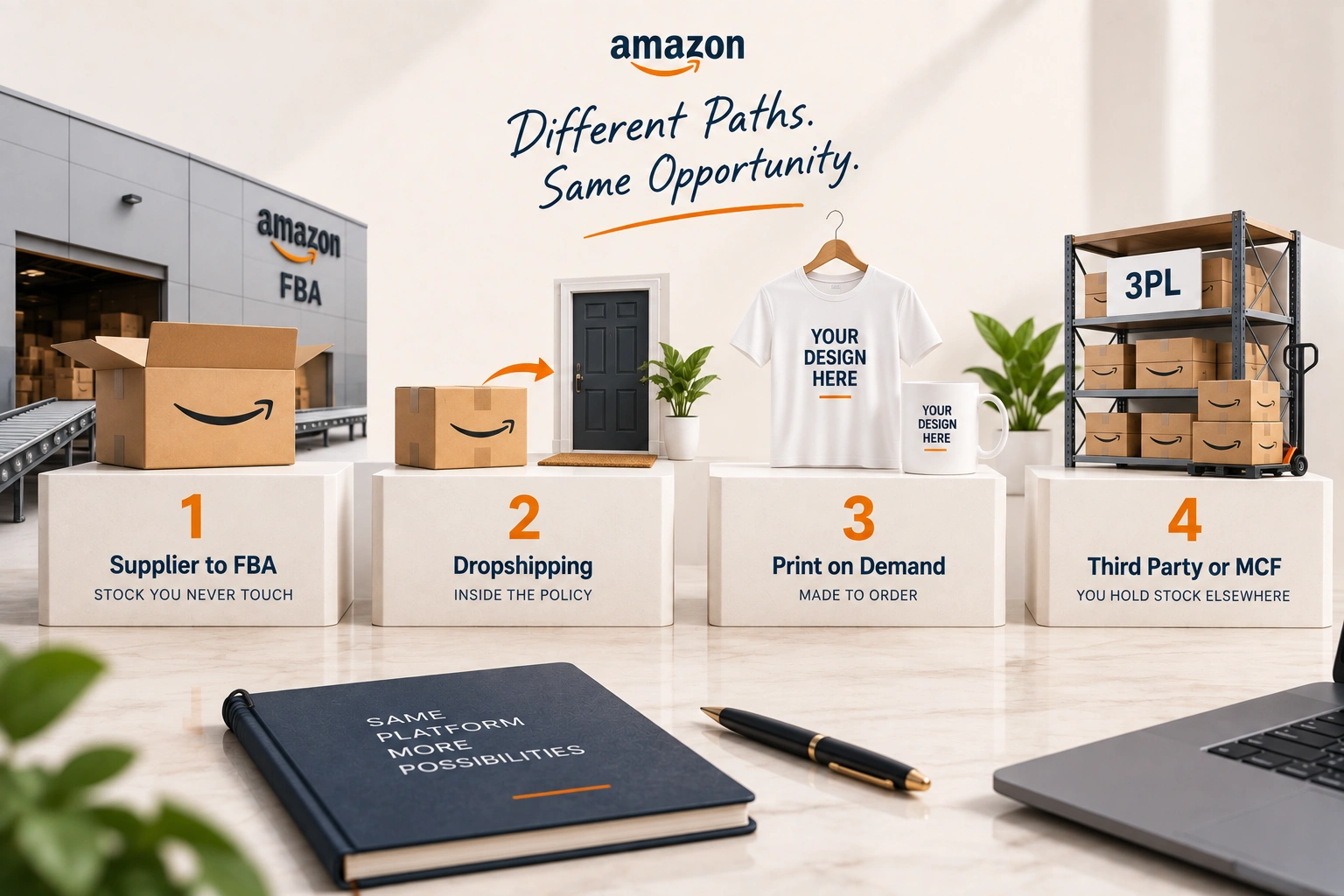
The search says without inventory, and what it usually means is without the money, the space and the risk of buying stock that may not sell. Amazon answers it four ways, and the internet answers it one way, which is dropshipping, and gives that word to things Amazon does not allow. The four models are different businesses with different rules and different margins, and picking one is the decision.
This is each model, the policy it has to satisfy, what it leaves after fees, and the one we would recommend to a business rather than to a hobby.
Model one: supplier to FBA, stock you never touch
The seller buys the product and never sees it: the supplier packs to Amazon's shipment requirements, labels the cartons, and ships to the fulfilment centre, and Amazon stores, picks, packs and delivers. The seller holds inventory in the sense that they paid for it; they hold none in the sense of space or handling. This is how most private label and wholesale businesses of any size actually run, and it is the model the phrase without inventory most often describes once the person searching understands the options.
The policy is simple because the seller is the seller: the goods are theirs, listed by them, fulfilled by Amazon. The risk is the purchase order, and it is managed by the forecast, which is the subject of the inventory management article. The margin is the product's margin after FBA fees, and it is the highest of the four because nobody else is in the chain.
Model two: dropshipping, inside the policy
Amazon permits dropshipping under conditions, and the conditions are the whole subject. The seller must be the seller of record on every order: the invoices, packing slips and external packaging identify the seller and nobody else, and no third party's name, logo or paperwork reaches the customer. Buying the item from another retailer and having that retailer ship it to the customer, with its packing slip in the box, is the version Amazon prohibits, and the one most dropshipping courses teach.
Inside the policy, dropshipping is an arrangement with a supplier who ships blind under the seller's name, which is a wholesale relationship with a fulfilment clause. The margin is the retail price less the referral fee less the supplier's price and their shipping, and it is thin, because the supplier is charging for the fulfilment the seller is not doing. The delivery promise is the supplier's, and the metrics it breaks are the seller's. The FBA versus dropshipping article sets the two side by side.
Model three: print on demand and made to order
For designs rather than products, Amazon's own programmes make the item when it is ordered: Merch on Demand for apparel and accessories, Kindle Direct Publishing for books, and the merchant integrations of print on demand suppliers for everything from mugs to wall art. There is no inventory because there is no product until the sale. The seller supplies the design and the listing; the programme or supplier supplies everything else.
The policy is the programme's, which is mostly about intellectual property, and the margin is a royalty or a fixed spread set by the supplier's price. It is a business of many designs and small margins, and it scales with the catalogue rather than with stock. It is the right answer for a designer and the wrong one for somebody who wants to sell a physical product they did not design.
Model four: a third party warehouse, and Amazon's own
A seller who does not want stock at Amazon, because of capacity limits, storage fees or a product Amazon stores badly, holds it at a third party logistics warehouse that ships each order under the seller's name, or uses Amazon's own Multi Channel Fulfilment to ship orders from other channels out of FBA stock. Neither removes the purchase of the stock; both remove the handling. The seller of record rule is satisfied because the warehouse ships under the seller's name and paperwork, which is what distinguishes this from the prohibited form of dropshipping.
The margin sits between models one and two, with the warehouse's pick and pack fee in place of FBA's, and the delivery promise depends on the warehouse's carriers. The multi channel fulfilment article covers when Amazon's own version is the right one.
Which one
For a business, model one. The supplier ships to FBA, the seller owns the stock and the margin, and the only thing the seller has to be good at is choosing the product and forecasting it. It is without inventory in every sense that costs time and space, and with inventory in the one sense that makes money. Model two is a way to test a product with somebody else's stock and is worth running for exactly that long. Model three is a business for people with designs. Model four is model one with a different warehouse, for products or sellers Amazon's storage does not suit.
What all four share is the listing, the price and the advertising, which is where the sale actually happens and where the work is regardless of who holds the box. That is the part we run under Amazon marketplace management for brands whose stock is at Amazon, at a supplier, or at a warehouse in another state. The fee stack under every model is in what it costs to sell on Amazon, and the honest reading of it is that the model with the least inventory is usually the one with the least margin.
Frequently asked questions
The questions that come up most often on this subject.
Yes, four ways: a supplier ships stock straight into FBA and Amazon fulfils it; dropshipping within Amazon's policy, where the seller is the seller of record on every order; print on demand through Amazon's programmes or a supplier; or a third party warehouse or Multi Channel Fulfilment shipping under the seller's name.
Under conditions: the seller must be the seller of record, and invoices, packing slips and packaging must identify the seller and no third party. Ordering from another retailer and having them ship to the customer with their paperwork in the box is prohibited.
Supplier to FBA, because nobody else sits in the chain between the product's cost and the customer. Dropshipping is the thinnest, since the supplier charges for the fulfilment the seller is not doing.
Programmes such as Merch on Demand and Kindle Direct Publishing, and print on demand supplier integrations, that make the item when it is ordered. The seller supplies the design and the listing and earns a royalty or a fixed spread.