What It Actually Costs to Sell on Amazon
The referral fee is the one everybody knows and the smallest part of the answer. The rest is where products that look profitable turn out not to be.


Loading Article banner
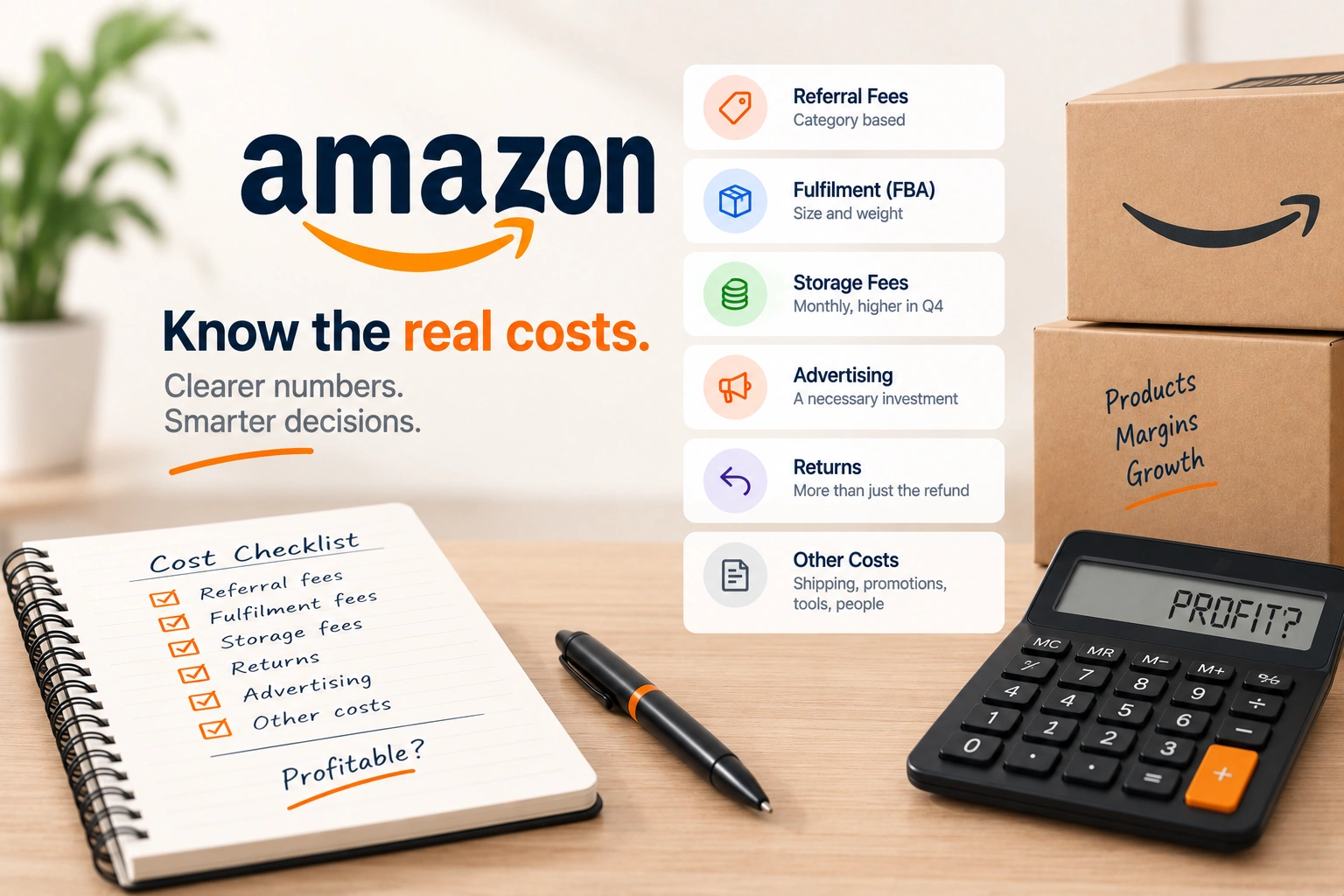
Most people asking what it costs to sell on Amazon are asking about the referral fee, get an answer, and go away with a number that is perhaps a third of the real one.
The costs that decide whether a product is worth selling are the ones further down: fulfilment, storage, returns, advertising and the handful nobody budgets for. This is all of them, in the order they hit.
The two that everybody knows
The subscription. A professional selling account is a flat monthly cost, and an individual account instead charges per item sold. The crossover is low enough that anybody selling seriously is on the professional plan.
The referral fee. A percentage of the total sale price, category by category, and it is charged on the item price plus shipping rather than on the item alone. Most categories sit in a familiar band, a few are far lower, and the current figures are published in Seller Central.
Neither of these is where products die. They are predictable, they are the same for everybody in the category, and they can be modelled before sourcing.
Fulfilment, which depends on size more than weight
FBA fees are set by size tier and weight, and size usually decides more than weight does. A light product in a slightly oversized box can cost more to ship than a heavier compact one.
That makes packaging a pricing decision rather than a logistics one. A fraction of an inch across a size boundary changes the fee on every unit for as long as you sell it, and it is worth measuring the packaged product yourself rather than trusting the recorded dimensions. Where those are wrong, the reimbursement route exists and it is worth checking.
Seller fulfilment replaces this with your own picking, packing, postage and the staff time behind them, which is not cheaper by default and is sometimes considerably worse.
Storage, and why slow stock is expensive twice
Storage is charged monthly by volume, and it rises sharply in the last quarter of the year when space is scarce.
Stock that has been sitting for a long time attracts additional charges on top, which is the mechanism that turns a slow product from disappointing into loss making.
The cost of holding is not only the fee. It is the money not available to buy something that sells, which is the larger number and the one that never appears on a statement.
Returns cost more than the refund
A returned unit costs the refund, the fulfilment fee that is not fully recovered, the handling of the return itself, and often the item, because a proportion comes back unsellable.
Categories differ enormously. Apparel and shoes carry return rates that make an otherwise healthy margin disappear; consumables and tools rarely do.
This is the cost most often left out of a model, and it is the one that most often explains why a product with good margin on paper makes nothing.
Advertising is a cost of doing business now
In a competitive category, a new product without advertising does not accumulate the sales history that ranking needs, so advertising is not an optional growth lever, it is the entry cost.
Budget it as a percentage of revenue rather than as a project cost, because that is how it behaves. What is reasonable varies by category and by stage, and carrying a target across from another channel unchanged is how accounts end up spending against benchmarks that never applied: ROAS standards across Amazon, TikTok Shop and Walmart is a better starting point.
Whether that spend is managed in house, by software or by an agency is a separate decision with its own arithmetic, worked through in in-house vs agency vs software.
The ones nobody budgets for
Inbound shipping to the warehouse, including prep and labelling if you do not do it yourself.
Removals and disposals when stock has to come back or be written off.
Coupons, deals and promotions, which carry their own fees on top of the discount.
Samples, photography and listing content, which are real costs of launching a product and rarely appear in a margin calculation.
Software: repricing, inventory, analytics, reimbursement tools.
People. The largest one on the list for most sellers, and the one least often counted.
Working out whether a product is actually worth selling
Take the sale price. Subtract the referral fee, the fulfilment fee, the landed cost of goods, an allowance for storage at the rate this product turns over, an allowance for returns at the rate this category runs, and the advertising it needs to sell at all.
What is left is the margin. Run it before sourcing rather than after the first quarter's statements, because that is the only point at which the answer is still useful.
Then do the same on the other channels. The economics differ enough that a product marginal on Amazon can be comfortable on Walmart, and a product that needs content rather than search belongs on TikTok Shop instead.
What the models change
Private label. Highest margin, highest launch cost, and advertising is the entry ticket.
Wholesale. Thinner margin, faster to start, and the cost that matters is capital tied up in stock.
Arbitrage. No development cost and no repeatability, so the real cost is the time spent sourcing each time.
Dropshipping. Almost no holding cost and the thinnest margin, which leaves nothing for advertising.
B2B. Larger orders, different pricing expectations, and a lower advertising cost per unit sold.
Keep reading
Related reading: our Selling economics: fees, pricing and margin service page, The Amazon FBA Business Plan: The Numbers It Needs and the Risks It Must Price, What an Amazon FBA Business Is Worth: How Buyers Value It and What to Fix First, Carrier Shipping Adjustments on Amazon Buy Shipping: Why You Were Charged and How to Dispute, How the Buy Box Is Won and Amazon Pricing Strategy: Setting a Price That Holds Margin and Rank.
Frequently asked questions
The questions that come up most often on this subject.
A monthly subscription for a professional account, a referral fee that is a percentage of the sale price and varies by category, and then fulfilment, storage, returns and advertising, which together usually exceed the referral fee considerably.
Yes. An individual account avoids the monthly subscription and charges per item sold instead, but referral fees apply either way, and every route to actually selling carries fulfilment or postage costs.
Amazon's commission on a sale, a percentage of the total charged to the buyer including shipping rather than of the item price alone. It varies by category and the current figures are published in Seller Central.
By size tier and weight, with size usually deciding more than weight. A light item in a slightly oversized box can cost more to ship than a heavier compact one, which makes packaging a pricing decision.
Usually returns, storage on slow stock, or advertising. Those three are the ones most often left out, and any one of them can turn a healthy looking margin into nothing.
As a percentage of revenue rather than as a project cost, because that is how it behaves. What is reasonable depends on the category and the stage, and carrying a target across from another channel unchanged is how accounts end up measuring against a benchmark that never applied to them.
Not by default. It replaces the fulfilment fee with picking, packing, postage and staff time, and it costs the delivery promise that Prime buyers choose on. It suits slow, heavy, fragile or seasonal items rather than everything.
Inbound shipping and prep, removals and disposals, promotion fees on top of the discount, photography and listing content, software, and people. The last is usually the largest and the least often counted.
Subtract the referral fee, fulfilment, landed cost, storage at this product's turnover, returns at this category's rate and the advertising it needs, from the sale price. Do it before sourcing, because after the first quarter's statements the answer is no longer useful.
No, and the differences are large enough to change which channel a product belongs on. A product that is marginal on Amazon can be comfortable on Walmart, and one that sells through content rather than search may belong on TikTok Shop instead.