The Amazon FBA Business Plan: The Numbers It Needs and the Risks It Must Price
A plan for an FBA business is one page of numbers and one column of risks. The unit economics per product, the launch cost, the cash the stock ties up, the month the business breaks even, and the six risks that end FBA businesses, each with a price the plan can carry.


Loading Article banner
A business plan for an Amazon FBA business is shorter than the templates suggest and harder than they admit. It is one page of numbers a bank would understand and one column of risks the numbers have to survive. Most plans have the first page, written optimistically. Almost none have the column, and the column is where FBA businesses actually end.
This is the plan we ask a brand to write before its first purchase order, in the order the numbers depend on each other, and the six risks with what each costs to carry.
The unit economics, per product
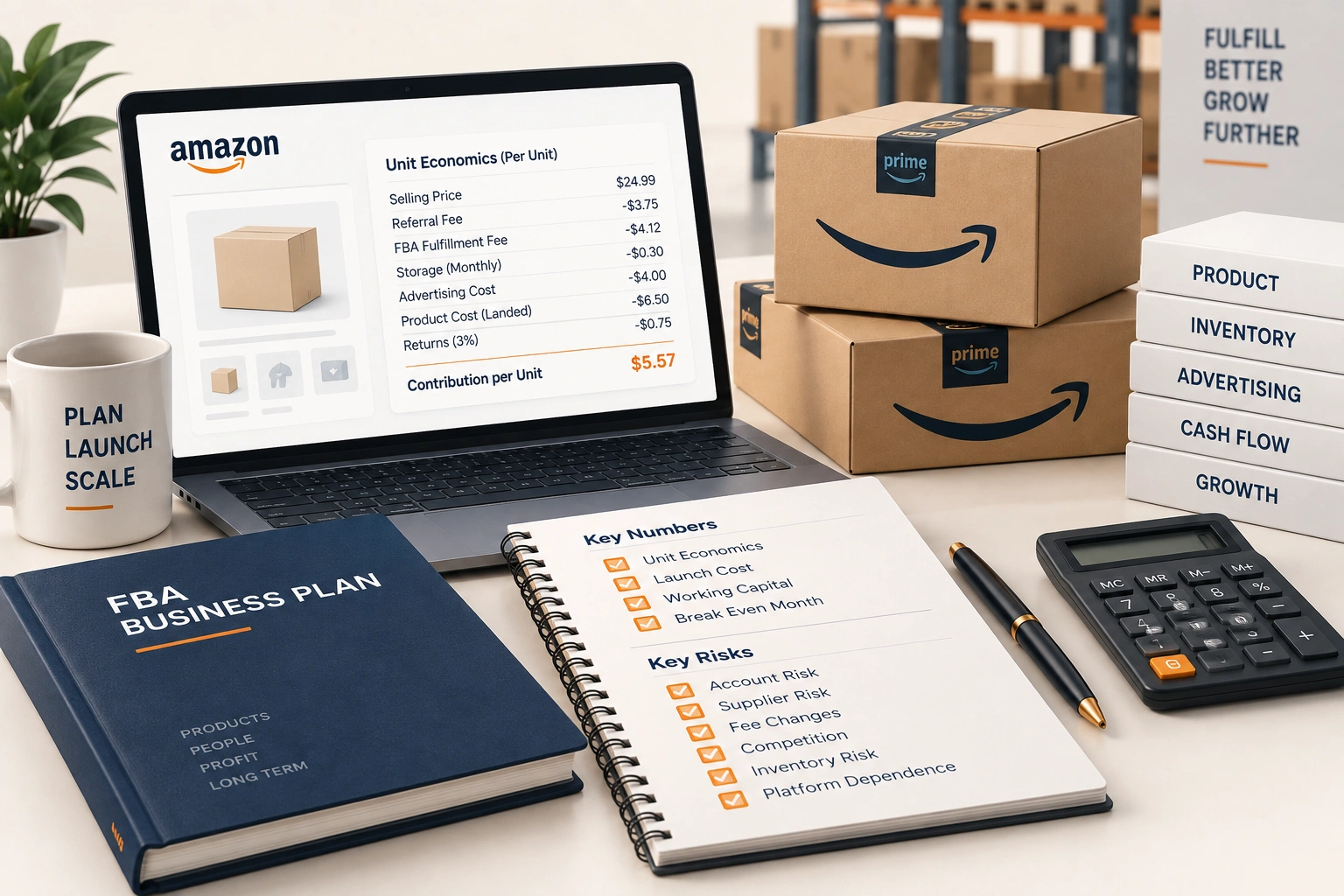
Start with one unit of one product and account for every dollar between the customer's payment and the seller's bank. The selling price. The referral fee, a percentage of the price by category. The FBA fulfilment fee, by size and weight. Storage per month, and the months a unit sits. The advertising cost per unit sold, which at launch is the largest line and later the second largest. The cost of the product landed at the fulfilment centre, including freight, duty and prep. Returns, as a percentage of units, at the cost of a returned unit. What is left is the contribution per unit, and it is the number every other number in the plan is built from. What it costs to sell on Amazon walks through each line with the current fee tables.
Do it for every product, not for the average product. A catalogue's average margin hides the product that loses money on every sale, and that product is usually the one that sells most.
The launch cost and the cash in stock
A launch costs more than the stock. The first order of stock, at the minimum the supplier will make. Freight. Photography and the listing. Samples and testing. The advertising for the first ninety days at a return below break even, because a new product buys its rank. Vine or the equivalent for the first reviews. The programme credits Amazon offers a new ASIN, which reduce some of those lines and belong in the plan as reductions rather than as a reason to skip the lines.
Then the cash: the stock tied up between paying the supplier and receiving the payout, which for a sea freight product is often four months, and the second order that has to be placed before the first has sold through. Working capital, not profit, is what ends most FBA businesses in their first year, and the plan has to show the cash position by month with the reorders in it. The inventory management article is the forecast that feeds it.
The break even month
With the unit contribution, the launch cost and the monthly fixed costs, the plan produces one date: the month the business has earned back its launch and is contributing. For most products it is between month six and month twelve, and a plan that shows month two has a mistake in it, usually in the advertising line. A plan whose break even is beyond month eighteen is a plan for a product that needs a different price, a different supplier or a different category.
The date is the plan's one honest test, because every optimistic assumption moves it later and every one of them shows. A supplier price that rises, a fee that goes up in January, a conversion rate that is half the guess, a return rate that is double: each is a line in the table, and a plan that survives the four of them at once is a plan worth funding. A plan that survives none of them is a hope with a spreadsheet attached.
The six risks, and what each costs to carry
One, the account: a deactivation stops every sale at once, and the plan carries it as a compliance routine with a cost in hours, described in the account health article. Two, the supplier: one supplier is one point of failure, and the plan carries a second source qualified before the first order, at the cost of the samples. Three, the fee change: Amazon revises fees every year, and the plan carries a margin buffer of a few points rather than an assumption that this year's table lasts. Four, the competitor: a product that sells is a product that gets copied, and the plan carries the brand, the trademark and Brand Registry, which is what makes the copy a violation rather than a competitor.
Five, the stock: too much is cash and storage fees, too little is rank lost, and the plan carries a forecast and a reorder rule rather than a feeling. Six, the platform itself: an FBA business sells on one company's terms, and the plan carries a second channel, even a small one, opened in the first year, because a buyer of the business, and a bank, price a single channel as the risk it is. The valuation a buyer will one day put on the business is built from exactly these six, and the fee lines the buffer protects are the ones in Amazon seller fees explained.
Keep reading
Is FBA risky, then. Yes, in the specific ways above, each of which has a price a plan can carry, and none of which is a surprise to a plan that has the column. The businesses that end are the ones whose plan had only the first page. For the brands we run, the plan is the unit economics work done before the first order, and revisited every quarter against what actually happened.
Frequently asked questions
The questions that come up most often on this subject.
One page of numbers: the unit economics for every product (price, referral fee, fulfilment fee, storage, advertising per unit, landed cost, returns, contribution), the launch cost, the cash tied up in stock by month with reorders, and the break even month. And one column of risks with what each costs to carry.
In six specific ways: the account, the supplier, fee changes, competitors copying the product, stock, and dependence on one platform. Each has a price a plan can carry, from a compliance routine to a second supplier to a margin buffer to a second channel. The risk is in not pricing them.
Usually between the sixth and twelfth month for a single product, once the launch cost and the advertising that buys rank are counted. A plan that breaks even in month two has a mistake in the advertising line; one beyond month eighteen needs a different price, supplier or category.
Enough to hold the stock between paying the supplier and receiving the payout, often four months for sea freight, plus the second order placed before the first sells through, plus the launch's advertising at a loss. Working capital ends more first year FBA businesses than margin does.