Amazon Seller Fees, and Where the Margin Goes
The referral fee is the one everybody knows and rarely the one that decides profitability. The rest arrive per unit, per month and per mistake.


Loading Article banner
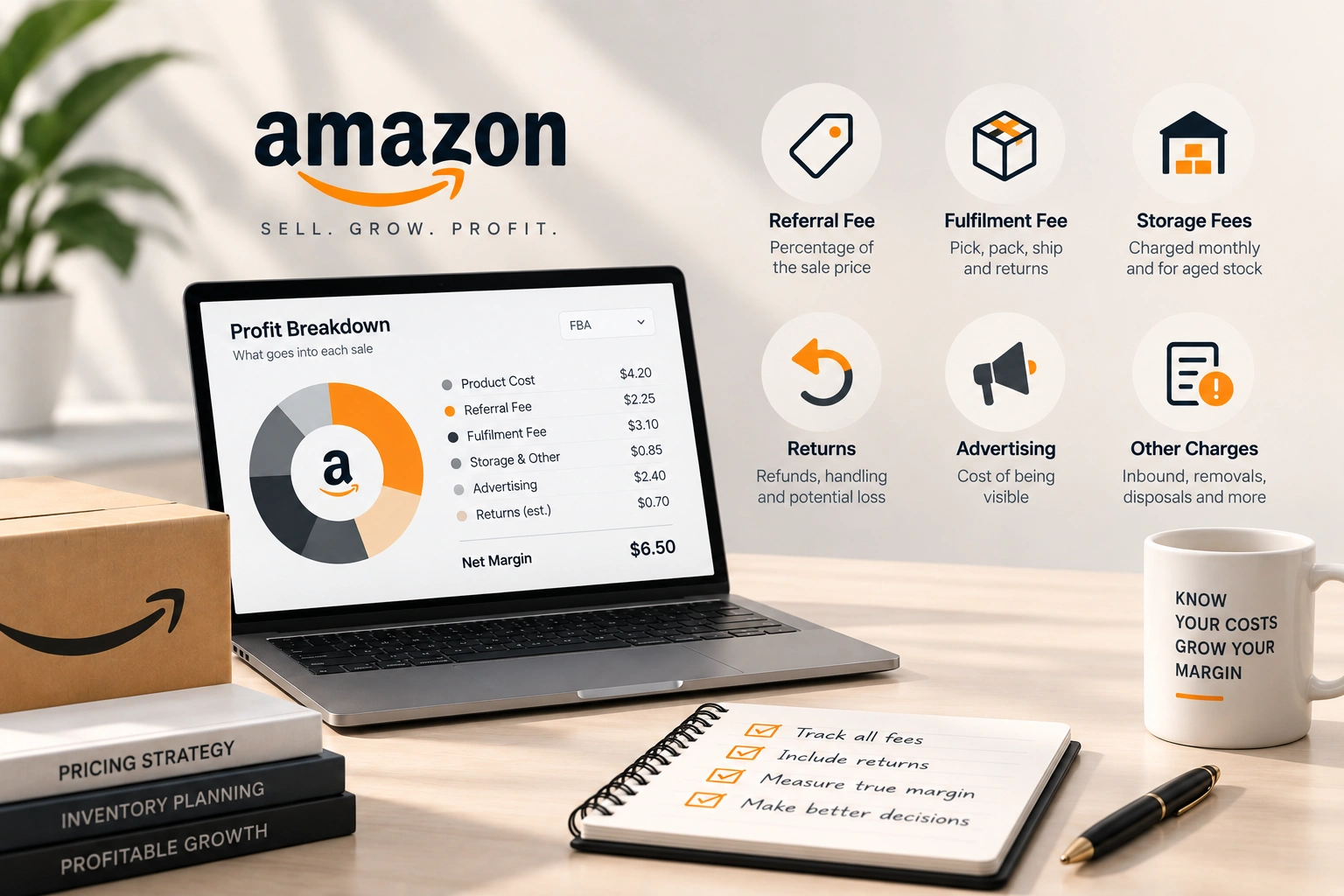
Most sellers can quote their referral fee and very few can say what an order actually costs them. The gap between those two numbers is where profitability lives.
The fees are not complicated individually. They are just charged in different places, at different times, and some of them do not appear against the order that caused them.
The fee charged on every sale
The referral fee is a percentage of the total price, category by category, and it is charged whether you fulfil the order or Amazon does. It is the one fee that is genuinely simple, and the one sellers already have in their spreadsheet.
Two things about it catch people out. It is charged on the whole amount the customer paid, shipping included where you charged for it, and the category it is charged at is the category Amazon has the item in, which is not always the category you think you listed it in.
Fulfilment, which is a fee or a job
Under FBA the fulfilment fee covers picking, packing, postage, customer service and the return. It is set by size and weight band, which is why an ounce or a centimetre at a band boundary can change the economics of a product.
Under FBM you pay the postage and do the rest yourself, and the cost is labour rather than a line on a statement. That makes it the easiest cost on the account to underestimate, because nothing invoices you for it.
Storage, which is charged for time rather than for sales
Monthly storage is charged on the space your inventory occupies, and it rises sharply in the last quarter of the year when everybody wants the same space.
Stock that sits long enough attracts an aged inventory surcharge on top of the monthly charge. That is the fee that turns a slow line into a loss, and it is entirely avoidable by deciding earlier.
Neither charge appears against a product's orders, which is why a product can look profitable in a per-order report and lose money over a year.
Returns, which cost more than the refund
A returned order refunds the customer, and depending on category and reason, part of the referral fee comes back to you and part does not. The unit itself may come back sellable, may need repackaging, or may be written off.
In a category with a high return rate this is the single largest hidden cost, and it does not show up in the fee estimator at all. The only way to know it is to measure your own return rate per product and price it in.
Advertising, which is a fee by another name
For most catalogues advertising is now a cost of being visible rather than an optional growth lever, so it belongs in the unit economics rather than in a separate marketing budget.
The number that matters is total advertising cost of sales across the account, not the return on one campaign. A product with an excellent campaign ROAS and half its organic sales cannibalised by that campaign is not as profitable as it looks, which is the pattern behind spend that converts badly.
The charges nobody plans for
Inbound placement charges, low inventory charges, removals, disposals, long term storage, and the cost of stock that arrives at a fulfilment centre incorrectly prepped and has to be handled.
Individually small. Together, on a catalogue of any size, they are the difference between the margin in the plan and the margin in the bank.
Money Amazon owes you back sits in the same reports, and most sellers never claim it. We cover that in FBA reimbursements.
Working out the real number
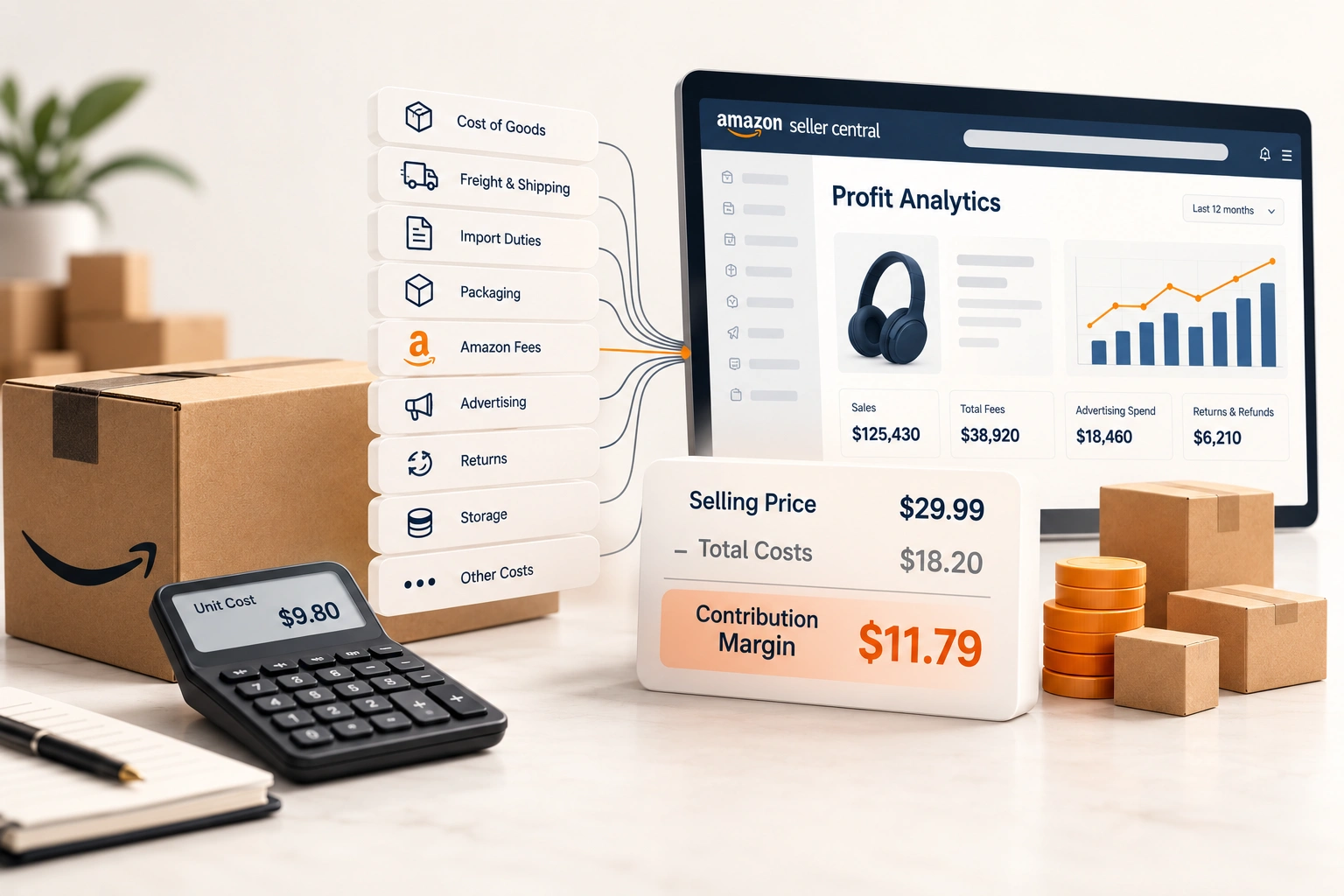
Take one product over one quarter. Add every fee charged against it, then add its share of the storage and the advertising, then subtract the returns. Divide by units sold.
That number, not the referral fee, is what tells you whether the product should be priced differently, fulfilled differently, or discontinued.
Do it for the ten products that make most of the revenue and the answer usually surprises somebody.
What we do with this
Fee and margin analysis is part of Amazon account management, because the decisions that follow from it, pricing, fulfilment, advertising and what to stop selling, are the same decisions the account is run on.
The arithmetic is different on every marketplace: Walmart charges differently, eBay differently again, and a brand's own Shopify store trades a referral fee for the cost of getting the traffic itself.
If you want it worked out against your own statements, start there.
Related reading: What It Actually Costs to Sell on Amazon.
Related reading: Repricing Without Racing to the Bottom.
Frequently asked questions
The questions that come up most often on this subject.
The referral fee is a percentage of the total the customer paid, set by category, and it is charged on every sale however it is fulfilled. It is the only fee that is a straight percentage. Everything else, fulfilment, storage, returns and advertising, is charged per unit, per month or per event, which is why the referral fee alone never answers the question.
The referral fee is what Amazon charges for the sale. The FBA fee is what it charges for handling the item: picking, packing, postage, customer service and the return. A merchant fulfilled order pays the referral fee and not the FBA fee, and pays the handling in labour instead.
Almost always because of the charges that do not appear against an order: monthly storage, aged inventory surcharges, removals, returns that came back unsellable, and advertising counted as marketing rather than as cost of sale. Per-order maths looks healthy while the account loses money over a year.
On the volume your inventory occupies in the fulfilment network, charged monthly and higher in the final quarter of the year. Stock that sits long enough also attracts an aged inventory surcharge. Both are charged for time rather than for sales, which is what makes slow moving stock expensive.
Partly, and it depends on the category and the reason. A refund administration fee is typically retained. The larger cost is usually the unit itself and its condition when it comes back, which is why measuring your own return rate matters more than the fee schedule.
For most catalogues, yes. Advertising is now the cost of being visible rather than an optional lever, so it belongs in the unit economics. The figure to watch is total advertising cost of sales across the account, because campaign level returns can look excellent while cannibalising organic sales.
Mostly by changing the product rather than by appealing a charge. Dimensions and weight decide the fulfilment band, so packaging changes move real money. Turning stock faster cuts storage. Fixing the listings that drive returns cuts the most expensive cost of all. Fee disputes and reimbursements recover what was charged in error, which is worth doing and is not a strategy.
For referral and fulfilment fees on a well categorised product, close enough to plan with. It knows nothing about your storage duration, your return rate or your advertising, which are the three that decide whether the product is actually profitable.
A charge applied to FBA products whose stock cover runs persistently low relative to demand. The intent is to discourage inventory that runs out and disappoints buyers. The practical effect is that inventory planning has a direct cost attached to getting it wrong in either direction.
Yes, by country and by category, and the differences are large enough that a product profitable in one marketplace can lose money in another at the same price. Any expansion plan needs the arithmetic done per marketplace rather than assumed from the home one.