FBA Reimbursements: What Amazon Owes You and How to Claim It
Amazon loses, damages and miscounts inventory in its own warehouses. Some of that is refunded automatically. A meaningful share is not.


Loading Article banner
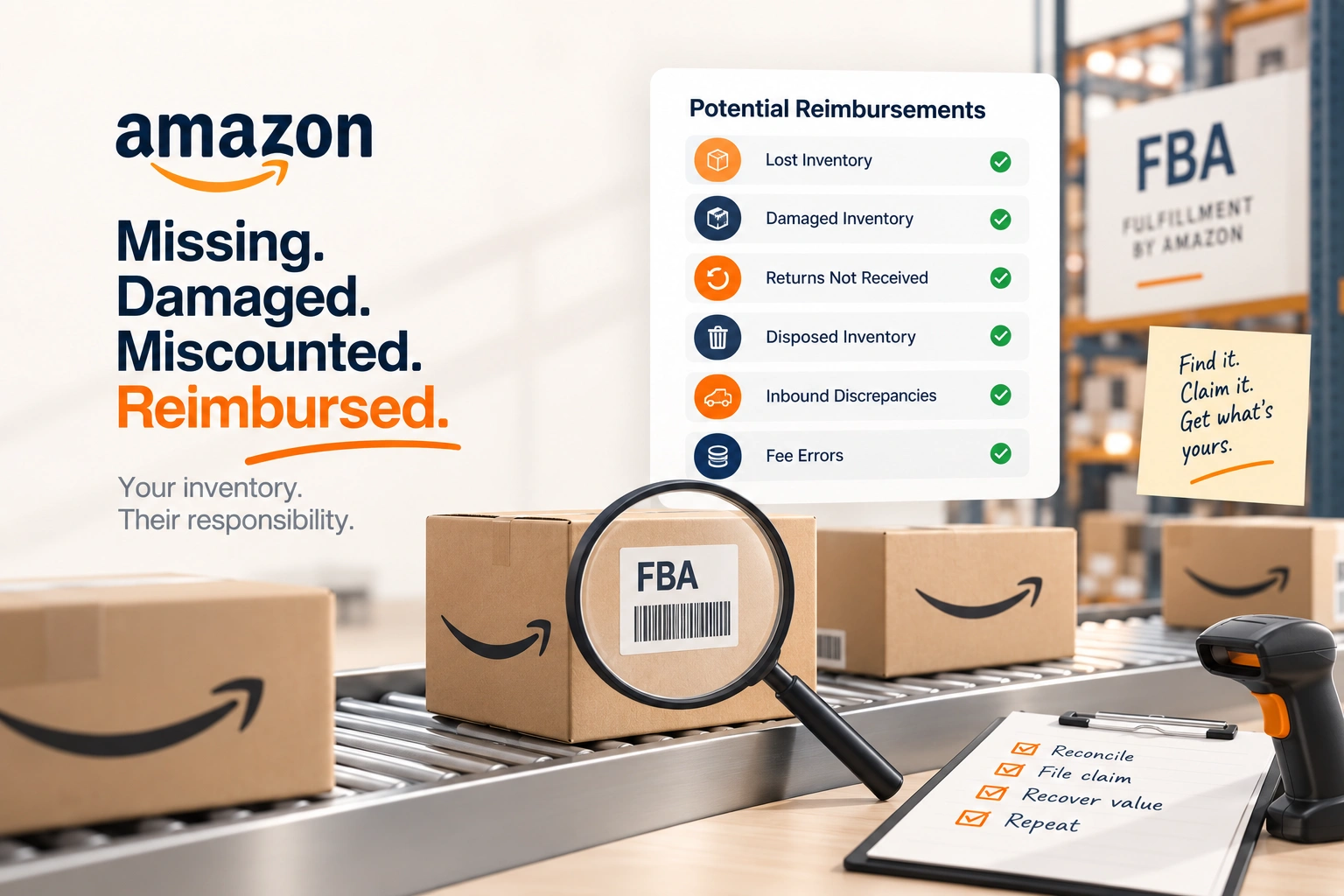
Amazon handles an enormous volume of physical goods, and a proportion of it goes wrong. Units are lost in transfer, damaged in the warehouse, disposed of by mistake, refunded to a customer who never returned them, or counted incorrectly on inbound.
Amazon's own policy is to reimburse for most of that. Some of it happens automatically. A meaningful share does not, and the difference between the two is money that stays with Amazon unless somebody claims it.
What Amazon reimburses for
Lost inventory. Units that disappear inside the fulfilment network, either in transfer between centres or during storage.
Damaged inventory. Units damaged by Amazon or by a carrier in Amazon's control, as opposed to damage that arrived with the shipment.
Customer returns that never arrived. A customer is refunded, the return is never received, and the window for it to arrive closes.
Disposed or destroyed inventory. Units removed without an instruction to remove them.
Inbound discrepancies. A shipment where Amazon received fewer units than were sent and verifiably dispatched.
Fee errors. Items charged at the wrong size tier or weight, which is one of the more common and least noticed.
How Amazon values what it reimburses
Since 31 March 2025, stock that is lost or damaged in Amazon's fulfilment network before a customer orders it is reimbursed at its manufacturing cost, not at its selling price. Amazon's announcement on the Seller Forums put it in one line: "we'll reimburse you based on the product manufacturing cost of the affected inventory." The change was first due on 10 March 2025 and was moved to 31 March to give sellers more time to review their costs.
Amazon defines manufacturing cost as "Your cost to source a product from a manufacturer, wholesaler, reseller, or produce the item if you are the manufacturer. It excludes costs such as shipping, handling, customs duties, or other costs." So the reimbursement for a lost unit covers what the unit cost to buy or make, and not what it cost to get it into the warehouse.
The figure used is either the seller's own or Amazon's estimate, which Amazon builds from comparable products. If a seller has not entered a cost, in Amazon's words, "we'll automatically apply our estimate which you can change when you're ready." Costs are managed on the Manage Your Sourcing Cost page in the inventory reimbursement area of Seller Central, which Amazon first announced as Manage Your Manufacturing Cost.
One thing did not change: "For items that are lost or damaged after a customer order in Amazon's store, we'll continue to reimburse you for the sales price on the original order minus applicable fees." The same unit pays out differently depending on whether it was lost before or after somebody bought it, which is worth knowing before reading a reimbursement as right or wrong.
Two checks follow. First, look at the cost Amazon holds for each product. An estimate below your real cost underpays every reimbursement from then on, quietly, and correcting it takes a few minutes per product with the supplier invoice to hand. Second, stop counting a reimbursed unit as a recovered one. A unit repaid at its purchase price has still lost its freight, its duty and its margin, which is why the loss rate belongs in a product's unit economics rather than being written off as covered.
Why the automatic reimbursements are not the whole picture
Amazon reconciles a great deal on its own, and for many sellers the automatic process covers most of what is owed. The gaps tend to be in the cases requiring evidence Amazon does not hold: an inbound shipment where the discrepancy needs your carrier documentation, a return that was refunded but never scanned back in, a fee tier that has been wrong since the product was measured.
These are precisely the cases that need a claim, and precisely the cases nobody has time to notice.
Claims expire, which is the part that costs the most
Reimbursement claims have deadlines, and they run from the event rather than from when you noticed it. The practical consequence is that the older an account is, the more of what it was owed has already gone.
This is why a first reconciliation on a long-running account often finds a substantial figure and an equally substantial amount that has expired. The second finding is the more useful one, because it is the argument for reconciling regularly rather than once.
How a reconciliation actually works
It is a data exercise before it is a customer service exercise. The inventory ledger, the reimbursements report, the returns report and the shipment records are compared to find events that should have produced a reimbursement and did not.
Each discrepancy is then a case, supported by evidence: shipment IDs, carrier confirmation, dates, quantities. Cases fail far more often for missing evidence than for being wrong, which is why the preparation matters more than the wording.
Volume matters too. An account of any size generates enough discrepancies that doing this by hand once a year finds a fraction of them.
What to be careful about
Amazon's policies on reimbursement claims change, and services promising guaranteed recoveries or using aggressive automated claim filing put an account at risk. Filing claims that are not owed is a policy problem, and the account carrying that risk is yours rather than the service's.
The safe version of this work is unglamorous: accurate reconciliation, well evidenced cases, filed within the deadlines, at a cadence that catches things before they expire.
Where it fits
Reimbursements are not a growth lever. They are money already earned that has not arrived, which makes them the cheapest revenue available to an account and the easiest to ignore.
For most brands the honest answer is that it should be a scheduled task rather than an annual panic. It is part of what our cost recovery work covers alongside inventory and forecasting, because the same data reveals both.
How much is usually at stake
The honest answer is that it varies enormously and anybody quoting a percentage of revenue is guessing. What is predictable is the shape: the more units you move through FBA, the more discrepancies occur, because the rate is roughly proportional to volume rather than to revenue.
The same reconciliation exists on any channel holding your stock, eBay included, where returns travel back through more hands than they went out through. That makes it a bigger issue for high-unit, lower-price catalogues than for low-unit, high-price ones. A wholesale operation shipping thousands of units a month generates far more reconcilable events than a private label brand selling hundreds at a higher price.
Whether to run the reconciliation in house, buy software for it or hand it to somebody is the same three way decision as advertising, worked through in in-house vs agency vs software. The same exercise exists on Walmart, with its own windows and claim routes. It also compounds. An account that has never reconciled has years of expired claims behind it and is still generating new ones weekly, which is why the first exercise is usually the largest and the schedule afterwards matters more than the size of it.
Related reading: our Amazon fulfilment, FBA and inventory service page and Seller Support Cases That Actually Get Resolved.
Frequently asked questions
The questions that come up most often on this subject.
An FBA reimbursement is money Amazon owes a seller when inventory is lost, damaged, disposed of, refunded without being returned, or miscounted inside the fulfilment network. Amazon reimburses much of this automatically, and a meaningful share only after a claim.
By reconciling the inventory ledger, reimbursements report, returns report and shipment records against each other to find events that should have produced a reimbursement and did not. Most accounts that have never done this find something.
Monthly or quarterly, depending on unit volume. The claim windows run from the event, so an annual exercise will always find that some of what it identifies has already expired. A schedule catches things while they are still claimable.
Yes. The reports are all in Seller Central and the cases are filed through normal support channels. The work is the reconciliation rather than the filing, and it is a data exercise that scales badly by hand once an account is doing real volume.
Yes, where an item has been charged at the wrong size tier or weight. This is one of the more common and least noticed cases, because the individual amounts are small and only become significant multiplied across every unit sold since the product was measured.
Yes. Claim windows run from the event rather than from when you noticed it, so the longer an account has run without reconciliation the more has already expired. That is the main argument for doing it on a schedule rather than once.
It depends entirely on how they operate. Accurate, well evidenced claims filed within policy are routine. Services promising guaranteed recoveries or filing aggressively at volume put your account at risk, and the account carrying that risk is yours rather than theirs.
Walmart Fulfillment Services has its own reimbursement process for inventory lost or damaged in its network. The principle is the same and the reports, deadlines and claim routes are different, so a process built for Amazon does not transfer directly.
Not if it is lost or damaged before a customer orders it. Since 31 March 2025 Amazon reimburses that stock at its manufacturing cost, the seller's own figure or Amazon's estimate, excluding shipping, handling and customs duties. Items lost or damaged after a customer order are still reimbursed at the sales price on the order, minus applicable fees.