Amazon FBA vs FBM: Which Fulfilment Method Fits
FBA and FBM are not a preference. They are two different cost structures, and the right one changes by product, by season and sometimes by unit.


Loading Article banner
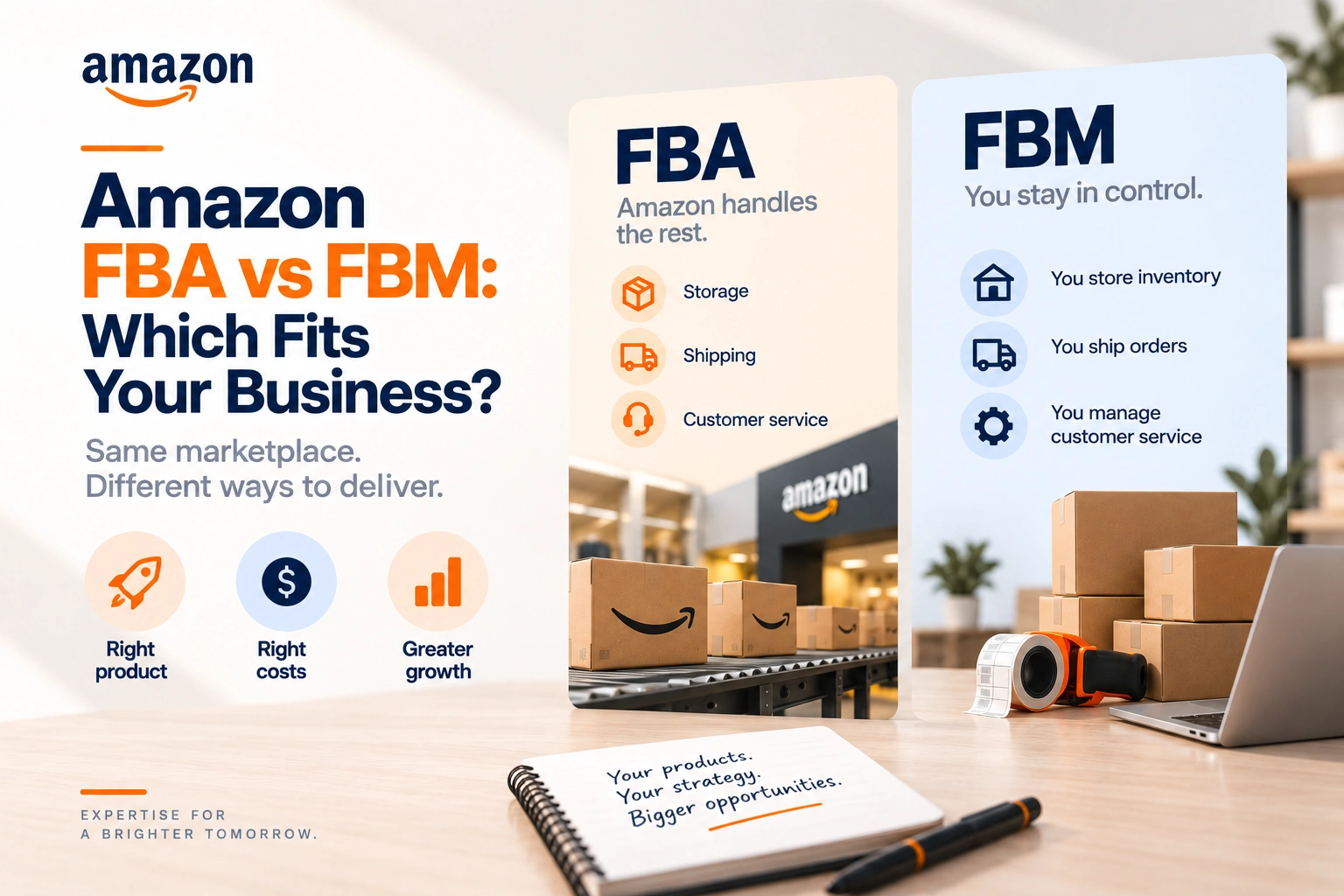
Most sellers pick a fulfilment method once, at the beginning, and then treat it as settled. It is not settled. FBA and FBM are two different cost structures, and which one wins depends on the product's weight, its size, how fast it sells and how often it comes back.
The decision is worth making per product rather than per account, and worth revisiting when any of those four things changes.
What the two actually are
FBA, Fulfilled by Amazon, means the inventory sits in Amazon's fulfilment network. Amazon picks, packs, ships and handles the customer service and the returns. The listing is Prime eligible without any further work.
FBM, Fulfilled by Merchant, means the stock stays with you or your third party warehouse. You ship each order, you answer the customer, and you handle the return. Prime eligibility is only available through Seller Fulfilled Prime, which carries delivery performance requirements of its own.
Everything below follows from that one difference: who is holding the box.
The fee comparison people get wrong
The commonest mistake is comparing the FBA fulfilment fee against the cost of postage and concluding that FBM is cheaper. It usually is, on that comparison, and the comparison is incomplete.
FBA's fee covers the pick, the pack, the postage, the customer service and the return handling. FBM's postage covers the postage. The rest of that work still happens; it is just paid for in somebody's time rather than in a line on a statement, which makes it invisible in a spreadsheet and very visible in a working week.
The honest comparison is total cost to deliver one order to one customer, including the labour, the packaging, the storage and the share of returns that arrive damaged. Do that per product and the answer stops being obvious in either direction.
Where FBA usually wins
Small, light, fast moving items. The fulfilment fee is smallest at the bottom of the size bands, and the storage cost only matters when stock sits still, so a product that turns over quickly barely pays it.
Anything where the buy box matters. Prime eligibility and delivery speed are inputs into the buy box, and on a competitive listing an FBM offer at the same price frequently loses to an FBA one.
Any product where the customer service load is unpredictable. Amazon absorbing the returns is worth more than it looks on a category with a high return rate, provided the returns are not arriving unsellable.
Where FBM usually wins
Large, heavy or awkward items, where the FBA size band is punishing and you may already have freight rates that beat it.
Slow moving stock. Storage costs and aged inventory surcharges are what turn a profitable line into a loss quietly, and stock that sits still in your own warehouse costs a fraction of stock that sits still in Amazon's.
High value or fragile goods where the handling matters, and anything with a short shelf life or serialised stock that you need to control by unit.
Products with erratic demand, because FBM has no restock limit and no inbound lead time. When a listing suddenly moves, an FBM offer can serve it today.
The cash flow difference nobody prices
FBA moves your money into inventory earlier. Stock has to be bought, prepped, labelled and shipped into the network before a single unit sells, and the lead time between the shipment leaving and the units becoming sellable is time your cash is doing nothing.
FBM lets you hold stock closer to the sale. That is worth a great deal to a business growing faster than its working capital, and it is the reason plenty of sellers run a hybrid: FBA on the proven lines, FBM on everything being tested.
Running both at once
Nothing stops one account using both, and most mature accounts do. The pattern that works is FBA on the products where speed and the buy box decide the sale, FBM on the products where size, value or unpredictability make Amazon's network the expensive option.
A second use for FBM is as a backstop. An FBA listing that runs out of stock loses its ranking and its review velocity together, and recovering both costs more than the margin lost on a few merchant fulfilled orders. Keeping a small FBM offer live on your best lines means a stockout dents the margin rather than the ranking.
If you are running advertising against those listings, the fulfilment choice affects the advertising too. Traffic sent to an offer that keeps losing the buy box spends the budget and converts nothing, which is one of the patterns we describe in why an Amazon PPC campaign spends without converting.
How to decide, per product
Take one product and work out four numbers. What it costs to get one unit to one customer under FBA, including storage for the average time it sits. The same under FBM, including the labour and the packaging. The difference in conversion rate, which you can estimate from what happens to the buy box. And the return rate, because returns are handled differently and priced differently.
Three of those four are in your own data. The fourth, conversion, is the one worth testing rather than assuming.
Do that for the ten products that make most of your revenue and you will usually find the account is split rather than uniform, which is the answer the question was really asking.
What we do with this
Fulfilment strategy is part of Amazon account management rather than a separate exercise: it decides the margin on every unit, and it interacts with pricing, advertising and inventory planning at the same time.
The same question arrives on every marketplace in its own form, and the answers do not transfer. Walmart's fulfilment service has its own economics, which we cover on Walmart marketplace management, and a brand selling on its own Shopify store alongside Amazon has a third set of numbers again.
If you want the arithmetic done against your own catalogue rather than in the abstract, talk to us.
Frequently asked questions
The questions that come up most often on this subject.
It depends on the product, not the account. FBA usually wins on small, light, fast moving items where the fulfilment fee is low and the buy box matters. FBM usually wins on large, heavy, slow moving or high value goods, where Amazon's size bands and storage costs are punishing. Most established accounts run both.
Yes, indirectly. Delivery speed and seller performance are inputs into the buy box, so an FBM offer competing against an FBA one at the same price is starting behind unless its delivery promise is comparable. Seller Fulfilled Prime closes some of that gap, at the cost of meeting Amazon's delivery performance requirements yourself.
Yes. The listing stays the same; the offer changes. What you cannot do instantly is move the stock, so a switch either waits for the FBA inventory to sell through or involves a removal order, which costs money and takes time. Plan the switch a season ahead rather than in the week you notice the fees.
It lets an FBM offer carry the Prime badge, provided you meet Amazon's delivery speed, on-time and cancellation requirements from your own warehouse, with Amazon's carriers or approved alternatives. It suits sellers who already run a fast, reliable fulfilment operation and want Prime placement without moving stock into Amazon's network.
Substantially. FBA returns go back into the network and are graded for resale, and the customer service is handled for you. FBM returns come to you, and so does the conversation. The cost difference is easy to underestimate in a category where a tenth of orders come back.
Not directly, and the effect is real anyway. Ranking follows sales velocity and conversion, and FBA listings usually convert better because of Prime and the delivery promise. The lift comes through conversion rather than through any preference in the algorithm for the fulfilment method itself.
It keeps costing storage, and after enough time it attracts an aged inventory surcharge on top. The options are to sell it down with price and advertising, to have it removed to your own warehouse, or to have it disposed of. All three cost something, which is why slow moving lines are the ones to think hardest about before committing them to FBA.
Yes, and it is a sensible hedge on your best sellers. The FBA offer serves normal demand; the FBM offer keeps the listing live if FBA runs out. Losing a ranking to a stockout costs more than the thinner margin on a handful of merchant fulfilled orders.
They cap how much you can send into the network, which turns FBA into a constrained resource in the run-up to a peak. Sellers with limited capacity usually spend it on the products with the best margin per cubic foot and fulfil the rest themselves, which is a different calculation from the per unit one.
Whichever protects the cash. FBM keeps the money out of stock for longer and lets you learn the demand curve before committing to inbound shipments; FBA gets a competitive listing live faster. For a first product with unproven demand, the cash argument is usually the stronger one.