Vendor Central and Seller Central, and Which One You Are In
One sells to Amazon, the other sells through it. The difference decides who sets the price, who carries the stock and who is accountable when something goes wrong.


Loading Article banner
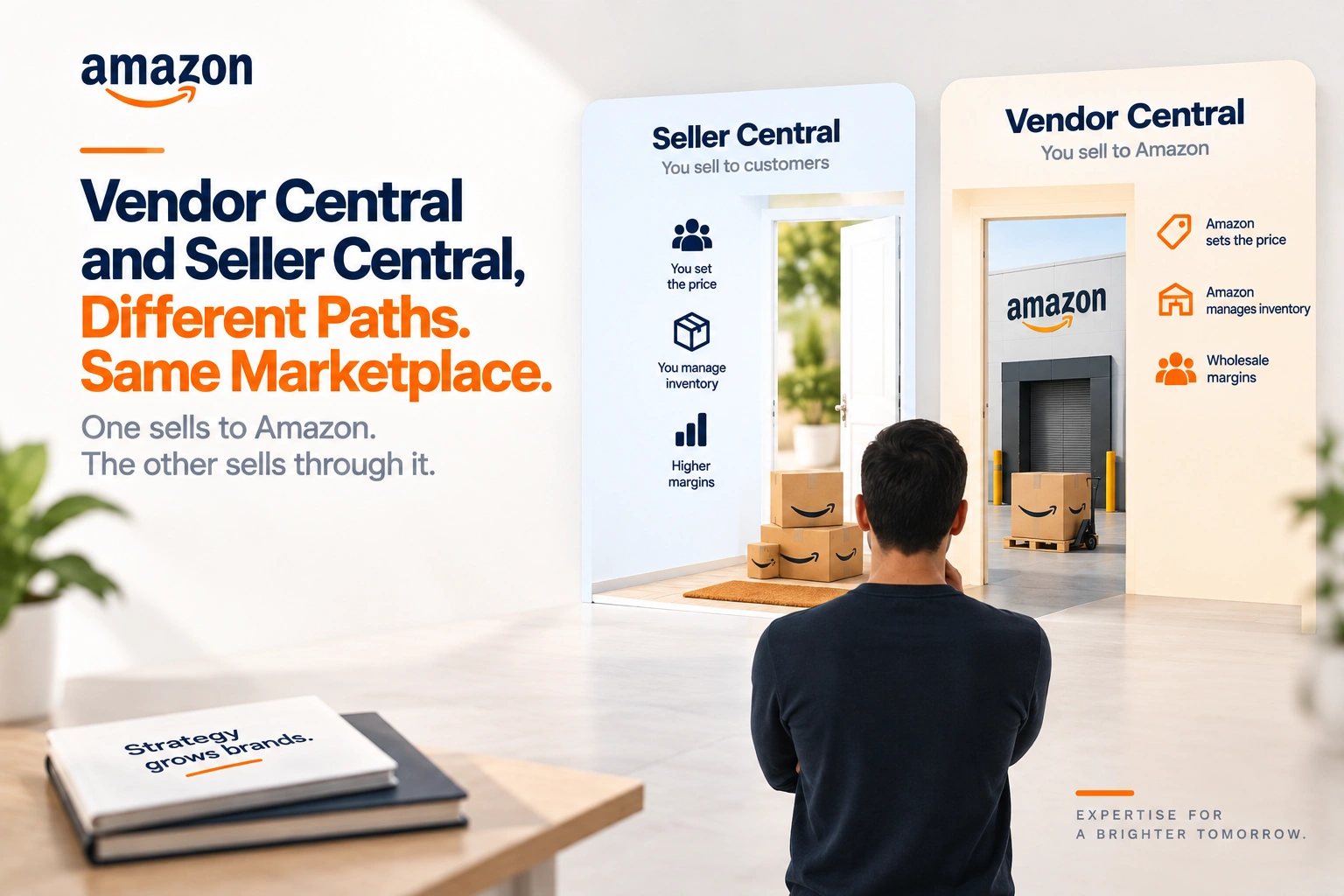
The two look similar from the outside and are opposite arrangements. In Seller Central a brand sells to the public and Amazon takes a cut. In Vendor Central a brand sells to Amazon at wholesale and Amazon sells to the public. The listing can look identical either way. Almost everything behind it differs.
The distinction is usually written as 1P and 3P, first party and third party, which is accurate and tells nobody anything. What matters is who owns the decisions.
Who sets the price
This is the difference that surprises people most. A vendor does not set the retail price. Amazon buys at an agreed cost and then prices however it wants, which includes pricing below what the brand sells for elsewhere, and includes matching a competitor's error.
That has consequences outside Amazon. A brand with wholesale customers who have their own margins to protect can find Amazon undercutting all of them, and the vendor has no lever to pull. A seller on Seller Central keeps the pricing decision, which is why repricing is a discipline there and not a thing that happens to you. We have written about how a repricing strategy holds up under pressure.
Margin, and why the comparison is not what it looks like
The obvious comparison is wholesale margin against retail margin minus fees, and on that arithmetic Seller Central usually wins by a distance. The comparison is incomplete in both directions.
A vendor is paid on invoice terms for a purchase order, which is a different cash flow shape from being paid per sale: predictable, larger, and slower. Against that sit the deductions, which is where vendor arrangements get expensive in ways that do not appear in a margin calculation. Chargebacks for cartons labelled wrongly, for shipments outside a delivery window, for anything not matching the routing guide. Co-op and marketing allowances agreed as a percentage. Price protection when Amazon discounts.
A seller carries a different set. The referral fee, the fulfilment fee, storage, returns, and advertising, all of which are visible and none of which is a surprise deduction six weeks later. What it actually costs to sell on Amazon covers those in order.
Who carries the stock, and who carries the risk
A vendor ships against purchase orders. Once Amazon owns the units it decides what to do with them: how much to hold, when to reorder, whether to stop. A brand can be selling well and receive no order for a quarter because the algorithm decided the network was long on that item.
A seller owns inventory until it sells and pays to store it. That is a real cost and a real risk, and it is also control: the decision to hold more before a peak, or to clear slow stock, belongs to the brand. Getting it wrong is expensive in both directions, which is why the reimbursements Amazon owes and does not volunteer are worth understanding.
The invitation, and why it is not always good news
Vendor Central is invitation only. Being invited reads as a promotion and is better understood as an offer with terms, because accepting it hands over the pricing decision permanently and the arrangement is not easy to reverse.
The question worth asking is what the invitation solves. If the constraint is operational, a team that cannot handle fulfilment and customer service at volume, then a vendor arrangement removes real work. If the constraint is growth, it usually does not: a brand that cannot sell its products profitably on Seller Central does not become profitable by selling them at wholesale.
The hybrid arrangement, where a brand runs both, exists and is more common than people expect. It is also the most operationally complex of the three, because the same catalogue is being managed under two sets of rules with two sets of reporting.
What stays the same
The listing still has to earn the click and the advertising still has to earn its budget. Vendors advertise through the same auction, on the same placements, against the same competitors, and a vendor's Sponsored Products campaign is subject to exactly the arithmetic every other campaign is. If anything the discipline matters more, because a vendor has fewer levers elsewhere.
Search behaves the same way too. Relevance is decided by the listing and by what shoppers do with it, not by which arrangement produced the listing. How Amazon SEO and PPC feed each other is the same on both sides of the line.
The reporting is not the same, and it catches people out
Vendor Central reports through Retail Analytics, and what it shows is what Amazon knows as the retailer: shipped units, shipped revenue, glance views, sourceable and procurable inventory. What it does not show is the customer. A vendor does not receive order level data, does not know who bought, and cannot contact them.
Seller Central reports the other way round. The seller has order level data, knows the buyer's address, handles the messages and owns the customer service outcome. That is more work and it is also more information, and the difference shows up in every decision that depends on knowing who is buying: which sizes sell together, which regions run hot, which products are bought once and which are bought again.
The practical consequence is that a vendor's view of demand is Amazon's view of demand. It is accurate about what Amazon sold and silent about why. Sellers who move to a vendor arrangement expecting the same reporting are usually surprised, and it is worth checking which figures a team actually depends on before the switch removes them.
Neither report answers the question people most want answered, which is whether the advertising is paying for itself, because that arithmetic sits across both. What a reasonable return on ad spend looks like is worth having in mind before reading either.
Which one to be in
Most brands should be on Seller Central and should stay there. It keeps the pricing decision, the customer relationship and the inventory decision in the brand's hands, and every one of those is a lever that can be pulled when something goes wrong. A vendor has fewer levers and a slower feedback loop.
The arrangement earns its place where the operational load is the real constraint: a brand shipping volume it cannot fulfil, with a team that cannot staff customer service, and a product whose margin survives wholesale pricing. That is a narrower set of circumstances than the invitation implies.
Either way the work underneath is the same, and it is the work that decides the outcome rather than the arrangement it happens under. That is what Amazon account management covers: the listings, the advertising, the inventory position and the account health, in whichever of the two a brand happens to be sitting.
Frequently asked questions
The questions that come up most often on this subject.
No. Vendor Central is invitation only and the invitation comes from Amazon's retail team. Seller Central is open to anybody who can pass the account verification, which is why almost every brand starts there whether or not it is where they intend to stay.
No, and this is the difference that catches most brands out. A vendor agrees a cost price with Amazon and Amazon sets the retail price, including pricing below what the brand charges elsewhere. A seller on Seller Central keeps that decision.
Usually not on margin, and the honest comparison is harder than it looks. Wholesale margin is lower than retail margin after fees, but vendor cash flow is larger and more predictable, and against that sit chargebacks, allowances and price protection, which are deductions that do not appear in a simple margin calculation.
Yes, and some do. It is the most operationally complex of the three arrangements because one catalogue is being run under two sets of rules with separate reporting, and the two can end up competing for the same buy box on the same product.