Amazon SEO and PPC: How Ranking and Advertising Feed Each Other
Organic rank and paid placement are not separate channels on Amazon. Each one changes the price of the other, which is why treating them as separate budgets costs money twice.


Loading Article banner
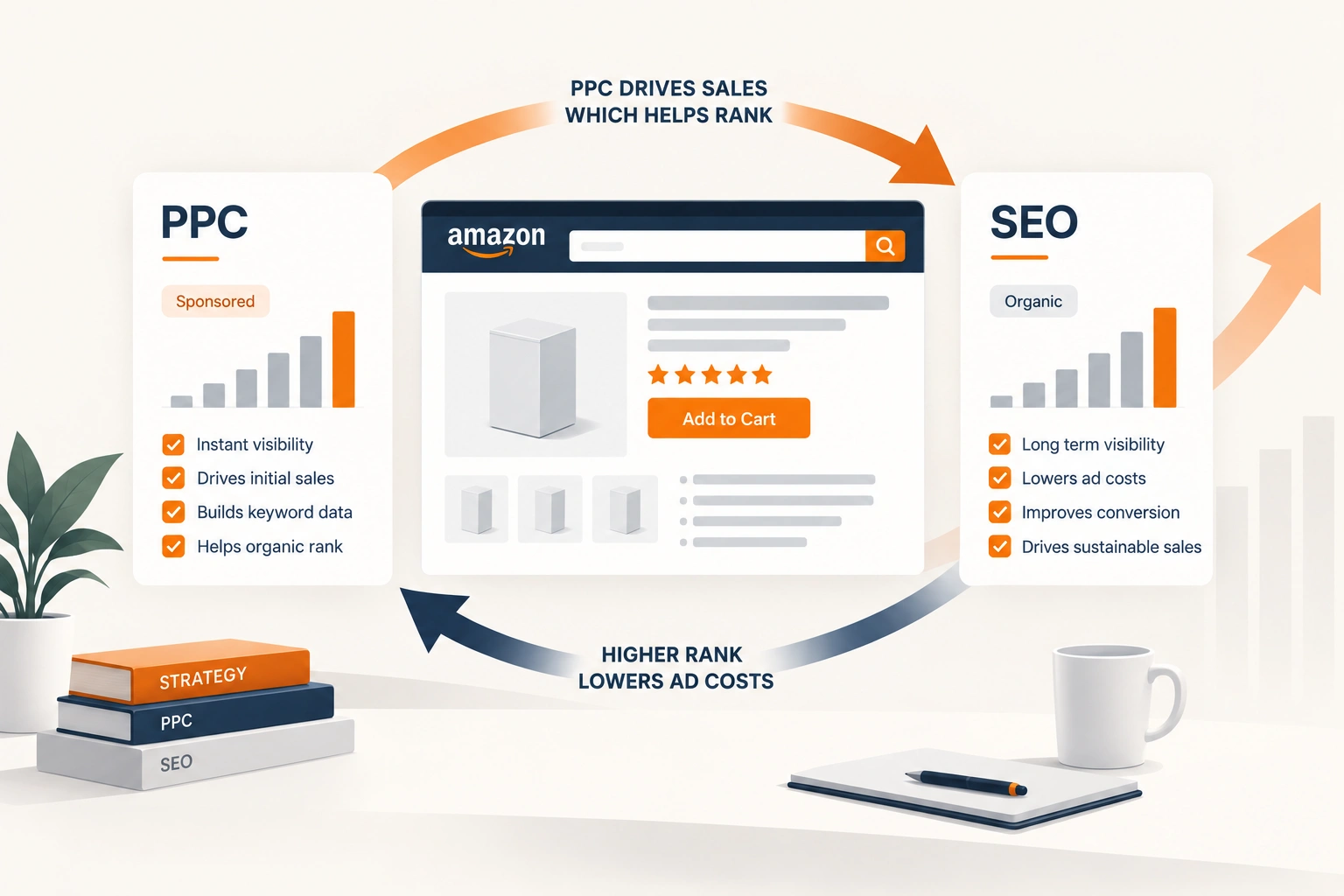
On Google, organic and paid are genuinely separate systems. On Amazon they are not, and running them as two budgets with two owners is why so many accounts pay twice for the same result.
The connection is simple: the same behaviour drives both. Sales on a term help you rank for it, and ranking for it makes advertising on it cheaper.
Advertising buys the sales that create rank
A new product cannot rank for a term because it has no history on that term. Advertising is the only way to get sales against a search you cannot yet appear for organically, and those sales are what start the rank.
That is the real return on launch advertising, and it does not appear in ACoS. Judging a launch on ACoS alone measures the cost and none of the benefit, which is why launches so often get cut a fortnight before they would have worked.
The measurement that matters is organic position on the terms you are paying for, checked at the start and again a month later. If it is not moving, the advertising is buying sales rather than a position, and the plan needs revisiting.
Rank makes advertising cheaper
The loop runs the other way too. Amazon gives placement to whichever ad is likely to earn it money, which means high converting listings win positions at lower bids than poor converters.
Everything that lifts organic performance therefore lowers advertising cost: a better main image, a title that reads like a product, reviews, a competitive price, being in stock. None of it appears in the advertising console and all of it changes what you pay.
This is why a listing problem cannot be solved with a bid. We wrote about diagnosing that in why your campaign is spending but not converting, and about the levers outside advertising in what sits beyond PPC.
Use the search term report to write the listing
The most underused connection between the two. Your search term report is a list of the exact words real shoppers used before buying your product, with the conversion rate beside each one.
That is better keyword research than any tool, because it is your product and your buyers rather than a category average. Terms that convert well and appear nowhere in your title or bullets are the cheapest listing improvement available.
Do it the other way round and you get a listing stuffed with terms nobody buys on.
What to do when you start ranking
The instinct is to stop advertising the term and take the saving. It is usually wrong for two reasons.
First, ranking first organically and holding a sponsored slot on the same page takes up more of the result than either alone, and the competitor who would have had that slot does not get it.
Second, the sales that earned the rank are partly the advertised ones. Remove them and the signal weakens, sometimes enough to lose the position you paid to get.
Reduce the bid and watch what happens to both organic position and total sales. That is a measurement rather than a guess, and it takes a fortnight.
Measure the pair, not each half
Total advertising cost of sale, advertising spend over total revenue including organic, is the number that reflects the loop. Plain ACoS describes the advertising in isolation, which is exactly the framing that makes people cut launch spend and defensive spend.
A campaign with an unremarkable ACoS that is lifting organic rank is doing its job. One with a beautiful ACoS that is harvesting terms you already own is not creating anything, and the two are indistinguishable if you only look at one number.
Sensible targets for both are in our ROAS standards, and the weekly work that keeps either honest is in the weekly optimization routine.
What we do with this
We plan the two together, with one owner and one number, because the alternative is paying twice for the same sale. The advertising half is set out in how Amazon pay per click works, and running both halves against a single target is part of Amazon advertising management.
Frequently asked questions
The questions that come up most often on this subject.
Indirectly but genuinely. Sales and conversion on a term contribute to how Amazon ranks you for it, and advertising is a way of getting those sales before you rank. It is not a shortcut to rank on a term you cannot convert.
Usually not entirely. Ranking first organically and appearing in a sponsored slot on the same page takes up more of the result, and stopping removes the sales that keep the rank. Reduce the bid and watch, rather than pausing outright.
Listing. Advertising buys visits, and everything that turns a visit into a sale sits on the detail page. Sending paid traffic to a listing that does not convert is the most reliable way to spend money and learn nothing.
It lists the exact words real shoppers used before buying your product, with the conversion rate beside each, which makes it better keyword research than a tool's category averages. Terms that convert well and appear nowhere in your title or bullets are the cheapest listing improvement available. Working the other way round fills a listing with terms nobody buys on.