Branded Conversations: What Alexa for Shopping Will Say About Your Brand, and What to Write Down Before January 2027
Amazon Ads announced Branded Conversations on 29 September 2026: from January 2027, US brands can give Alexa for Shopping their own expertise to use when a shopper keeps talking. What it reads, what a brand supplies, and the brand guidelines that have to exist before a machine speaks for you.


Loading Article banner
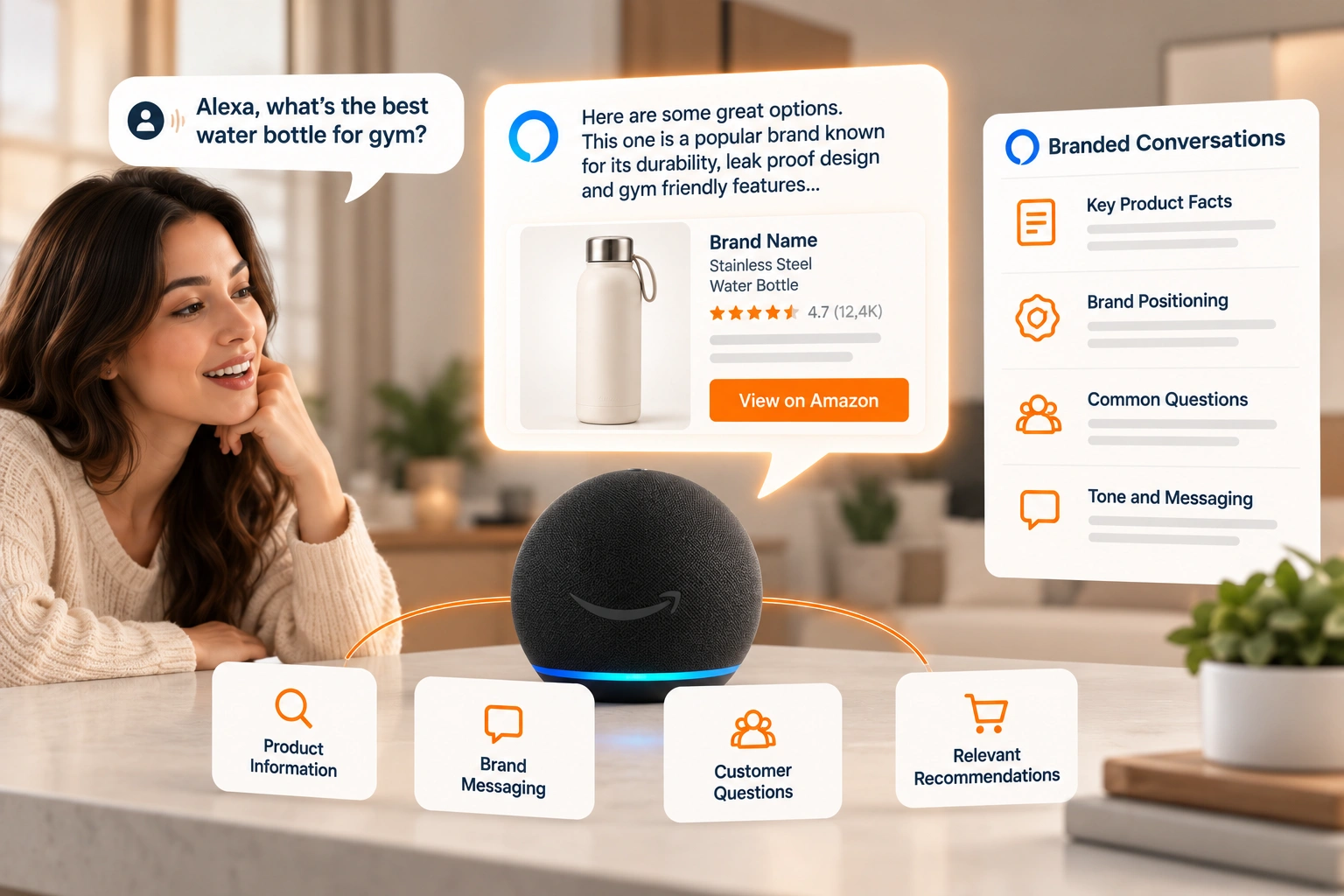
Until now, when a shopper on Amazon asked a question about a brand, the answer came from whatever Amazon could read: the detail page, the Store, the reviews. The brand had no voice in the conversation except through the pages it had already published. On 29 September 2026 Amazon Ads announced the first format that changes that, and it arrives in the United States in January 2027.
Branded Conversations lets a brand hand Alexa for Shopping its own expertise. The practical consequence is that the brand's knowledge, which mostly lives in people's heads, now has to be written down in a form a machine can use without getting it wrong. That is a brand guidelines job, best done before the format opens.
What Amazon announced
Branded Conversations is the next step from Sponsored Brands prompts, the AI-powered suggestions under a Sponsored Brands ad that Amazon made generally available in the US on 25 March 2026. Amazon's description of the step before: when a shopper tapped a prompt, it "opened a conversation with Alexa for Shopping that leveraged Amazon's first-party signals from a brand's detail pages, Brand Store, campaign data, and more."
The new part, in Amazon's words: "Branded Conversations takes that experience further by incorporating brand-provided expertise", so that Alexa for Shopping acts as a deeper product specialist for the brand. Brands can "highlight what makes them different, what sets their products apart, how they address customer needs, and how their products complement each other for the best results."
Amazon's example is a skin care brand that tells Alexa which cleanser suits oily skin, which suits sensitive skin, which is the right first step for a beginner building a routine, and which toners, serums, moisturisers and sunscreens go with each. The shopper can keep asking, and Amazon's unBoxed page describes the result as multi-turn conversations about the brand's products and complementary offerings.
Three facts to hold onto. It launches in January 2027, in the United States. It is advertising: Amazon says it will be "clearly marked as Sponsored within Alexa for Shopping". And the demand is already there: in Amazon's testing, "nearly 20% of shoppers who interact with a Sponsored Brands prompt continue the conversation about that brand."
Why this is a brand guidelines problem first
A brand guidelines document is usually thought of as the logo, the colours and the typeface. Those matter, and they are the easier half. The harder half is the written standard: what the brand claims, what it never claims, who each product is for, how products are meant to be used together, and the words the brand uses for all of it.
Branded Conversations makes the written half the input. Whatever the brand supplies is what Alexa will say, in its own phrasing, to a shopper who may buy on the strength of it. Supply a vague paragraph and the assistant fills the gaps from the detail page and the reviews. Supply a clear, bounded set of statements and it has something it can repeat accurately. The difference between those two outcomes is a document.
It is also the same document that Amazon's shopping assistant already draws on without the brand's help. Keyword research when shoppers ask instead of type covers how Alexa for Shopping and Rufus answer from the listing today, and why a listing written only for phrases leaves the assistant guessing. Branded Conversations is the paid, brand-authored layer on top of that; it does not replace the listing it sits on.
What to write down, section by section
What the brand is, in two sentences. The origin, the point of view and the thing the brand will not do. If the assistant is asked why this brand rather than the cheaper one in the carousel, this is the answer it needs.
Who each product is for, and who it is not for. Amazon's own example is a map from skin type to cleanser. Every category has an equivalent: dog size to harness, room size to purifier, skill level to kit. Write the exclusions as carefully as the recommendations. A product recommended to the wrong buyer is a return, and a return is worse than a lost sale.
How the products go together. The routine, the system, the order of use. This is the part Amazon calls complementary offerings, and it is where a conversation turns one purchase into two. A brand that has never stated which of its products belong together will find the assistant pairing them by guesswork.
The claims the brand can substantiate, and the list of the ones it cannot. A claim in a Branded Conversation is a claim in an advertisement. The rules that govern what the listing may say govern this too, and Amazon's policy warnings show what happens when a claim outruns its evidence. The guidelines should carry a short list of prohibited words as plainly as the list of permitted ones.
The words. The product names as the brand spells them, the terms the brand uses for its own features, and the tone: whether it says moisturiser or hydrator, whether it explains or reassures.
The facts a shopper asks about and the listing hides. Sizes, compatibility, what is in the box, how long it lasts. The questions people ask an assistant are the questions the bullets did not answer, and the reviews and Q&A on the listing are the record of them.
Keep the sources consistent, because Alexa reads all of them
Amazon's description of the conversation is explicit that it draws on detail pages, the Brand Store and campaign data as well as the brand's own expertise. So the guidelines cannot live in a document alone. The same facts have to be true on the A+ content, in the Store and on every listing, or the assistant will be reading three versions of the brand and choosing between them.
That is the discipline a brand guidelines document is for: one statement of who the products are for, carried into the A+ content as the comparison chart, into the Brand Store as the page structure, and into the bullets as the first line. When those agree, the brand-provided expertise confirms what Amazon already sees. When they disagree, the brand has handed the assistant a contradiction.
Ownership is a condition of all of it. Sponsored Brands, the Store and the brand's say over its detail pages all run through Brand Registry, and Brand Registry and listing protection sets out what that requires.
What is not known yet
Amazon's page does not say how the expertise is submitted, whether as structured fields, documents or prompts, nor how it is billed, nor how a brand reviews what the assistant has said in its name. Until the console shows them, the one plan that is not a guess is having the material ready, which is the part a brand controls and takes longer than three months to do well.
How we approach it
We write the standard before the format exists to receive it: the two sentences, the audience map with its exclusions, the system of products, the claims register with its prohibited list, the vocabulary and the facts shoppers ask about, then carry the same statements into the listings, the A+ content and the Store so every source agrees. That is the work of our brand guidelines service, and January 2027 is the first date on which an Amazon shopper will hear the result read back to them. If you would like to know what your brand would sound like today, we can tell you from the listing alone, which is the point.
Frequently asked questions
The questions that come up most often on this subject.
An Amazon Ads format announced on 29 September 2026 that lets a brand give Alexa for Shopping its own expertise: what sets its products apart, which product suits which customer, and which products go together. The assistant uses it, with Amazon's own signals, when a shopper keeps a conversation going. It launches in the United States in January 2027 and is marked as Sponsored.
Sponsored Brands prompts, generally available in the US since 25 March 2026, open a conversation that draws only on what Amazon can already read about the brand. Branded Conversations adds brand-provided expertise to that conversation, so the assistant can speak to the brand's own differentiators and recommendations rather than inferring them.
A written standard: who the brand is, who each product is for and not for, how the products go together, the claims it can substantiate and the ones it must not make, its vocabulary, and the facts shoppers ask about that the listing does not state. The same statements then need to be carried into the listings, A+ content and Brand Store so every source agrees.
Amazon's announcement does not list eligibility, but the format builds on Sponsored Brands prompts and draws on the Brand Store, both of which require Brand Registry. A brand that is not enrolled has neither a Store for the assistant to read nor a Sponsored Brands campaign for a prompt to appear under.
They should not. The format is advertising, marked as Sponsored, and the brand is responsible for what is said in its name. A claim the listing cannot support is no safer in a conversation than in a bullet point, and a brand guidelines document that lists prohibited claims is the protection.