The FTC's Amazon Ad Surcharge Case: What It Alleges, and What to Check in Your Own Account
The FTC and 22 states allege that Amazon's Sponsored Products auction charged advertisers their own bid close to 80% of the time while describing a second price auction. What the complaint says, what it does not decide, and how to bid as if you pay what you bid.


Loading Article banner
On 31 August 2026 the Federal Trade Commission and 22 states sued Amazon in the US District Court for the Western District of Washington over the auction that prices Sponsored Products ads. The complaint alleges that Amazon told advertisers they were in a second price auction while a hidden surcharge made them pay their own bid most of the time.
These are allegations. No court has ruled on them, and the FTC's announcement does not include Amazon's response. But the question underneath them, how close a click's cost sits to the bid placed for it, is one every advertiser can answer from their own reports today. This is what the case says, what it does not settle, and what to check in an account while it runs.
What the complaint alleges
The FTC says Amazon described its ads as "'second price' auctions where the winner of the auction would only pay 'one cent more than the next highest bidder'", and that "Amazon has made these or similar representations on its website, in training videos and in other public-facing materials."
Against that, it alleges "a surcharge hidden in it", which it says Amazon called a "soft reserve price" and which internal documents describe with phrases including "invented auction participant", "proxy 2nd price that we calculate" and "shill bids". The effect it alleges is that "Amazon has charged its Sponsored Products advertisers their own winning bid close to 80% of the time."
The figures in the announcement are large. "The percentage of the time advertisers paid the amount of their bid increased from between 30% and 40% in 2021, to 70% in 2022, and to approximately 80% in 2024." The FTC puts the result at "tens of billions of dollars of revenue", from "over one million brands and sellers", including "500,000 small- and medium-sized businesses."
Why the auction type matters to a bid
In a second price auction, the bid is a ceiling rather than a price. The winner pays just above the next highest bid, so an advertiser can bid the most a click is worth to them and expect to pay less most of the time. That is the logic most bidding advice is built on, including the advice to bid your true value and let the auction find the price, and it is how Amazon PPC is usually explained.
If the winner pays their own bid most of the time, the bid is the price. Every bid set on the assumption of a discount has cost more than its owner planned, and every target set from those costs is out by the same amount. What a click costs and what moves it sets out the other forces on the price; the case is about whether the auction itself was one of them.
What the case does not decide yet
It does not establish that the allegations are true. Amazon has not had its say in court, and the announcement does not quote a response. The announcement does not set out the remedies being sought, and there is no refund process for advertisers. Anybody offering to recover an advertiser's share of the alleged surcharge today is selling something the case has not produced.
It also does not change how the auction works tomorrow. Whatever the outcome, an advertiser's bids are running in the auction as it is now, which is the one thing within their control.
What to check in your own account
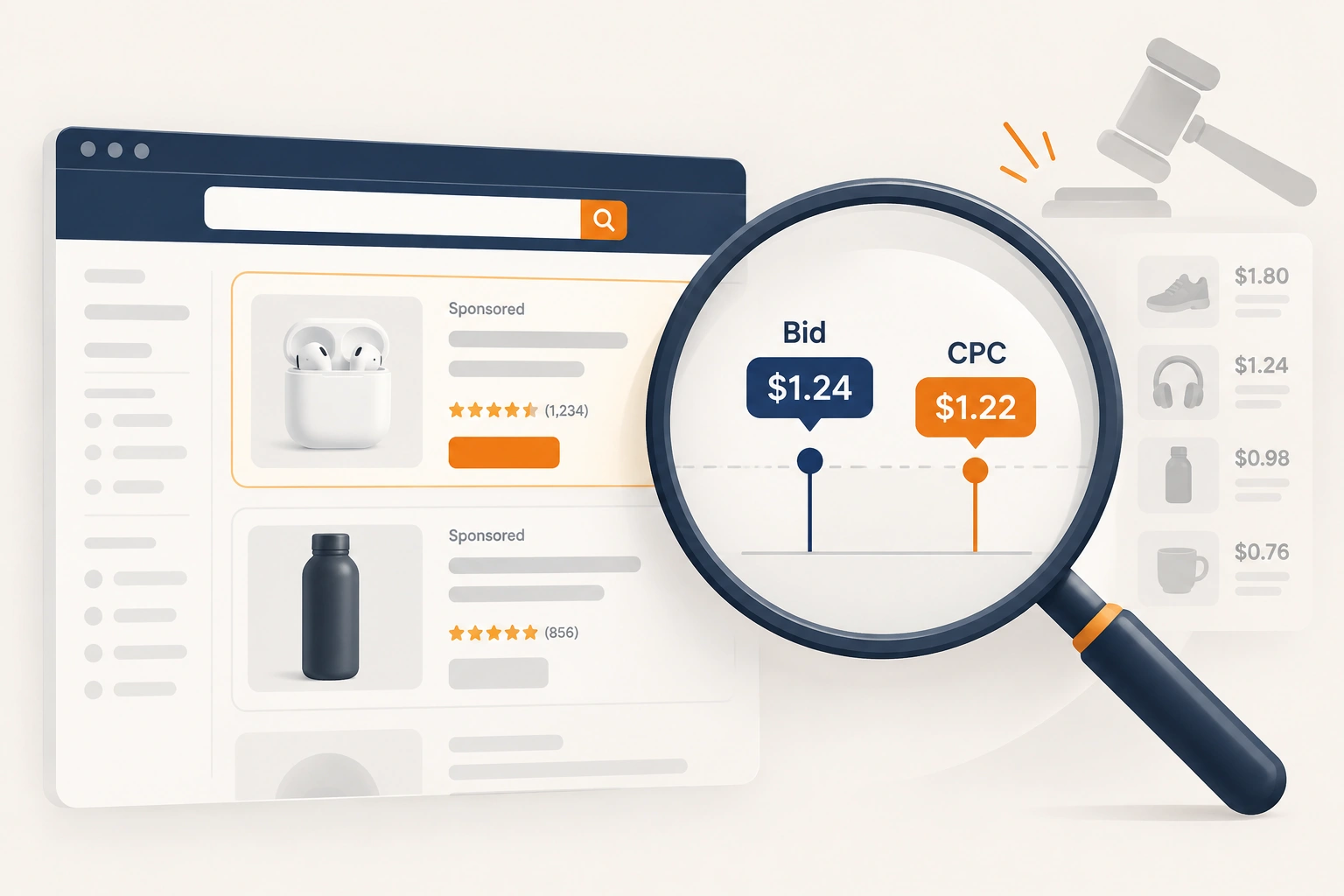
Compare cost per click with the bid. In the Sponsored Products targeting and search term reports, put the average cost per click beside the bid for each keyword or target that has spent in the last month. Where cost per click sits at or just below the bid week after week, the account is paying its bid, whatever the auction is called. Reading the search terms report covers where those numbers live.
Look at the targets where the gap is widest and narrowest. A keyword that costs well under its bid is a keyword where competition sets the price; one that costs almost exactly its bid is one where the bid does. Those are the bids that deserve attention first, because they are the ones where every cent of the bid is a cent spent.
Check the settings that raise bids. Placement adjustments and bidding strategies that increase a bid for top of search raise the price paid as well, if the price paid is the bid. They are worth reviewing on that basis, not only on the sales they bring.
How to bid if you assume you pay what you bid
Set each bid from what a click is worth, not from what the auction might charge. A click is worth the average order value, times the conversion rate, times the share of that order you are willing to spend on advertising. A product selling at $40 that converts one click in ten, with a 25% advertising cost of sale target, is worth $1.00 a click. Bid that, and treat it as the price.
Then judge the result on the measures that matter. ACoS, TACoS and ROAS each answer a different question, and a bid that looks expensive against one can be right against another. The bids that pay their own way at their full value are the ones that survive whatever the case decides.
How we approach it
Bids set from value, and cost per click read against them, are the discipline our Amazon Advertising service is built on, and this case makes that check worth doing in every account. For an account that has not been looked at closely for a while, the audit that finds wasted spend is the wider review to run alongside it.
Frequently asked questions
The questions that come up most often on this subject.
On 31 August 2026 the FTC and 22 states sued Amazon, alleging that it described its Sponsored Products ads as a second price auction while a hidden surcharge meant advertisers paid their own winning bid close to 80% of the time. The case is in the US District Court for the Western District of Washington, and the allegations have not been decided.
According to the FTC, it is the name Amazon gave to the surcharge the complaint says was hidden in the ad auction, raising the price advertisers paid above what the next highest bid would have set. The FTC quotes internal documents describing it as an invented auction participant and shill bids.
Not as things stand. The FTC's announcement does not describe the remedies being sought, no court has ruled, and no refund process exists. Be wary of anybody offering to recover money from it now.
Compare the average cost per click with the bid for each keyword or target in your Sponsored Products reports. If the cost per click sits at or just under the bid consistently, you are paying close to your bid on those clicks.
Set bids from what a click is worth to you, the order value times the conversion rate times your advertising cost of sale target, and treat that bid as the price you may pay. That holds whatever the case decides.