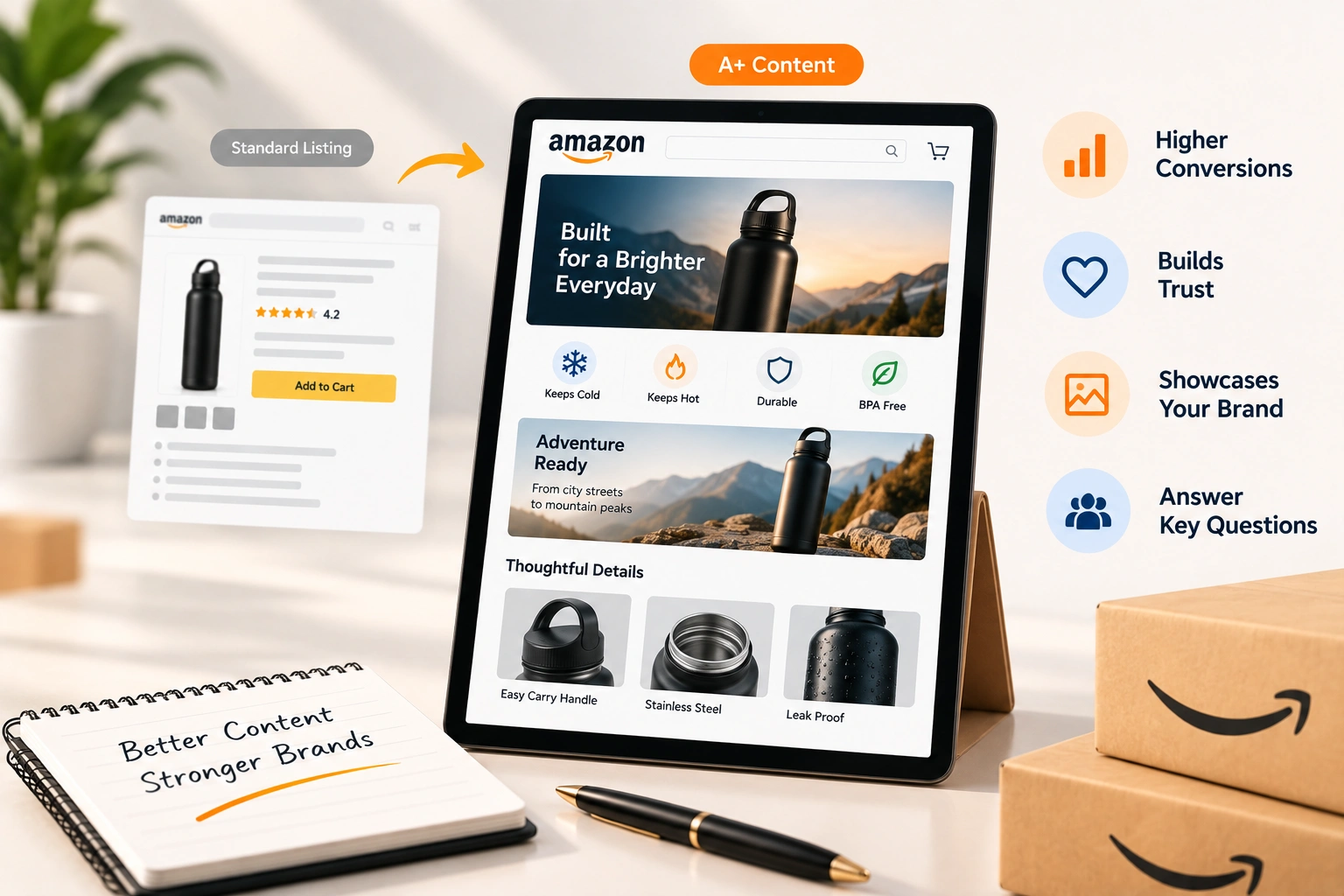
A+ content sits below the buy box, which tells you who reads it: somebody who did not buy from the images and bullets and is still deciding.
That makes it a comparison surface rather than a description. The listings that get the most out of it are the ones that treat it that way.
On a listing with A+ content, the plain text description is replaced. Anything that was doing work there is gone unless it is carried over, and sellers routinely lose a sizing note or a compatibility warning this way.
The description is also indexed in a way A+ modules are not, so the keywords living there need somewhere else to go: the bullets, the attributes or the backend fields.
The comparison chart. The single most useful module on a catalogue with more than one product, because it answers which of yours a shopper wants without sending them back to search.
Image with text overlay. Where the objection the reviews keep raising gets answered visually.
Use case blocks. Who this is for, and who it is not for. Deterring the wrong buyer is worth more than it looks, because a return costs more than a lost sale.
Brand story. Worth having once, reused across the catalogue, and worth very little beyond that.
Premium adds larger images, video modules, interactive comparison tables and hover content. It is eligibility-gated and, where it is not free, priced.
It earns its cost on considered purchases: higher price points, technical products, anything where a video answers a question a photograph cannot. On a cheap, obvious item it is decoration.
The honest test is whether the extra modules would change a decision, not whether the page looks better with them.
Since 2024 the A+ Content Manager has carried Amazon's own generative tools. Amazon's announcement: "Generative AI tools in the A+ Content Manager are now available to all Brand Registered sellers in the US." They work on the modules that carry an AI Ready badge, need a brand-owned ASIN to start from, and are free for select English language modules. Amazon's forum staff described what they produce: creative copy about the product, and lifestyle imagery that can be refined through further prompts, across Basic and Premium A+ Content. Amazon's 2026 summary for new sellers puts it as "Gen AI-powered A+ Content: Showcases your products and shares your brand's story on product detail pages with videos, enhanced images, and AI-powered creation tools."
Amazon attaches its usual figure, A+ Content "potentially increasing sales by up to 20%," and the words to weigh are up to: it is Amazon's ceiling across every brand that uses A+, not what a generated module will do for one product.
Use them the way a brand would use a fast junior designer. The copy they write is plausible and generic until it is edited, so the claims, the specifications and the brand's own words go in by hand and are checked against the product, because a generated sentence that promises something the product does not do is a claims problem on a page Amazon can suppress. The imagery has the same rule: a lifestyle scene is fine, an invented feature, colour or accessory is not, and every generated image is checked against the product in hand before it publishes. What the tools are good at is the first draft and the volume, a comparison module for twenty ASINs in an afternoon; what they cannot do is decide what the brand should say, which is the part of A+ that moves the number.
Short lines. A shopper who scrolled this far is scanning, not reading, and blocks of text at this position get skipped as reliably as they do anywhere else.
Every image needs alt text, and it is worth writing properly: it is what a shopper using a screen reader gets, and it is the only text in a module that is machine readable.
Keep it accurate to the listing. A+ content that describes a bundle the listing does not include is a returns problem waiting to happen, and it is the kind of thing that reaches
account health.
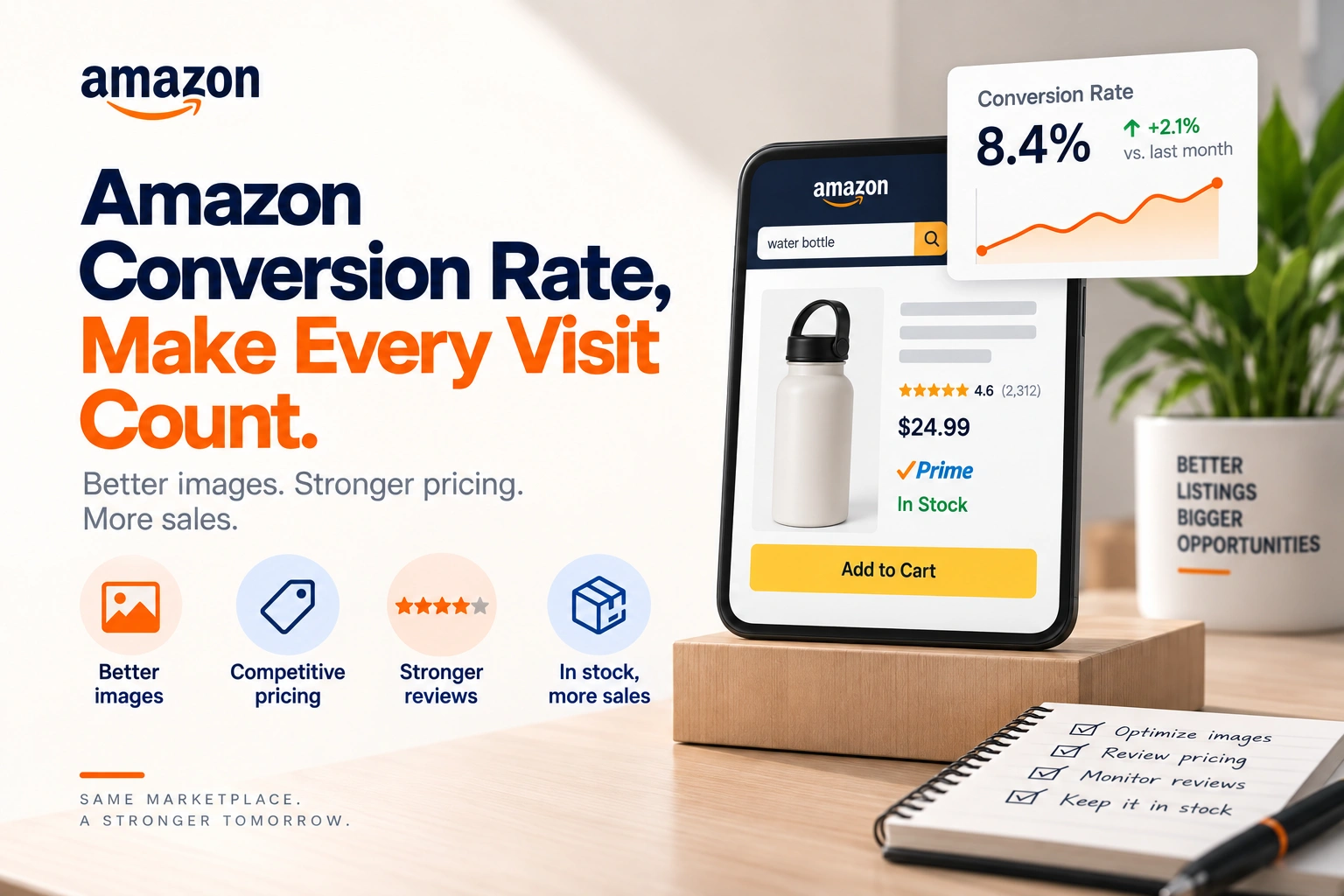
Conversion rate on the listing, before and after, with nothing else changed in the same fortnight. That is the only measurement that means anything, and it is why A+ should not be launched in the same week as a price change or a new main image.
On a listing with low traffic the change will not be readable at all. Put A+ on the products that get enough sessions for the number to move.
Where Manage Your Experiments is available, use it. A split test answers the question in a fortnight with an answer nobody can argue with, and it also settles the more useful question of which version of a module works rather than whether modules work at all.
Treating it as a second description. Repeating the bullets in bigger type answers nothing. The shopper reading A+ has already read the bullets and is still deciding, which means the bullets did not settle it.
Losing the description's content. A sizing note or a compatibility warning that only existed in the plain text is gone the moment A+ goes live, and the first anybody hears about it is in the returns.
Claims that cannot be substantiated. Rejections are commonest for exactly this, along with references to price, shipping and contact details. Writing to the guidelines first is faster than appealing afterwards.
Text baked into images with no alt text. Everything the module says is then invisible to a shopper using a screen reader and to anything else that reads the page.