How to Increase Sales on Amazon: The Twelve Levers, in the Order to Pull Them
Sales on Amazon are traffic times conversion times stock, and every lever moves one of the three. The twelve that move them, why the order matters more than the list, and the one that most sellers pull first and should pull last.


Loading Article banner
Every answer to this question is a list, and the lists are all the same: better images, more keywords, run ads, get reviews, lower the price. They are not wrong. They are unordered, and the order is where the money is, because a lever pulled before the one it depends on costs the same and moves nothing. Advertising a listing that does not convert buys traffic to a page that loses it.
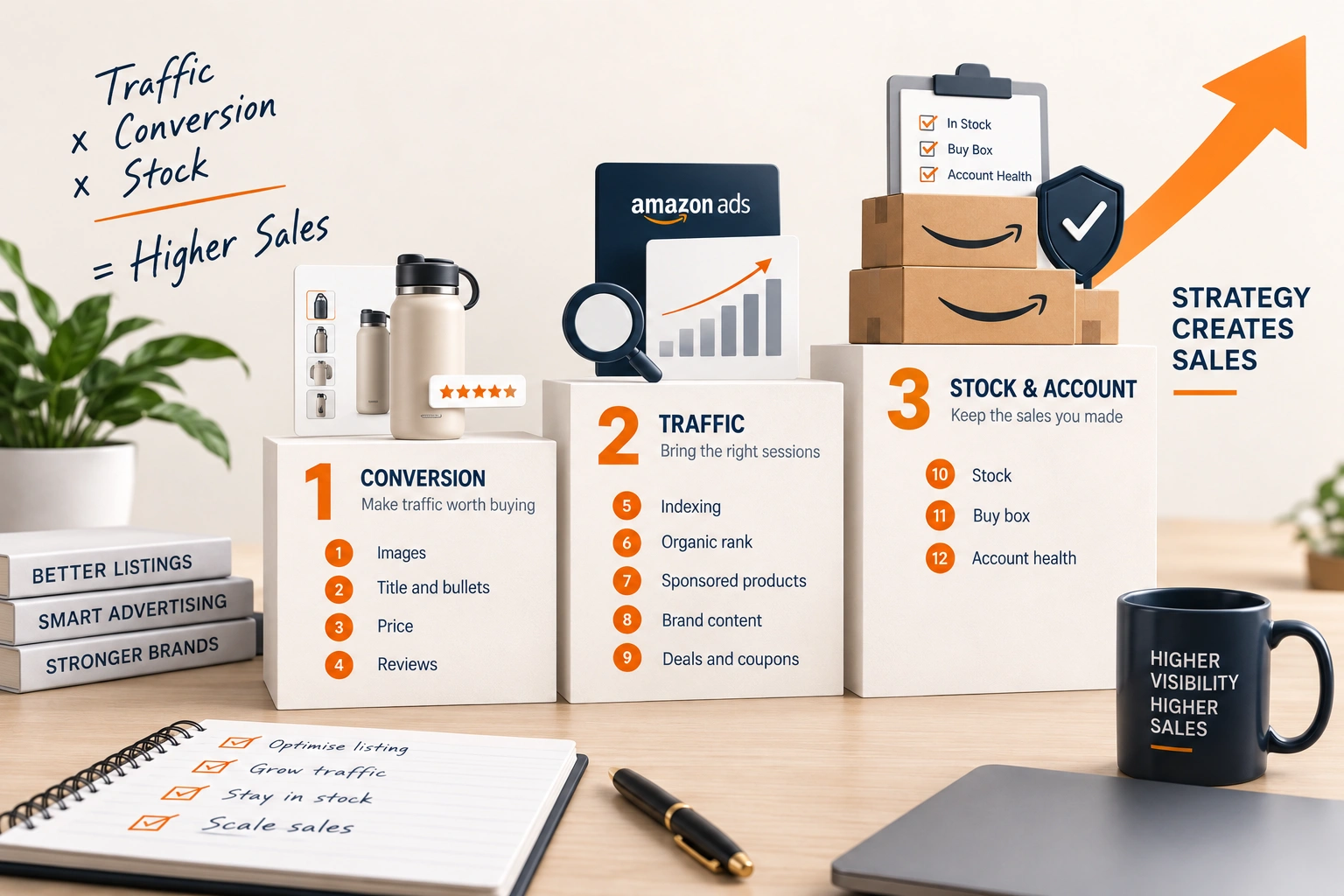
Sales on Amazon are three numbers multiplied: the sessions a listing gets, the share of them that buy, and whether there was stock to sell them. This is the twelve levers grouped by which number they move, in the order we pull them on an account we take over.
First, conversion: the four levers that make traffic worth buying
One, the main image and the image set. The main image decides the click on the results page and the second image decides the read on the product page, and both are fixed before anything else is touched, to the rules in the image requirements and beyond them to what makes a buyer stop. Two, the title and bullets, rewritten for the buyer's question rather than the keyword count: what it is, who it is for, what is in the box, in the first line. The listing optimisation article is the method.
Three, the price, set against the unit economics and the competing offers rather than against a wish; a product priced ten percent above the page's next offer with no visible reason converts at a fraction of its rate. Four, reviews: the count and the recent ones, earned through the Request a Review button and the Vine programme for a new product, and protected by fixing what the bad ones say. A listing with these four right converts, and only then is traffic worth paying for.
Second, traffic: the five levers that bring the sessions
Five, indexing: the listing has to be found for the terms that matter, which means the terms in the title, bullets and backend search terms, checked by searching for them, because a product that is not indexed for its own category term is invisible whatever the ads do. Six, organic rank, which follows sales velocity and conversion on the term, so it is a result of the first four levers and this one, not a separate campaign. Seven, sponsored products on the product's own terms, structured so that the search terms report can be read and acted on, which is the routine in the weekly PPC article.
Eight, the brand's own surfaces: A+ content, the brand store and sponsored brands video, which bring traffic from the brand's other products and from the video placements on the results page. Nine, deals and coupons, used for velocity on a term the product is close to ranking for, rather than as a permanent discount. Advertising is lever seven of twelve, and it is the one most sellers pull first. Pulled first, it measures the conversion problem at the price of a click each.
Third, stock and the account: the three levers that keep the sales you made
Ten, stock: every day out of stock resets velocity and rank, and the forecast is the lever, covered in the inventory management article. A product that sells out in the third week of a campaign hands its rank to the next offer on the page and pays for the climb twice. Eleven, the buy box: for a listing with more than one seller, the offer that holds the buy box takes most of the sales, and holding it is price, fulfilment method and account metrics together; a brand that has let resellers onto its own listing is competing for its own sales. Twelve, account health: a suppressed listing or a deactivated account makes every other lever irrelevant, and the routine that keeps the account clean is a sales lever in the only sense that counts.
These three do not add sales; they keep the ones the first nine made. They are last in the order because they are checked rather than built, and first in the calendar because a check takes an hour and a rebuild takes a month.
A worked example
A kitchen product with 3,000 sessions a month, a unit session percentage of 4%, and an advertising budget that is half the margin. The seller's plan was more budget. The report said conversion: 4% on a page with fifteen offers and a main image that showed the box. The main image was reshot, the second image became the product in use with the one line the reviews kept repeating, the price moved to the page's median, and the Request a Review button was pressed on every order for a month. Conversion went to 9% on the same 3,000 sessions, which is the same as doubling the traffic for nothing. The advertising, unchanged, then paid at twice the rate, and the budget increase the seller wanted in month one was made in month three against a listing that could use it.
Reading the numbers to pick the lever
The business report gives sessions and unit session percentage by product, and those two numbers say which group of levers to pull. Sessions low and conversion high is a traffic problem: levers five to nine. Sessions high and conversion low is a listing or price problem: levers one to four. Both low is the first group first, always. Sales that spike and stop is stock or the buy box. The search term report says which terms the product is seen for and which it converts on, and the gap between the two is the next lever.
Keep reading
For the brands we run under Amazon marketplace management, the first month on an account is levers one to four and ten, with advertising held at maintenance, and the second month is the traffic. It looks slow from outside. It is the order that makes the advertising in month two pay, and it is why the article on how SEO and PPC feed each other is about sequence rather than either one alone. The twelve levers are a list; the order is the strategy.
Frequently asked questions
The questions that come up most often on this subject.
Fix conversion first: the main image, the title and bullets, the price against the page's other offers, and reviews. A listing that converts turns every existing session into more sales without buying a single click, and makes the advertising that follows pay.
Yes, after the listing converts. Advertising is lever seven of twelve. Run first, it buys traffic to a page that loses it and measures the conversion problem at the price of a click each.
From the business report's sessions and unit session percentage by product. Low sessions with a good conversion rate is traffic; high sessions with a poor rate is the listing or the price; both low is the listing first.
Days out of stock reset sales velocity, which organic rank follows, so the listing returns lower on the results page than it left. Stock is a sales lever, and the forecast is how it is pulled.