Amazon Backend Search Terms, and What Platinum Keywords Actually Are
The hidden keyword fields decide what a listing can rank for at all. Most are filled wrong, and one of them does nothing whatsoever.


Loading Article banner
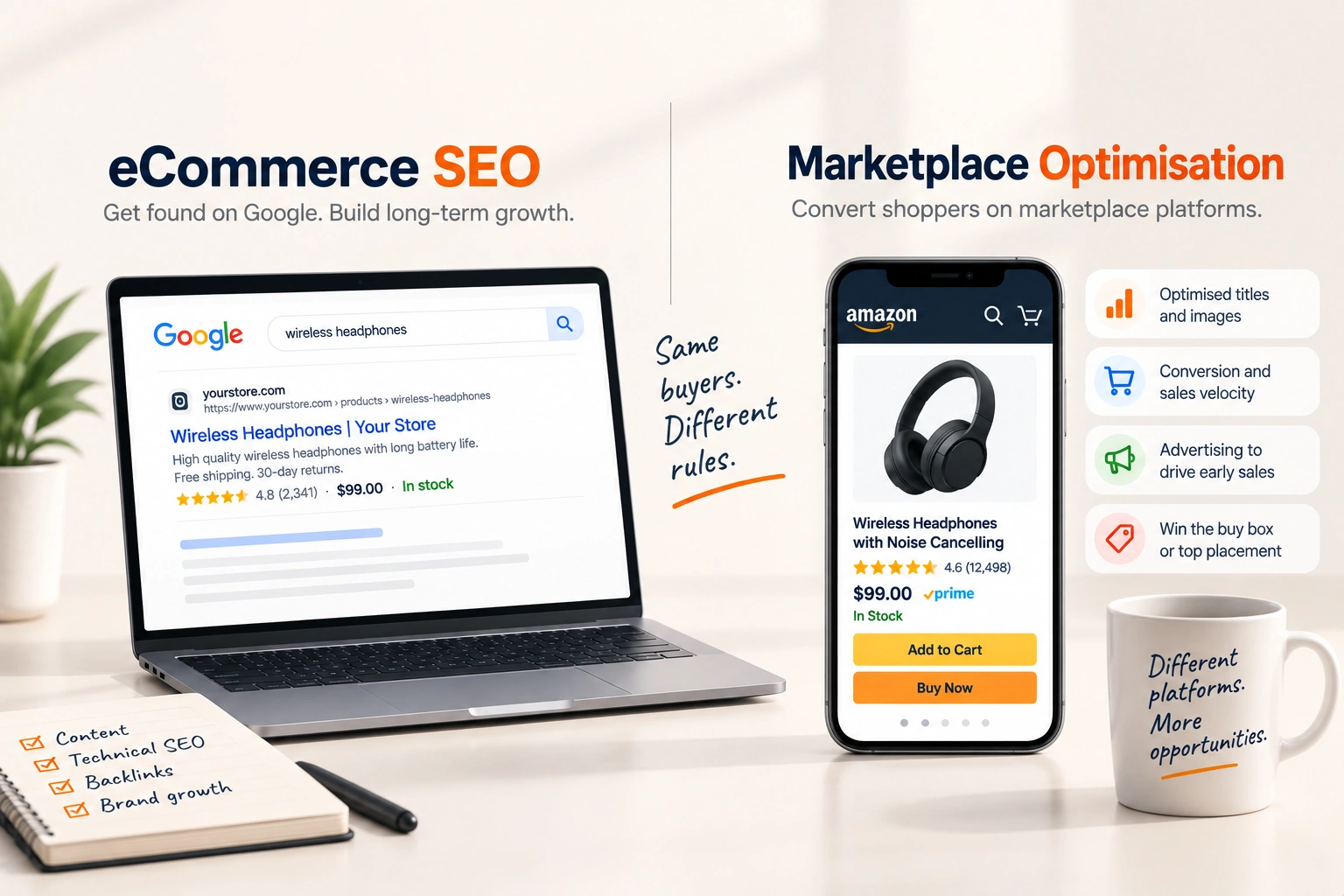
Marketplace search runs on different signals from Google, which is worth settling before touching a keyword field: what ranks an Amazon listing is not what ranks a Shopify page. There are two keyword fields on an Amazon listing that shoppers never see. One of them decides a meaningful part of what your product can be found for. The other has done nothing for most sellers in years, and is still filled in daily by people who assume an empty field is a wasted opportunity.
This is what each one does, what belongs in it, and what quietly wastes the space. The equivalent fields on Walmart and eBay work differently again, which is why a catalogue copied between channels rarely performs the same on both.
What backend search terms are for
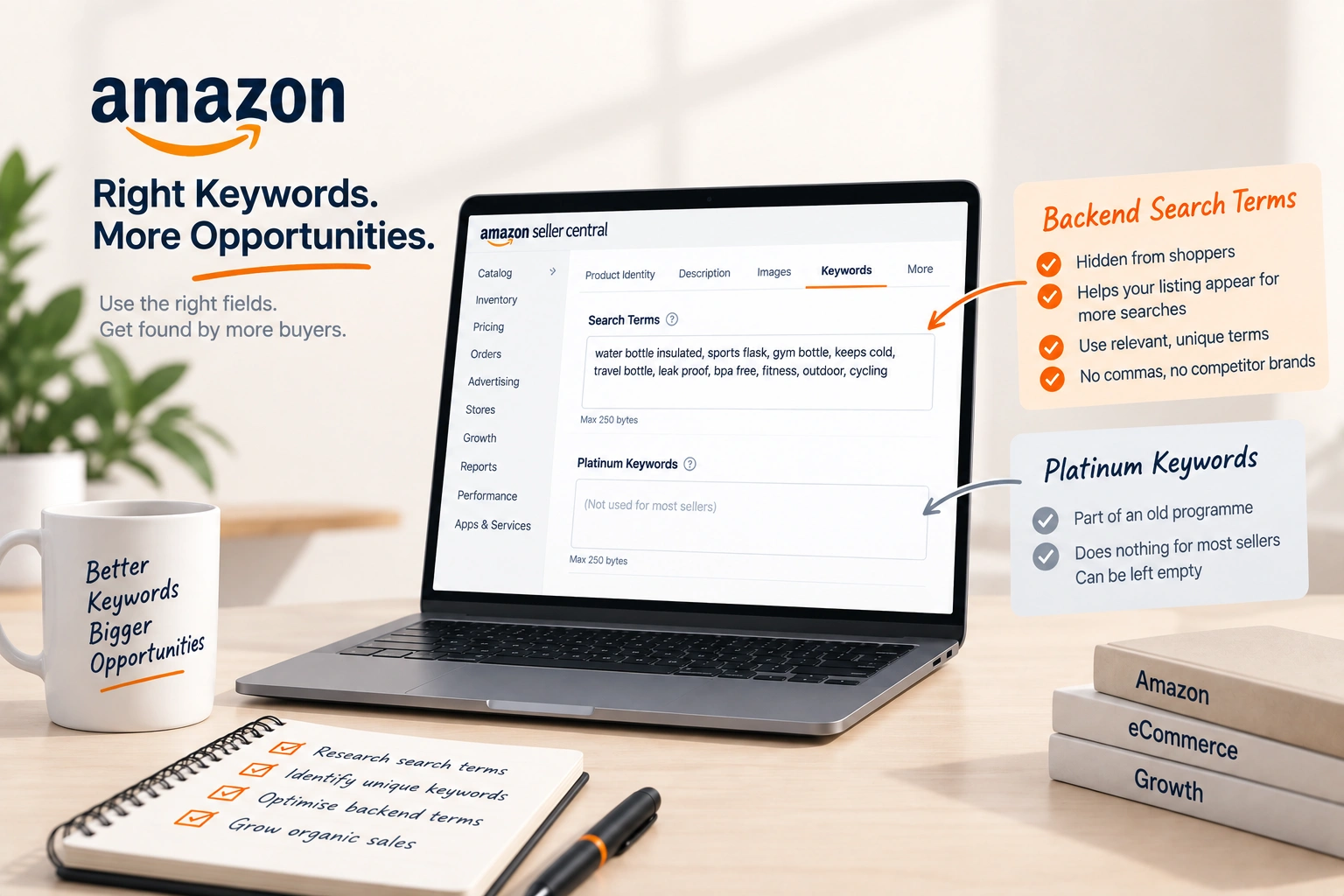
Backend search terms are a hidden field in Seller Central, under the Keywords tab of a listing. Words placed there make the listing eligible to appear for searches it would otherwise be invisible to, without those words appearing anywhere a customer reads.
That eligibility is the whole function, and it is worth being precise about the limit of it. Backend terms do not rank a listing. Relevance and sales history do that. What the field controls is whether the listing is in the running at all, which matters most for the phrasings your title and bullets could never carry: regional words, common misspellings, alternative names for the product, and the way people describe a problem rather than a solution.
The practical model is a door rather than an engine. Backend terms open doors. Whether you walk through one depends on whether people who came through it bought.
The character limit, and why it is smaller than it looks
Amazon caps the field, and the cap is measured in bytes rather than in words. Exceeding it does not produce an error you will notice. Amazon can simply ignore the field, which means a listing that looks fully optimised is indexed for none of it.
That failure is silent and common. The fix is to check the field length rather than to assume, and to treat the limit as a budget to spend deliberately instead of a box to fill.
What wastes the space
Repetition. A word already in your title, bullets or description is already indexed. Repeating it in the backend buys nothing and spends budget you do not have.
Commas and punctuation. Terms are separated by spaces. Commas consume characters and add nothing, which on a byte-limited field is a straightforward loss.
Competitor brand names. Not permitted, and worth avoiding on more than policy grounds: it invites complaints from the brand owner, and those go somewhere unpleasant.
Long phrases. Amazon recombines individual words, so "stainless steel water bottle insulated" covers the phrases those words can form. Writing each phrase out separately spends the budget several times for the same coverage.
Plurals and near-duplicates. Amazon handles most plural and singular matching itself. Listing both is usually redundant.
So what are platinum keywords?
Platinum keywords are a separate field, still visible in Seller Central, left over from the Platinum Merchant programme. That programme was invitation-only and is effectively historical.
For almost every seller reading this, the field does nothing at all. It can be left empty with no consequence.
It is worth stating plainly because the field's presence implies otherwise. A seller optimising a listing sees an empty box labelled with an impressive word and reasonably concludes something is being missed. Nothing is. The keywords that matter are the backend search terms above it, and time spent on this field is time not spent there.
How to choose what goes in
Start with the search term report, if the listing has advertising history. It records what real buyers typed before they bought your product, which is better evidence than any keyword tool, because it is drawn from your product rather than from your category. For the category half of that picture, brand analytics reports what shoppers searched for across the market, which is the other side of the same question.
Then add what the visible copy cannot carry: the alternative names for the product, the misspellings people actually make, the regional variants, and the phrasing used by somebody describing the problem rather than naming the solution. A person searching "stops water leaking under sink" is a customer for a product whose title says "compression fitting".
Leave out anything the title, bullets and description already contain. The field is for coverage those cannot reach.
How to tell whether it worked
Index checking is the direct test: search for your ASIN together with the term and see whether the listing appears. If it does not, the listing is not indexed for that term and no amount of bidding will change it.
The slower test is the search term report over the following weeks, which will start reporting impressions on terms the listing has become eligible for. Both are more useful than watching a rank tracker, because backend work changes eligibility rather than position, and position follows sales.
Where this sits in the bigger job
Backend terms are cheap, quick and worth doing correctly. They are also the smallest lever on the page. The advertising version of the same fault, spend arriving and orders not, is worked through in why your Amazon PPC campaign is spending but not converting. A listing that is eligible for the right searches and still does not convert has a content problem, a pricing problem or an image problem, and none of those are solved in a hidden field.
If you want the whole of it looked at rather than one field, that is what our Amazon account management work covers: listing content and keywords together with the advertising and account health that decide whether any of it is seen.
Frequently asked questions
The questions that come up most often on this subject.
Backend keywords, properly called backend search terms, are a hidden field on an Amazon listing that makes it eligible to appear for searches the visible copy does not contain. Shoppers never see them. They control what a listing can rank for, not where it ranks.
Amazon enforces a byte limit on the field, and exceeding it can cause the whole field to be ignored rather than truncated. That failure is silent, so the length is worth checking rather than assuming, and the limit is best treated as a budget to spend deliberately.
No. Terms are separated by spaces and commas simply consume characters from a limited budget without adding any indexing value.
Platinum keywords are a legacy Seller Central field from the old Platinum Merchant programme, which was invitation-only and is effectively historical. For almost every seller the field does nothing and can be left empty.
Yes, for what they have always done: making a listing eligible for searches its visible copy does not cover. They have never been a ranking lever on their own, and expecting them to lift position rather than open eligibility is the most common reason sellers conclude they stopped working.
No. It is against Amazon policy, and beyond the policy it invites complaints from the brand owner. Those complaints go to Amazon and land on your account health, which is a costly way to buy a few impressions.