Brand Analytics: The Market Data Nobody Opens
It is the only view of the wider market Amazon gives a seller, and most registered brands have never used it.


Loading Article banner
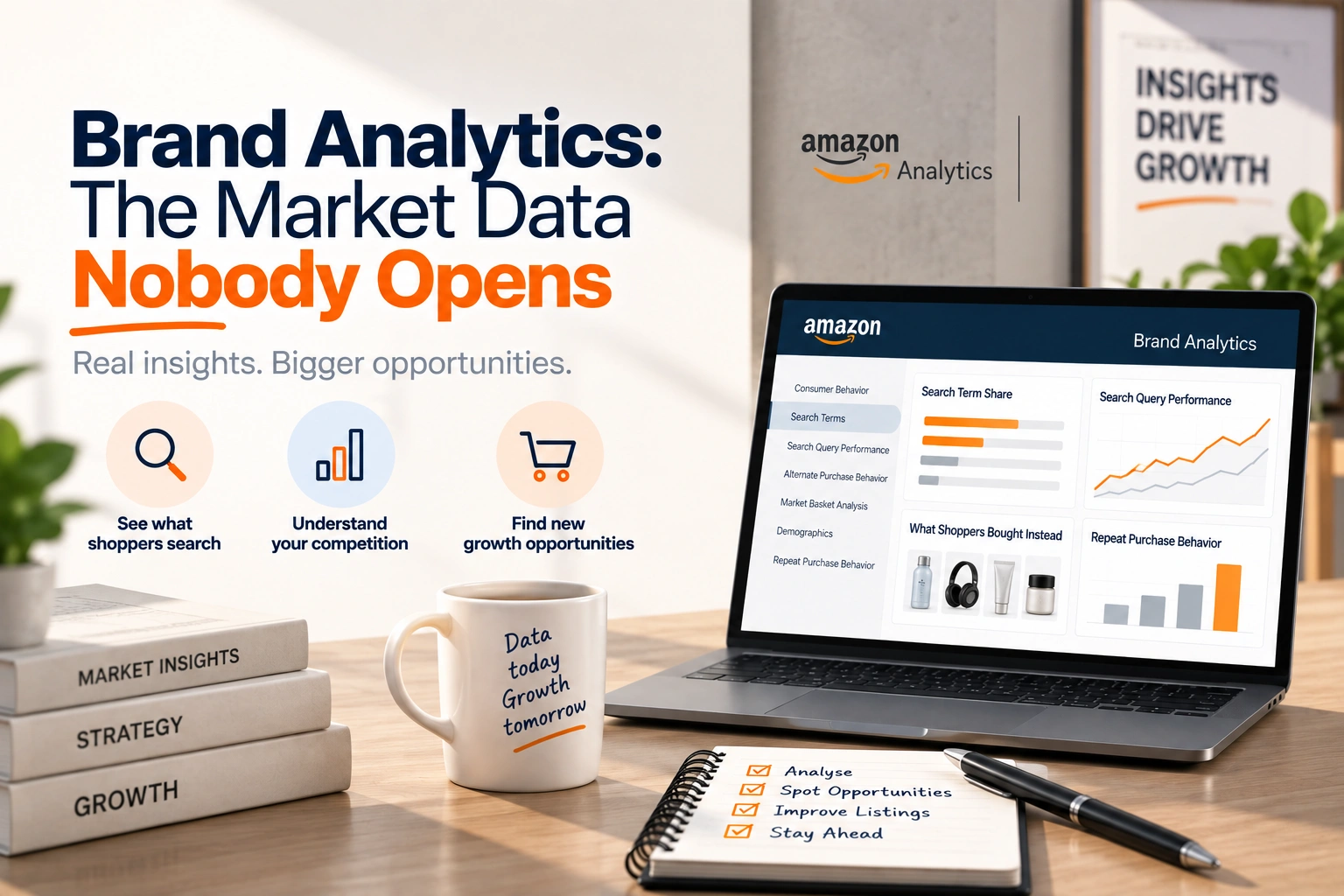
Every other report in Seller Central is about you. Brand analytics is about the market: what shoppers searched for, which listings they clicked, and which ones they bought.
It is available to brands enrolled in Brand Registry, it costs nothing, and in most accounts nobody has ever opened it.
Search term share
For a search term, the top clicked products and their share of clicks and of purchases. That is competitive intelligence Amazon gives to nobody else and sells to nobody at all.
Two things to do with it. First, find terms where you get clicks and not purchases: that gap is your listing or your price, not your ranking, and no amount of advertising fixes it. Second, find terms where a competitor takes most of the purchases and go and look at why their page is better.
Search query performance
The same idea from your own side: for each query, impressions, clicks, add to baskets and purchases, with your share of each.
It is the most direct answer to where the funnel breaks on a given term. Impressions without clicks is a title and a main image problem. Clicks without baskets is the page. Baskets without purchases is the price or the delivery promise.
What shoppers bought instead
The products people bought after viewing yours, and the ones they bought alongside it. The first is your real competitive set, which is often not the set you assumed.
The second is a bundling and advertising list. Products bought together are the obvious targets for sponsored placements on each other's pages, and sometimes for a bundle listing of their own.
Repeat purchase behaviour
How many customers came back, and how quickly. It is the only view of loyalty a marketplace seller gets, because you do not own the customer relationship.
For a consumable it is the number that decides whether the acquisition cost makes sense: paying above margin for a first order is a mistake on a one-off product and an investment on one people rebuy every six weeks. Nothing else in the console tells you which you have.
Demographics, and why to be careful with it
The report describing who bought is the one people find most interesting and act on worst. The samples behind it are often small, a lot of the fields are unreported, and a marketplace buyer is frequently not the person the product is for.
Use it to check an assumption, not to form one. If your whole creative direction assumed one audience and the data shows another, that is worth investigating properly rather than acting on directly.
What it does not tell you
Anything about a customer as a person you could contact. Amazon owns that relationship and brand analytics is aggregate by design, which is the standing argument for having somewhere of your own that people can buy from, as the store against marketplace question sets out.
The practical answer is to keep a channel where you do own it: a store of your own is the only place a marketplace seller can hold an email address and a repeat customer rather than a share figure.
It also says nothing about why. It will show that a competitor takes most of the purchases on your best term and it will not say whether that is the price, the images, the reviews or the delivery promise. That still comes from opening their page and reading it against yours.
How to use it without drowning
Once a month, three questions. Which terms give us clicks and no purchases. Which competitor is taking the purchases on our best term. And has repeat purchase moved.
Everything else is interesting. Those three change decisions, which is the difference.
What we do with this
Search term share is where we look first when a listing ranks and does not sell, because it separates a ranking problem from a page problem, and the fix for one does nothing for the other. It is part of how we read an keyword research.
It also decides what gets rebuilt: a page losing the purchase share on its own best term is a creative brief, not a bid adjustment.
If you are Brand Registry enrolled and have never opened it, there is usually a quarter's worth of decisions sitting in it.
Related reading: our Amazon SEO, listings and content service, Amazon Listing Optimization: What Actually Moves Rank and Adding Keywords to Amazon Listings Without Ruining Them.
Related reading: Amazon Backend Search Terms, and What Platinum Keywords Actually Are and A+ Content and Premium A+: What Each Is Worth.
Frequently asked questions
The questions that come up most often on this subject.
A set of reports available to brands enrolled in Brand Registry showing what the market did rather than what you did: search term share, what shoppers bought instead of you and alongside you, and repeat purchase behaviour.
Brands enrolled in Brand Registry, through Seller Central. It costs nothing extra, and in most accounts nobody has opened it, which makes it one of the cheapest advantages available.
For a given search term, the top clicked products and their share of clicks and purchases. It is the only view Amazon gives of how shoppers chose between you and the competition on a specific term.
The problem is after the click: the page, the price, the reviews or the delivery promise. It is not a ranking problem, and advertising more only buys more of the same clicks that were not converting.
The funnel for each query from your side: impressions, clicks, add to baskets and purchases with your share of each. It says exactly where the funnel breaks, which decides whether to change the image, the page or the price.
The report showing which products customers bought alongside yours. It is the practical list for bundle ideas and for sponsored placements on complementary pages, because those are purchases that already happen together.
It is the only view of loyalty a marketplace seller gets, and it decides what a first order is worth. Paying above margin to acquire a customer is a mistake on a one-off product and an investment on something people rebuy regularly.
Monthly, with three questions: which terms give clicks and no purchases, which competitor is taking purchase share on our best term, and has repeat purchase moved. Everything else is interesting rather than actionable.
No, it is periodic and it lags, so treat it as a monthly review rather than a dashboard. That is a good fit for what it is used for, which is deciding what to change rather than watching what is happening.
It shows share of clicks and purchases on a search term, not another seller's revenue. That is enough to know who is winning a term and by how much, which is the decision it exists to inform.