Amazon Vine in 2026: What It Costs, Who Qualifies and What It Does for a Launch
Vine is the one sanctioned way to put reviews on a listing that has none. The fee tiers, the eligibility, when Amazon charges and when it does not, and the launch plan that gets the most from thirty units.


Loading Article banner
A listing with no reviews converts at a fraction of one with twenty, and every other route to the first twenty is either slow or against the rules. Amazon Vine is the route Amazon built for exactly this: a seller gives units away, invited reviewers write what they think, and the listing has reviews before the first advertising dollar is spent.
It is also the one launch tool most sellers half understand. The fee is quoted wrongly in most places, the eligibility has a condition people miss, and the reviews that come back are not always the reviews people hoped for. This is the programme as Amazon publishes it on its Vine page for sellers, read on 20 September 2026, and the plan that gets the most out of it.
What Vine is
Amazon invites a pool of reviewers it calls Vine Voices, chosen on the helpfulness of reviews they have already written. A seller enrols a product, sets aside a number of units, and Vine Voices who want the product order it at no charge. Amazon ships the units from its own fulfilment network, which is why the product has to be on FBA, and the reviewer writes a review that carries a Vine badge. The seller pays an enrolment fee and the cost of the units, and has no say in who reviews, what they write, or whether they review at all.
That last part is the whole design. A Vine review is credible because the seller could not influence it, and Amazon treats any attempt to do so the way it treats any other review manipulation. The brand tools that come with Brand Registry are the frame Vine sits inside: it is offered to brands because a brand has something to lose.
Who qualifies, in Amazon's words
The seller needs "a Professional selling account and a Brand Representative or Reseller role assigned to a brand enrolled in Amazon Brand Registry, or have generic products in your catalog." So the unregistered reseller of somebody else's brand is out, and a brand that has not finished its registration is out until it has.
The product needs "a listing with FBA selected as the fulfillment method" and "fewer than 30 reviews on its product detail page." And three kinds of product are excluded outright: "adult, digital, and bundled products are not eligible for Vine." The review ceiling is the condition sellers miss. Vine is for a listing that is starting, not for one that is stalling at forty reviews and would like sixty.
What it costs, and when Amazon charges
The enrolment fee is tiered by the number of units enrolled per parent product: up to 2 units, $0; 3 to 10 units, $75; 11 to 30 units, $200. The fee is per parent, so a product with six colour variations enrolled together is one fee, not six, and the thirty unit ceiling is shared across the variations.
The timing matters more than the amount. In Amazon's words: "You aren't charged until 30 days after enrollment and after your first review is published. If you don't receive a Vine review within 90 days from the date of enrollment, you aren't charged." Two things follow. A product nobody orders costs nothing but the listing time. And the fee is not the real cost: thirty units given away, plus FBA fees on each of them, is the number to put in the launch budget, and on a product with a high unit cost the free tier of two units is a real option rather than a token one.
Amazon's claim for the programme is "up to 30 high-quality reviews." Up to. Sellers commonly report that a share of enrolled units are ordered and not reviewed, and that Vine reviews run more critical than organic ones, because the reviewer paid nothing and has no reason to be generous. Neither is stated by Amazon and both are worth planning for: a product with a known weakness will have it written down by somebody who noticed.
Where it fits in a launch
Amazon's own advice is on the same page: "we recommend enrolling in Vine and having your inventory available in our fulfillment network at least three weeks before your planned launch date." That is the sequence. Stock lands in FBA, the listing is complete, Vine is enrolled, and the reviews arrive while the campaigns are still being built, so the first advertising click lands on a page with social proof on it. The launch plan is the same one whether Vine is in it or not; Vine changes what the first week looks like, not what the first quarter needs.
It also fits beside the other launch incentive Amazon runs this year. A brand adding new ASINs may qualify for the New Selection programme, which includes Vine credits among its benefits, and the two are worth reading together before a launch is dated.
The four mistakes
Enrolling before the listing is finished. A Vine Voice reviews what is on the page and in the box on the day it arrives. A listing with placeholder images or a missing insert gets reviewed as that listing, and the review stays after the page is fixed.
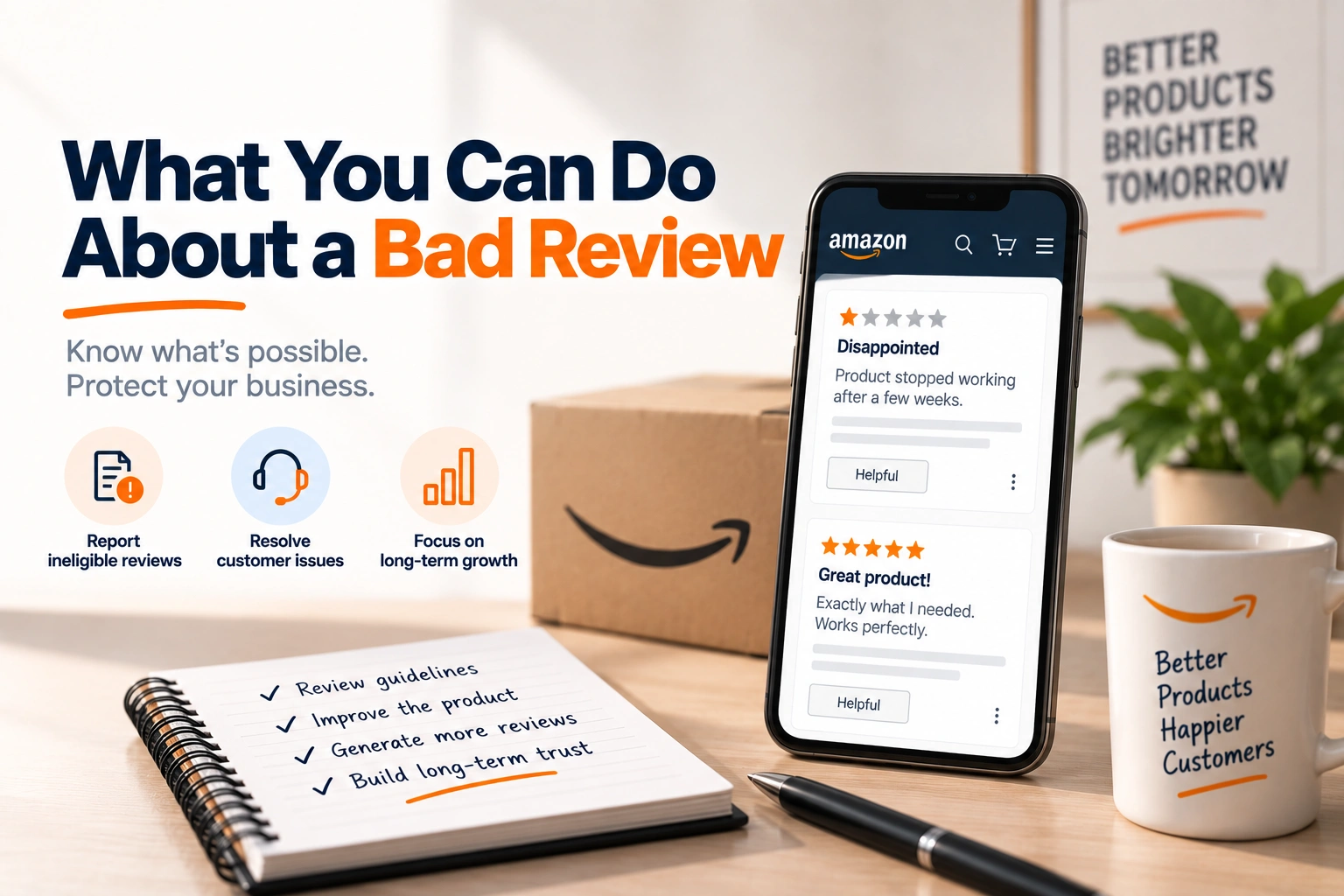
Enrolling thirty units of a product with a known fault. The fault is now in writing, with a badge. Fix the product, then enrol it. What can be done about a bad review is short, and a Vine review is not removable because it is unwelcome.
Treating Vine as the review strategy. It is the first twenty reviews, once. After that the listing earns reviews the way every listing does, through the request a review button, an insert that asks correctly, and a product that satisfies. The order to pull the levers has reviews near the top for a reason, and Vine is the lever for a listing that has none.
Leaving it out of the numbers. Thirty units, the FBA fees on them and the enrolment fee are a launch cost like the first month of advertising, and a business plan that has not counted them is short by exactly that amount in the month it can least afford it.
What we do with it
For a brand we run, Vine is scheduled into the launch calendar rather than remembered on the day: the listing is signed off, stock is confirmed in the network, the enrolment is made with the unit count the margin can carry, and the first campaigns are timed to go live as the reviews land. Where the first Vine reviews raise a fault, the product is fixed before the advertising scales, because a review that says the lid leaks is cheaper to read at unit thirty than at unit three thousand. That is the discipline our Amazon management applies to every launch, Vine or not.
Frequently asked questions
The questions that come up most often on this subject.
The enrolment fee is tiered by the units enrolled per parent product: up to 2 units is $0, 3 to 10 units is $75, and 11 to 30 units is $200. Amazon does not charge it until 30 days after enrolment and after the first review is published, and if no Vine review arrives within 90 days of enrolment the fee is not charged at all. The units themselves and the FBA fees on them are the larger cost.
A seller with a Professional selling account and a Brand Representative or Reseller role on a brand enrolled in Brand Registry, or with generic products in the catalogue. The product must be fulfilled by Amazon and have fewer than 30 reviews. Adult, digital and bundled products are not eligible.
Up to 30, which is the enrolment ceiling per parent product. Amazon's own wording is up to 30 high quality reviews. Sellers commonly report that some enrolled units are ordered without a review following, so thirty units enrolled is not thirty reviews guaranteed.
Only if it has fewer than 30. Vine is built for a listing at the start, not for adding reviews to an established one. A product at 30 or more reviews is not eligible however new the listing feels.
Amazon does not say so, and the reviewer is under no instruction either way. Sellers commonly report that Vine reviews run more critical than organic ones, which is consistent with a reviewer who paid nothing and has no reason to round up. The practical answer is to enrol a product that is ready, because whatever is wrong with it will be written down.