Amazon PPC Management: In-House vs Agency vs Software(2026)
In 2026, choosing between in-house management, an amazon advertising agency, or software is no longer a simple preference. It is a strategic decision based on resources, scalability, and the growing complexity of every online advertising platform.


Loading Article banner
In 2026, choosing between in-house management, an amazon advertising agency, or software is no longer a simple preference. It is a strategic decision based on resources, scalability, and the growing complexity of every online advertising platform. As Amazon USA evolves, brands need a structured, results-driven approach to Amazon PPC management. This approach should focus on profitability, visibility, and sustained growth.
Why Amazon Advertising Strategy Matters More Than Ever in 2026
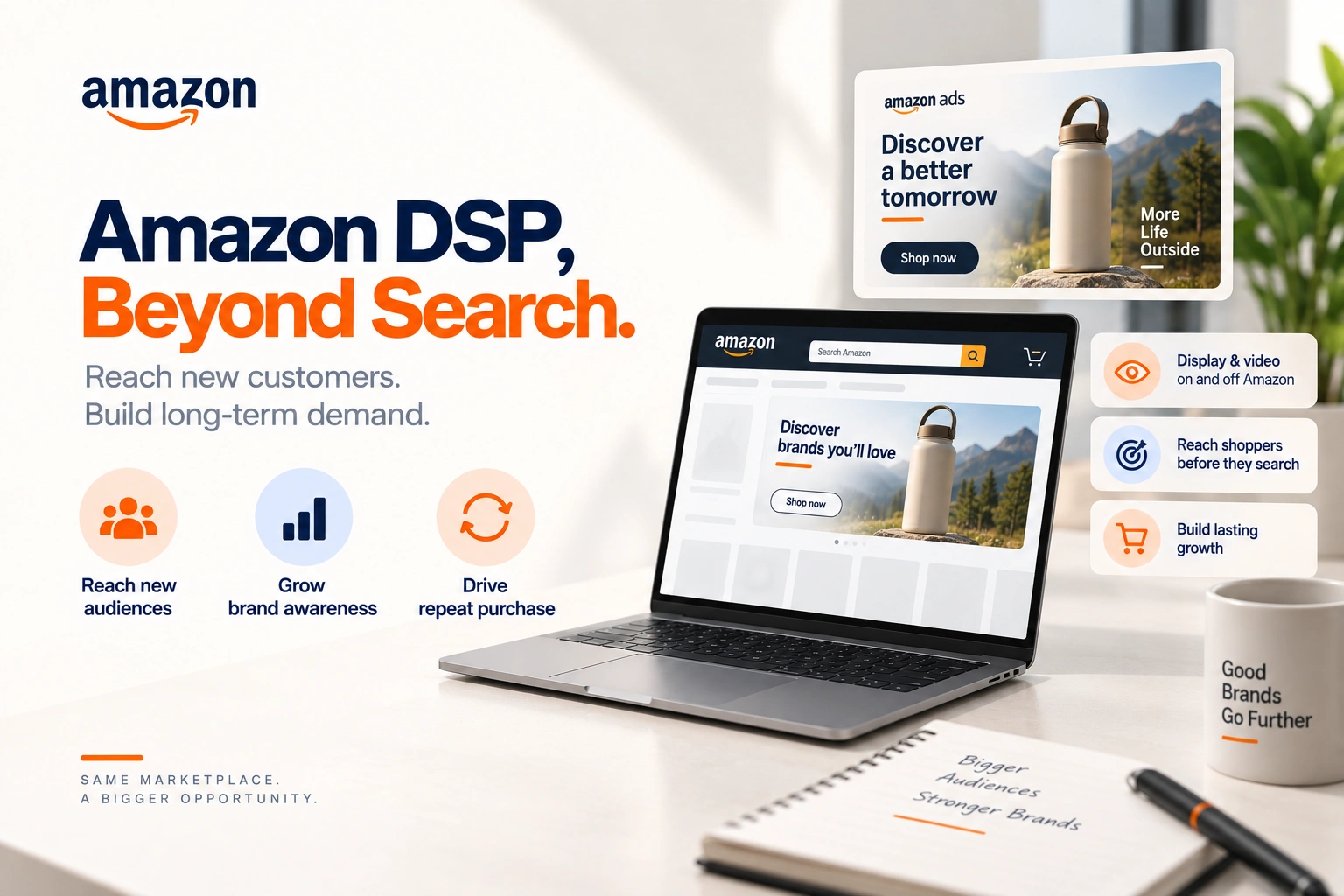
Amazon advertising is now more advanced. It offers many ad types, such as Sponsored Products, Sponsored Brands, Sponsored Display, and DSP. At the same time, brands are expanding beyond Amazon USA into additional platforms, increasing execution complexity.
Without a clear system, managing campaigns becomes inconsistent, which directly impacts performance and reduces overall amazon order volume. Success now depends on a disciplined optimization process. It also depends on aligning campaigns with business outcomes, not just traffic generation.
Key Factors to Consider Before Choosing Your Model
Before deciding between in-house, agency, or software, brands must evaluate their internal capacity, growth stage, and operational needs. Time, campaign complexity, and the ability to execute consistently help determine the right approach.
A model that looks cost-effective on paper can fail if the team cannot execute it properly. The focus should always be on building a system for long-term Amazon PPC success. Avoid putting immediate convenience first.
In-House Amazon PPC Management
When In-House Management Works Best
In-house management works well when brands can keep a steady optimization pace and have experts to manage complex campaigns. Businesses often explore amazon hiring to build dedicated teams, aiming for better control and faster decision-making.
Key Challenges of In-House Teams
The biggest risk is becoming overwhelmed by the increasing workload. Without proper systems and accountability, internal teams can slow down execution and limit growth potential.
Working with an Amazon Advertising Agency
Benefits of Hiring an Agency
Partnering with an amazon advertising agency provides immediate access to expertise, faster execution, and scalable campaign management. Agencies are helpful when internal teams are small. They are also useful when brands want to grow quickly on Amazon USA and other channels.
What Should Stay Internal
Even when working with an agency, brands should retain control over strategy, goals, and performance benchmarks. This ensures that Amazon PPC management aligns with business objectives rather than focusing only on operational activity.
Using Amazon Advertising Software
How Software Supports PPC Management
Advertising software helps reduce manual work and improves efficiency across any online advertising platform. It enables bulk operations, automated bidding, alerts, and consolidated reporting, allowing teams to focus on strategy instead of repetitive tasks.
Risks of Poor Adoption
The value of software depends on consistent usage. Many brands buy tools but do not use them in daily work. This limits their impact on Amazon PPC management.
The Hybrid Model: Best Approach for 2026
Why Hybrid Models Are Growing
Most top brands on Amazon USA use a hybrid approach. It mixes in-house ownership, outside agency support, and automation tools. This model balances control with scalability, making it easier to manage complex advertising operations.
How Hybrid Improves Performance
By combining expertise, technology, and structured workflows, brands can maintain consistent optimization while scaling efficiently. This directly improves Amazon order volume, profitability, and brand visibility.
Common Mistakes Brands Make in Amazon PPC Management
Many brands struggle not because of the model they choose, but because of poor execution. A lack of consistent optimization can waste ad spend.
- The organization doesn’t clearly define accountability.
- An excessive dependence on tools exists.
- A unified strategy is absent.
Another common mistake is focusing only on traffic instead of outcomes. In 2026, strong Amazon PPC management links to profit, conversion rates, and steady order growth, not vanity metrics.
How to Build a Scalable Amazon Advertising System
To succeed on a competitive online advertising platform like Amazon USA, brands need a plan for steady growth. They should build a system they can use consistently. This system should also be able to scale over time.
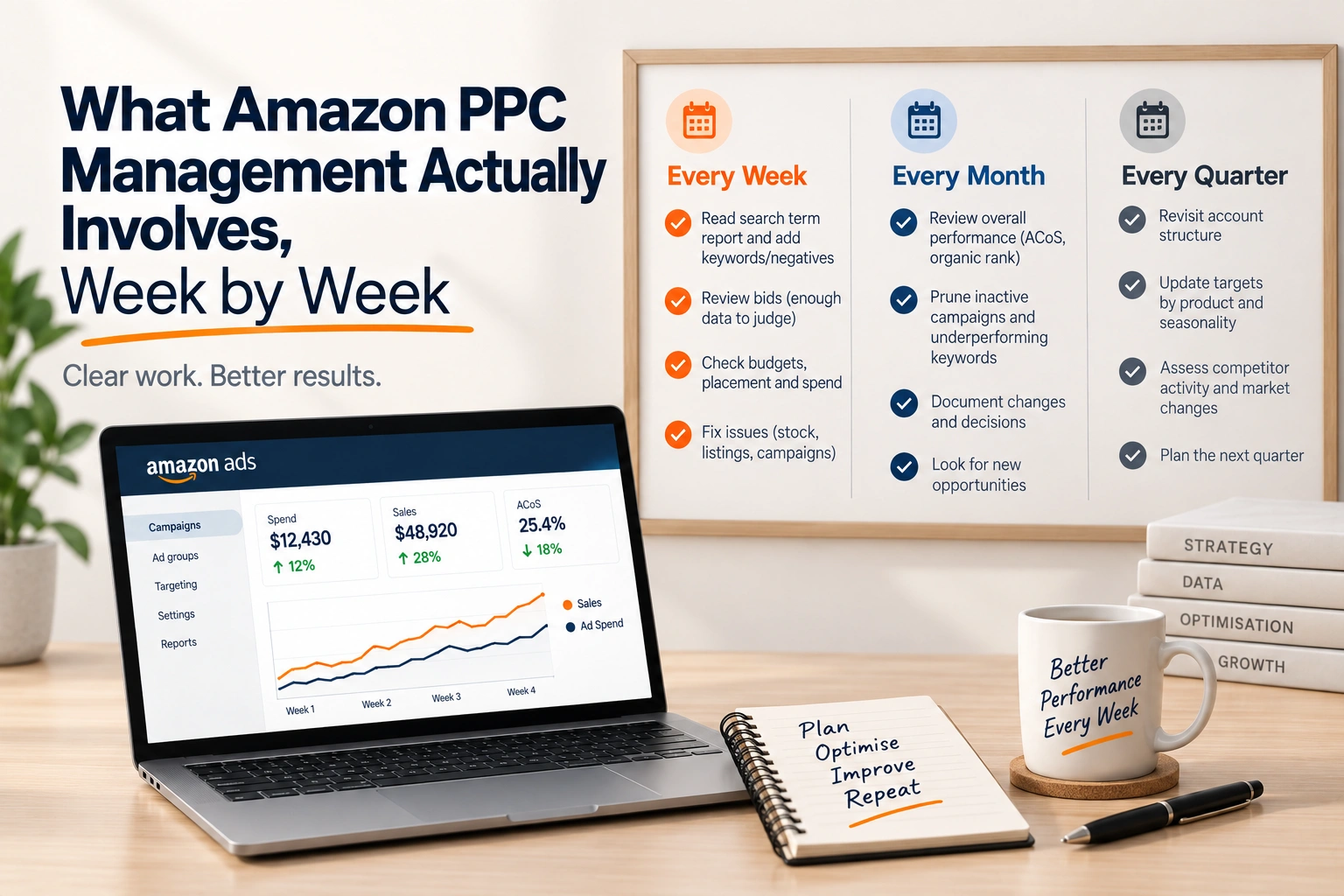
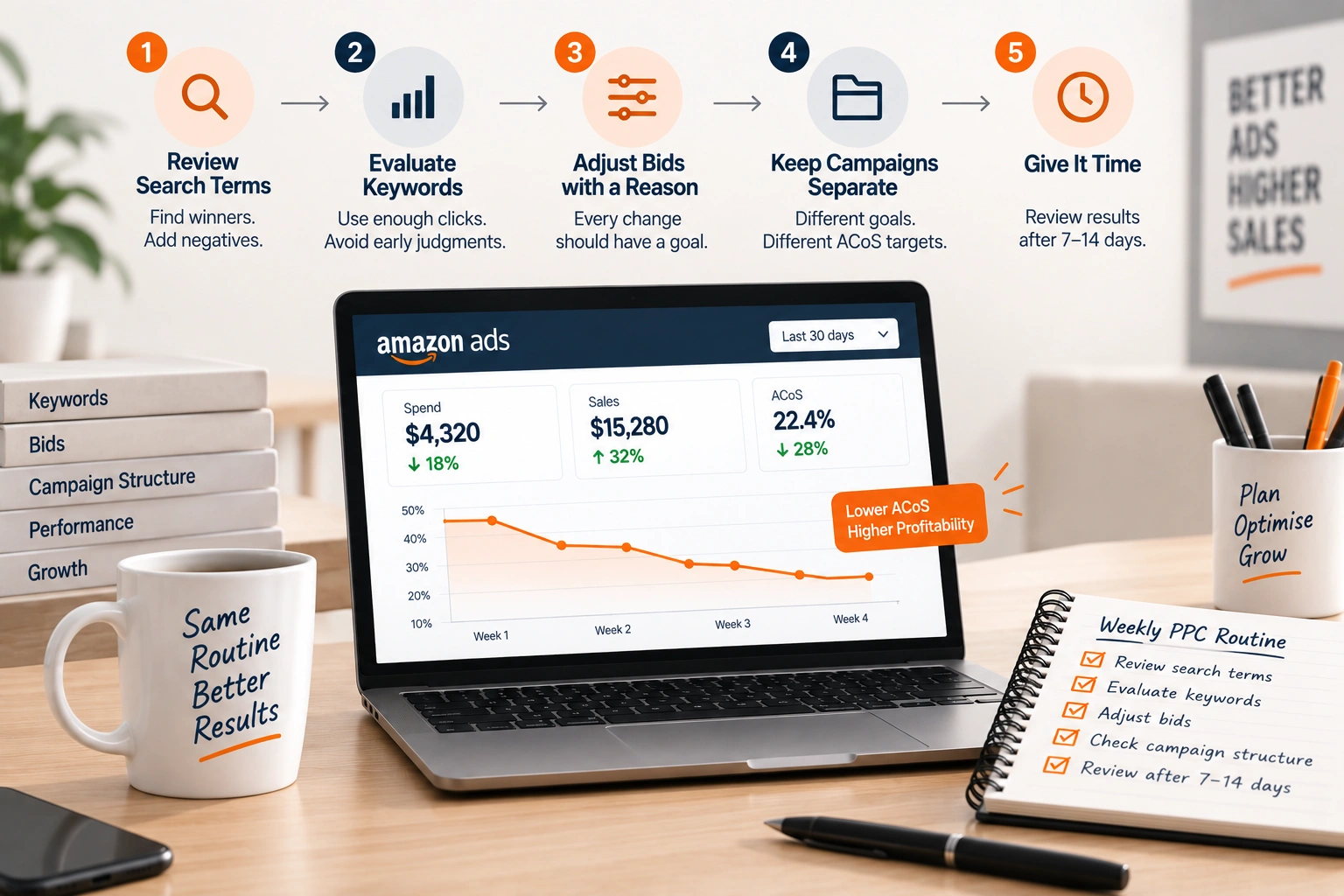
This includes defining clear ownership of tasks, maintaining a weekly optimization cadence, and aligning reporting with business outcome. A structured approach ensures that campaigns are continuously improving rather than reacting to short-term fluctuations.
ROAS Standards for Amazon PPC , TikTok Shop Advertising, and Walmart Connect: Goals to Aim for in 2026
As advertising expands across multiple platforms, understanding ROAS benchmarks has become essential for evaluating performance. On Amazon USA, strong Amazon PPC management aims for a balanced ROAS. It supports both profit and growth, not just short-term returns.
For TikTok Shop advertising, ROAS expectations may initially be lower because of audience testing and creative experimentation, but improve as data accumulates. Walmart Connect, on the other hand, often delivers stable but moderate returns, making it a valuable secondary online advertising platform for diversification.
The key in 2026 is not comparing platforms directly, but aligning ROAS targets with each channel’s role in your growth strategy. Brands succeed when they integrate these platforms into one system. This ensures steady optimization and measurable impact on Amazon order volume and total revenue.
Five signs the account has outgrown software
The comparison above is not usually where people get stuck. What is hard is knowing which week you crossed from one model being right to another. These are the five signs, in the order they normally appear.
You are overriding the tool most weeks. Rule based software is excellent while the rules hold. The moment somebody is regularly stepping in to stop it doing something sensible but wrong, the rules have stopped describing the situation. One override a month is a tool working; one a week is a person doing the thinking and paying a subscription for the privilege of typing it in afterwards.
The question has become why rather than what. Software is very good at what happened: spend, sales, ACoS, which keywords moved, instantly and accurately. It is not built to answer why ACoS rose in September, whether that was seasonality or a competitor, and what to do about it. When the questions in the weekly meeting have all become that kind, a dashboard is not the thing that is missing.
Several products want different things at once. One product launching, one mature and defending, one being wound down. Each wants a different target and a different response to the same signal, and a single set of automation rules across all three will be wrong for at least two. The moment the account holds three stages, the judgement load rises faster than the spend.
Nobody has read the search term report in a month. Not because anybody is lazy, but because it is the first thing to fall off the list when whoever runs the account also runs three other things. It is also the highest value hour in the week and the cheapest work available. An account where it has stopped happening is not being managed, whatever the software is doing overnight.
The cost of a mistake has outgrown the cost of advice. Early on, a bad month costs a few hundred and teaches you something. Later, a bad quarter in the run up to the busiest season costs more than a year of anybody's fee. That is the crossover, and it usually arrives before people notice, because the fee is a visible number and the mistake is not.
What you are buying from an agency, and how to tell a good arrangement from an expensive one
Not effort. The mechanical work should be automated whoever does it. What you are buying is judgement, and having seen the same situation on other accounts before: whether a rise is seasonal or structural, whether a competitor is testing or committed, whether a launch is failing or simply early. Those are pattern questions, and patterns come from a volume of cases rather than a volume of data.
Ask what the monthly report contains. If it is numbers, you are buying a dashboard with a person reading it out. If it contains decisions, what changed, why, what was learned and what happens next, you are buying the thing that is worth paying for. And ask what is automated: an agency doing by hand what software does in a second is charging for hours rather than judgement.
How to Choose the Right Model for Your Business
The right choice depends on your internal capacity, growth stage, and operational complexity. Instead of focusing on preference, brands should evaluate their ability to maintain execution consistency, manage workload, and achieve measurable outcomes.
In 2026, systems, not just strategies, define success in Amazon PPC management. Whether you rely on amazon hiring, partner with an amazon advertising agency, or leverage automation tools, the goal remains the same: build a scalable framework that turns advertising efforts into real business growth and increased amazon order performance
What we do with this
Which of the three is right changes with account size, and it changes back. The work all three are trying to cover is the same, and it is described in how Amazon pay per click works; when the answer is an agency, that work is part of Amazon advertising management.
Keep reading
Frequently asked questions
The questions that come up most often on this subject.