Amazon PPC Automation: When Manual Management Stops Working
Manual Amazon PPC does not fail suddenly. It fails as the account generates more decisions each week than anybody has hours to make.


Loading Article banner

Manual Amazon PPC management does not fail suddenly. It fails gradually, as the number of campaigns, keywords and products grows past the number of hours anybody has to look at them. The work does not get harder; there is simply more of it than fits in a week.
This is the point at which most brands start losing money quietly. Bids stay where they were set, search terms go unread, and the account keeps running on decisions made when it was a third of the size. What follows is how to tell you have reached that point, what to hand over first, and how to keep control of the parts that still need judgement.
How to tell manual management has stopped working
These are the seven signs, in the order they usually appear. Two or three of them is a workload problem. Five is an account that is being managed by whatever there was time for.
1. PPC takes twenty to thirty hours a week. Monitoring, keyword updates and bid adjustments multiply as the account grows. Effort rises and returns do not, which is the clearest signal that the work has outgrown the method rather than the person.
2. Search terms are reviewed weekly or less. The search term report is where the account tells you what people actually typed. Read once a week, most of what it says has already stopped being true, and the negatives that should have been added are three days late.
3. Bids go unchanged for weeks. Amazon's auction moves constantly. A bid that was right a month ago is now either overpaying or invisible, and there is no way to tell which without looking.
4. Manual process is being defended rather than chosen. Familiarity is not performance. If the reason for doing it by hand is that it has always been done by hand, that is a reason to look at the results rather than at the method.
5. Launches get whatever attention is left. A launch needs concentrated work in a narrow window, and it is the first thing squeezed when the routine work fills the week. The cost is ranking that never arrives, which is expensive for a long time afterwards. A launch has a structure of its own and it does not survive being fitted around everything else.
6. The strategy is clear and the execution is not. Knowing which keywords to push and not having got to it is not a strategy problem. It is a capacity problem wearing a strategy problem's clothes.
7. The platform is adding formats faster than they can be learned. New ad types and targeting options arrive whether or not there is time to evaluate them, so the account drifts toward whatever was set up first.
Why it breaks at scale rather than at a size
There is no account size at which manual management stops working. What matters is the number of decisions the account generates each week against the number anybody has time to make.
A catalogue of twenty products across three campaign types with four match groups is already several hundred bid decisions a week before a single new keyword is harvested. Double the catalogue and the decisions do not double, they compound, because every product interacts with the ones beside it in the same auctions.
That is why the failure is quiet. Nothing breaks. The account simply stops being optimised and starts being maintained, and the difference between those two takes a quarter to show up in the numbers.
What to automate first, and what to keep
Automation is not one decision. Some of this work is mechanical and should never have been manual; some of it is judgement and should never be automated. Getting that line right matters more than which tool is used.
Automate the collecting. Pulling search term reports, formatting them, flagging what crossed a threshold. This is the largest share of the twenty to thirty hours and none of it requires a decision.
Automate the watching. Noticing a campaign that has spent its budget by noon, a keyword whose cost per click has doubled, a listing that has lost the Buy Box and is still being advertised. A person should be told, not be the one checking.
Automate bids inside limits somebody set. Adjustments within a range, against a target that was chosen deliberately. The range is the judgement; moving within it is not.
Keep the account's purpose. What each campaign is for, which products are being defended and which are being pushed, and what an acceptable cost looks like this quarter. Nothing can infer that, and a system optimising toward a target nobody chose will hit it.
Keep the structure. How campaigns are split decides what every later decision is able to see. It is the one thing that is expensive to get wrong and cheap to get right at the start. The relationship between automatic and manual campaigns is a structural choice, not a setting.
Keep reading the search terms. Not the flagging, which is mechanical, but the reading. New phrasing, a competitor's product name appearing, a use case nobody had thought of: those are found by a person or not at all.
Three limits that make automated bidding safe
Bid adjustment is genuinely automatable and it is where the damage happens, because a rule applied to thin data is confident about noise. Three limits make it safe. A minimum number of clicks before a keyword may be adjusted at all. A ceiling no rule may bid above. A maximum change per adjustment, so nothing doubles overnight. Without those, an automation will eventually find a keyword that converted once at four dollars a click and decide that four dollars is the price.
Negatives can be automated on the same terms. A search term that is plainly a different product can be negated automatically once it has spent enough with nothing to show for it. A term that is plausibly relevant should not be, because the reason it is not converting may be your price, your images or a stock out, and negating it hides a problem rather than fixing it.
The test before you automate anything
Would you be comfortable if this ran for a month while you were away? If yes, automate it. If the honest answer is that you would want to check, then what you want is an alert, not an action. Accounts that get this backwards do not fail loudly. They keep running, keep reporting, and quietly get very efficient at doing the wrong thing.
Does this mean giving up control
No, and the fear is worth addressing directly because it is the usual reason for staying manual too long.
Automation applies rules somebody wrote, within limits somebody set, against targets somebody chose. Control moves from making every adjustment to deciding what the adjustments are for. That is more control over the account, exercised less often, which is what anybody managing at scale actually wants.
What genuinely loses control is a system nobody has looked at in a month. The rules need reviewing, and the review is a real task in the week rather than a thing that happens by itself.
When it stops being a tooling question
There is a point at which more automation stops helping, and it is recognisable: the tool is being overridden most weeks, several products want different things at once, and the questions have turned from what to do into why the account behaves the way it does.
That is a judgement problem rather than a capacity problem, and it is where software stops being the answer. The comparison between running it in house, buying software and hiring help is a real decision with real trade-offs, and it is set out in full in the in-house, agency and software comparison.
How to tell whether it worked
Hours saved is the wrong measure on its own, because hours can be saved by simply doing less. Three numbers, read together a month later, say whether the account is better run rather than just less work.
Wasted spend. Money on search terms that produced no order, as a share of total spend. This is the number automation should move first, because it is what goes unnoticed when nobody has read the report.
Time to a decision. How long between a search term appearing and something being done about it. Weekly manual review makes this three or four days on average. It should now be hours.
Spread of attention. How many products got a deliberate change this month, against how many are being advertised. Manual management concentrates on whatever is loudest; the rest of the catalogue quietly runs on old settings.
If wasted spend has not moved after a month, the rules are wrong rather than the approach. That is worth saying because the usual response is to automate more, and more of a rule that is not working produces the same result faster.
Where to start this week
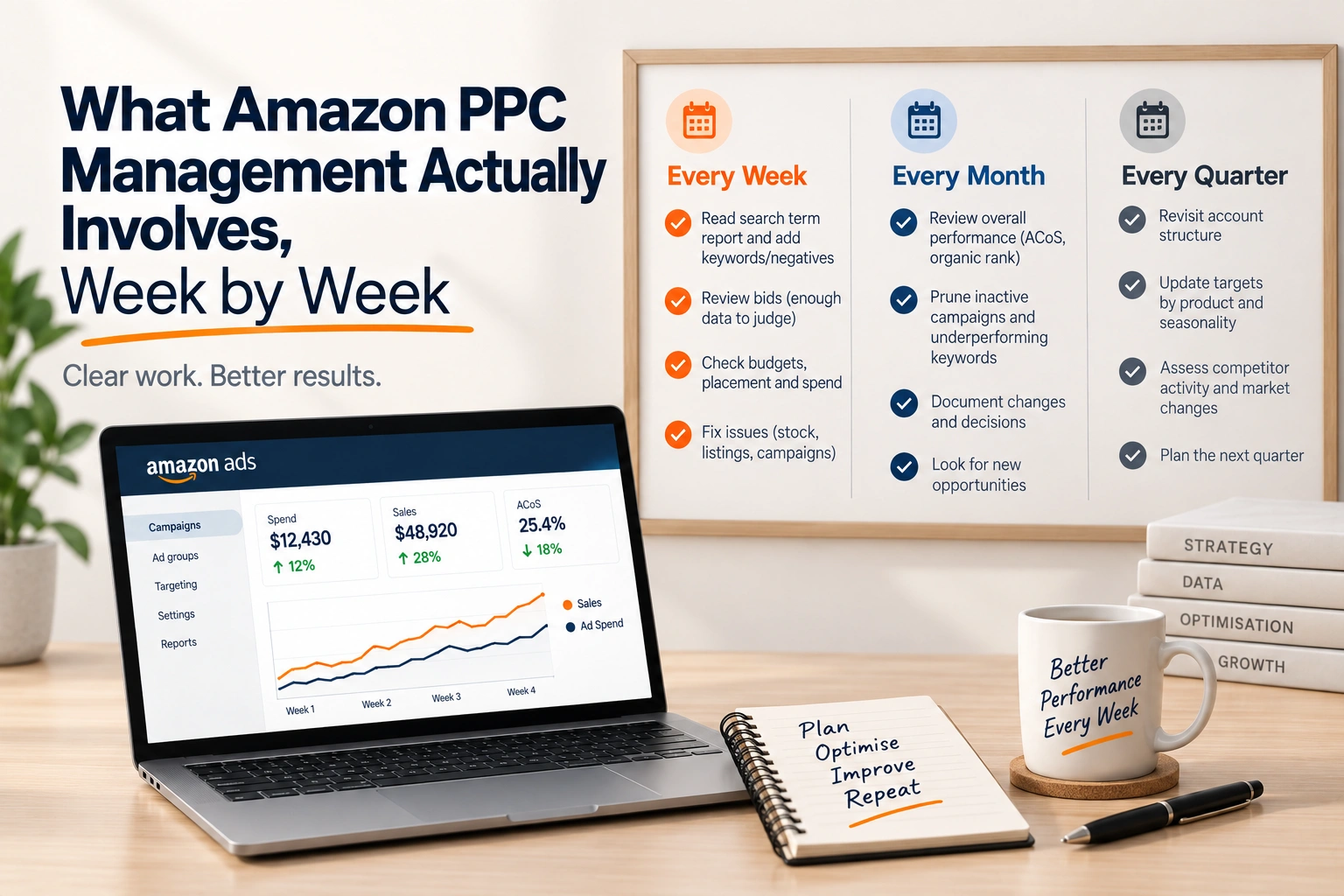
Count the hours honestly for one week, including the ones spent thinking about it. Then take the two most mechanical tasks on the list, usually report pulling and threshold flagging, and remove them. That is most of the time back for the least risk.
Only then look at bidding, and only with a written target and a written range. An account that is being optimised toward a number nobody agreed is not better off for being optimised faster. If the wider account needs work before any of this pays, the strategy layer comes first.
What we do with this
We take the mechanical work away first and leave the judgement where it is, which is the opposite order to the one automation is usually sold in. What that mechanical work actually consists of is in how Amazon pay per click works, and taking it off somebody's week is part of Amazon advertising management.
Related reading: our Amazon PPC service page.
Frequently asked questions
The questions that come up most often on this subject.