What Amazon PPC Management Actually Involves, Week by Week
Everybody sells Amazon PPC management and almost nobody says what the work is. Here is the actual list, so you can judge whether a price is fair.


Loading Article banner
Amazon PPC management is sold everywhere and described almost nowhere. The pitch is usually a promise about ACoS and a monthly fee, which leaves you comparing two numbers with no idea what either of them buys.
So here is the work itself. Not a methodology, just the list of things that have to happen for an account to keep improving, and roughly how often each one is due.
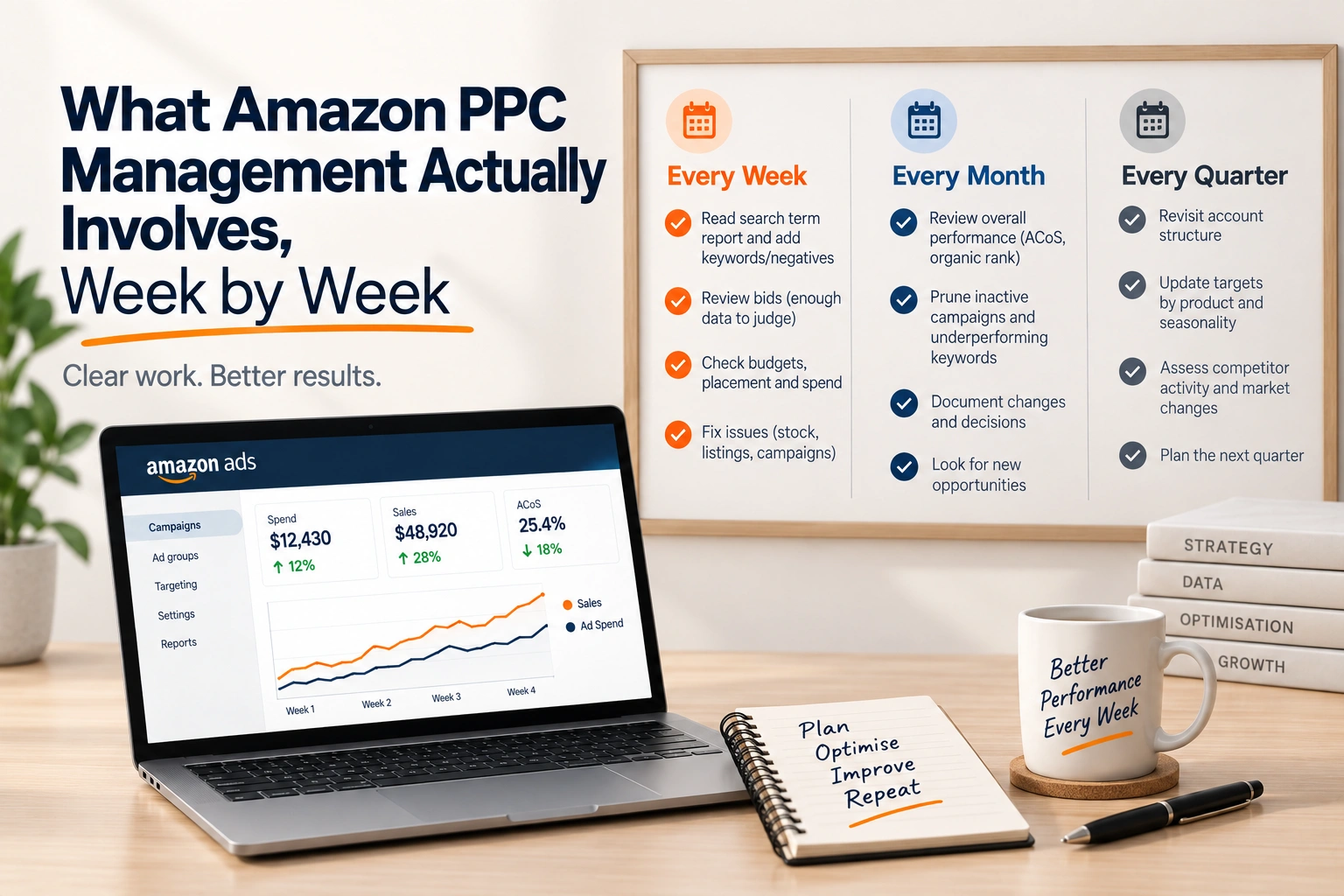
Every week
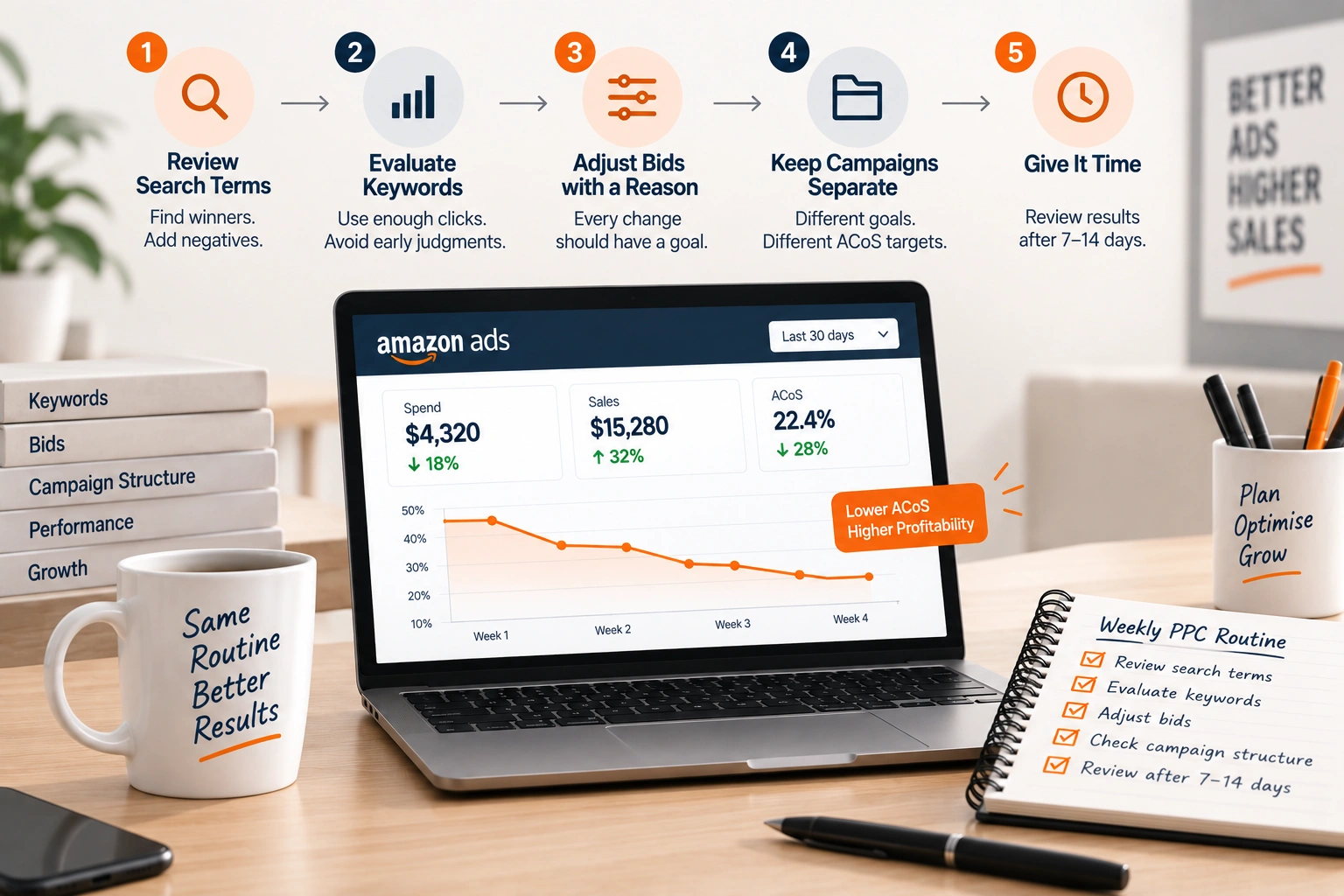
Read the search term report and act on it. Terms that convert become their own keywords. Terms that spend without converting become negatives. Terms belonging to a different product become negatives immediately. This single pass usually recovers more wasted spend than anything else on the list.
Review bids on keywords with enough clicks to have earned a judgement, and leave the rest alone. Check which campaigns are limited by budget and which are limited by bid, because those need opposite responses.
Check nothing has broken. A suspended listing, an out of stock variation, a campaign that ended, a budget that ran out at nine in the morning. None of this is clever work and all of it costs money when it is missed.
The order matters as much as the list, and we set it out in the weekly optimization routine.
Every month
Look at the whole account rather than the campaigns. Is total advertising cost of sale moving in the right direction? Is organic rank improving on the terms you are paying for, which is the return that does not show in ACoS?
Prune. Campaigns that made sense in March and have not spent since. Keywords that have had two hundred clicks and four sales. Ad groups holding one product that went out of stock in June.
Then write down what changed and why, in words. A report of numbers with no decisions in it tells you what happened and nothing about whether anybody was steering.
Every quarter
Revisit the structure. Products get added, seasonality shifts, competitors change what they bid on. A structure that was right in January quietly stops being right, and the symptom is campaigns that neither fail nor improve.
Revisit the targets too. A product that has finished launching should not still be running at launch ACoS, and one entering its season may deserve to run above target on purpose.
What that adds up to
One to three hours a week for most accounts, plus a few hours a month and a longer session each quarter. Catalogue size is less of a factor than you would expect. What actually drives the hours is how much of the collecting and formatting is manual, which is why the same account takes one team an hour and another most of a morning.
That number is the one to hold a price against. A fee far below the hours is buying you a report, and a fee far above them should come with something specific in return.
Doing it yourself, hiring it out, or buying software
All three are reasonable and each is genuinely better in different circumstances. The tradeoffs, including the account sizes where each stops making sense, are in in house versus agency versus software.
The thing to notice in that comparison is which parts of the list above are judgement and which are mechanical. The mechanical parts are the ones worth removing first, whoever ends up doing the rest. We wrote about what that recovers in reclaiming twenty hours a week.
What we do with this
Every item on the list above is either judgement or mechanics, and which it is decides who should be doing it. The vocabulary the list assumes is in how Amazon pay per click works, and doing the whole list on somebody's behalf is what Amazon advertising management means in practice.
Related reading: our Amazon PPC service page.
Frequently asked questions
The questions that come up most often on this subject.
Most agencies charge either a monthly retainer or a percentage of ad spend, commonly somewhere between ten and twenty percent. The useful question is not the rate but what is included, because the work below takes a known number of hours and a price far under that is buying you a monthly report.
One to three for most accounts, done by hand. Catalogue size matters less than how much of the reporting and switching is manual, which is why the same account can take one specialist an hour and another most of a morning.
Spend, sales, ACoS and total ACoS, the changes made and why, what was learned from the search term report, and what happens next month. A report that only contains numbers is a statement, not management.
Revisit the structure and the targets. Products get added, seasons shift and competitors change what they bid on, so a structure that was right in January quietly stops being right; the symptom is campaigns that neither fail nor improve. A product that has finished launching should no longer run at launch ACoS, and one entering its season may deserve to run above target on purpose.