Amazon DSP, and Whether You Are Ready for It
Sponsored Products advertises to people already searching. DSP advertises to people who are not, which is a different job, a different budget and a different way of being judged.


Loading Article banner
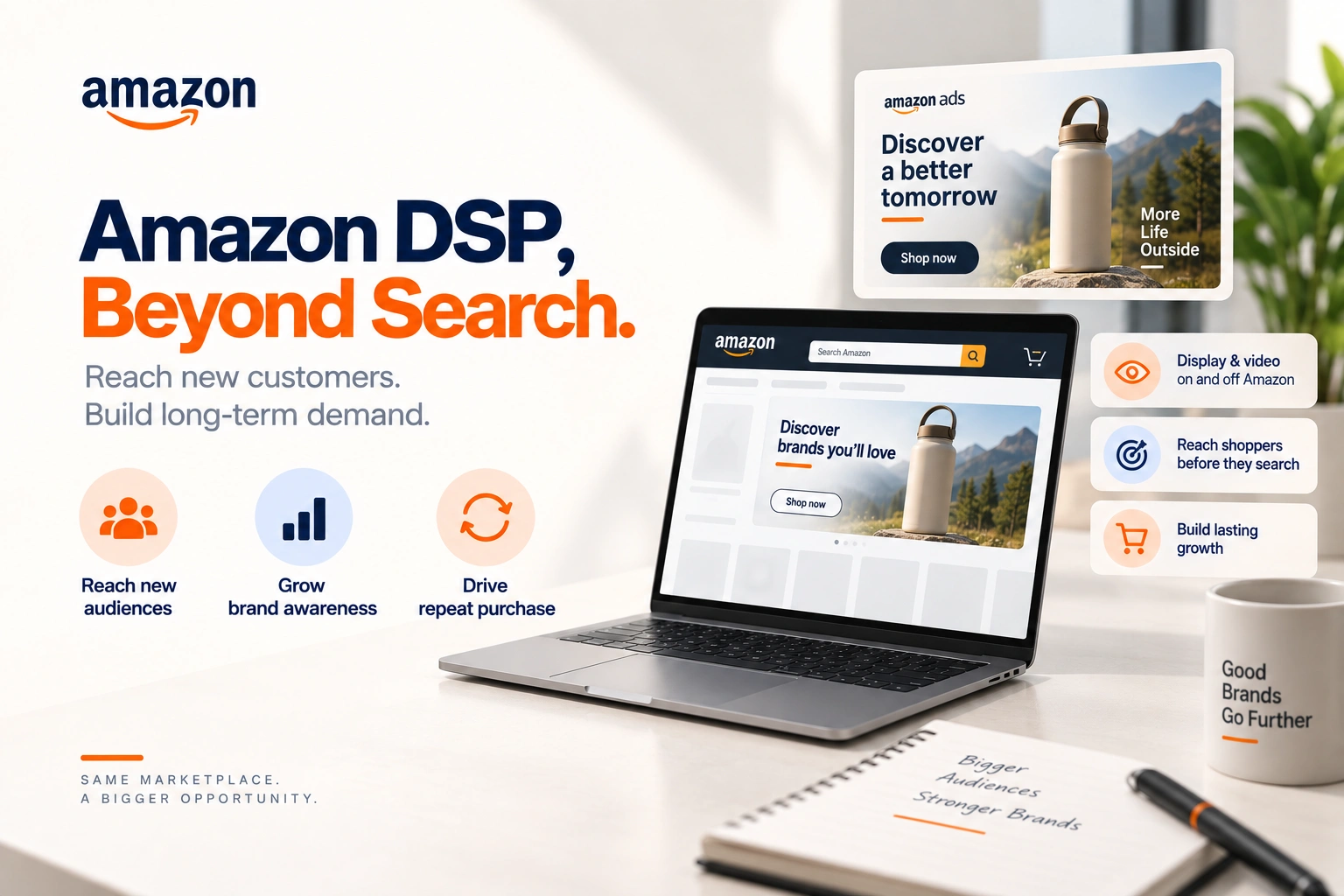
Sponsored Products works because somebody typed something. The intent arrives before the advertisement does, which is why it is the most forgiving advertising most brands will ever run: a mediocre campaign against a good listing still makes money because the shopper was already looking.
Amazon DSP is the opposite arrangement. It buys display and video placements aimed at audiences, on and off Amazon, and almost nobody it reaches is searching for anything at that moment. The intent has to be created or anticipated rather than captured, which changes what the advertising is for and how long it takes to tell whether it worked.
What it can target that search advertising cannot
The audiences are built from Amazon's own shopping signals, which is the part no other platform can match. People who viewed a product and did not buy. People who bought a competitor's product. People who bought yours eleven months ago and are due. People in a category who have never bought from you.
That first one, retargeting a viewer, is where most brands start and where most of the early return comes from. Somebody who reached a product page and left is the cheapest person to bring back, and Sponsored Products cannot reach them again unless they search again.
The last one is the one that justifies the budget in the long run and takes the longest to prove: reaching a category buyer who has never heard of the brand. That is prospecting, it is measured in months, and it is the reason DSP exists rather than a bonus on top of retargeting.
What it costs to start
More than Sponsored Products, and in a different shape. Sponsored Products can be run with any budget: a campaign with twenty dollars a day is a real campaign and it will teach you something. DSP is bought in larger commitments, historically through a managed service with a minimum spend, and self service access is not universally available.
The practical consequence is that DSP cannot be tested cheaply the way search advertising can. A brand cannot spend a little, decide it is inconclusive and stop, because a little is not enough to reach a conclusion. That makes readiness the important question rather than curiosity.
Judging it, when the sale happens days later
This is where most DSP disappointment comes from, and it is a measurement problem rather than a performance one. Somebody sees a display advertisement, does not click, and buys three days later after searching for the product by name. Search advertising takes the credit, DSP looks like it did nothing, and the brand concludes it does not work.
So DSP is judged on view through attribution and on a longer window, which is a genuinely different standard from the same day return on ad spend a search campaign is held to. It is also a standard that is easier to fool yourself with, in both directions, which is why the useful measure is what happened to total sales and to the branded search volume rather than to the campaign's own reported return.
The same trap exists inside search advertising, where a campaign's reported return can look excellent while cannibalising organic sales. We have written about that in what performance marketing looks like beyond PPC, and the reasoning transfers directly.
Performance+, Brand+ and the Ads Agent
Two things have changed since DSP meant a managed buy with a large minimum. In March 2025 Amazon Ads made two automated campaign types available in the DSP "globally for all advertisers." Brand+ is for advertisers who want to "Build long-term brand awareness and foster engagement over time." Performance+ is for those who want to "Accelerate immediate conversions (cost per acquisition (CPA), return on ad spend (ROAS))." In both, the advertiser sets the goal, the budget, the inventory preferences, brand safety and suppression lists, and Amazon's models choose the audiences and the bids from its own signals.
Amazon's evidence for them is advertiser-provided: it cites PepsiCo at "4X ROAS (prospecting), 2X ROAS (remarketing)" from "Advertiser-provided data, PepsiCo, Global, 2024." Read that as one large advertiser's result, not a benchmark for a brand with one category and a launch budget.
The second change is the console itself. At unBoxed in November 2025 Amazon Ads introduced the Ads Agent, "an AI-powered advertising tool that transforms campaign management and optimization," which "pre-drafts audience strategies based on campaign settings and helps users maximize Amazon Marketing Cloud's analytics capabilities through intuitive, natural-language queries." Amazon's DSP page now describes the DSP as part of that agent, "available to both advertisers who sell on Amazon and those who do not," with self-service and managed-service routes, and says of the change that "Your campaigns, audiences, and reporting continue without disruption."
For a brand weighing DSP, the practical effect is that the first campaign no longer has to be a managed buy at a managed minimum: Performance+ with a conversion goal and a modest budget is a way to learn whether programmatic reaches shoppers the sponsored ads do not, before committing more. The judgement below, about when the sale happens days later and when it is too early, applies to the automated campaigns exactly as it does to the rest.
When it is too early
Three tests, and failing any of them means the money is better spent elsewhere.
The listings have to convert. DSP sends traffic to the same product pages everything else does, and a page that does not convert search traffic will not convert display traffic either. It will convert it worse, because the display visitor arrived with less intent. A campaign that spends without converting is almost never an advertising problem, which is covered in why a campaign spends without converting.
Search advertising has to be saturated first. If there are still profitable search terms with budget constraints on them, that money returns faster there. DSP is what you buy when the intent that already exists has been bought and the constraint is that not enough people are searching.
And the catalogue has to be worth retaining. DSP's best economics come from repeat purchase and from range, because the audiences are built on what people bought before. A single product with no repeat cycle has the least to gain.
How it sits with everything else
The mistake is treating DSP as another campaign type in the same account, competing for the same budget on the same terms. It is a different layer: search advertising harvests the demand that exists, DSP creates and recovers it, and the two are judged over different periods.
Run together the interaction is visible and useful. Prospecting that works shows up as more branded search, which then gets harvested cheaply by search campaigns, which look better as a result. Reading either in isolation misses that entirely, and the account level view is the only one that shows it. How Amazon SEO and PPC feed each other makes the same point about the organic side.
Getting the sequencing right, and knowing when the search side is genuinely saturated, is most of the judgement here. It is the kind of decision that sits inside Amazon account management rather than inside any one campaign.
Frequently asked questions
The questions that come up most often on this subject.
Sponsored Products advertises to people who are searching, so the intent arrives before the advertisement does. DSP buys display and video placements aimed at audiences, on and off Amazon, and almost nobody it reaches is searching at that moment. That changes what the advertising is for and how long it takes to judge.
Effectively yes, and it is materially larger than Sponsored Products. DSP has historically been bought through a managed service with a spend commitment, and self service access is not universally available. The practical consequence is that it cannot be tested cheaply the way search advertising can.
Usually because of attribution rather than performance. Somebody sees a display advertisement, does not click, and buys days later after searching by name, so the search campaign takes the credit. DSP is judged on view through attribution over a longer window, and the honest measure is what happened to total sales and branded search rather than the campaign's own reported return.
When the listings do not convert search traffic, because display traffic arrives with less intent and will convert worse. When there are still profitable search terms held back by budget, because that money returns faster. And when the catalogue has no repeat purchase or range, because DSP's best economics come from audiences built on what people bought before.
Two automated campaign types Amazon Ads made available in the DSP globally in March 2025. Performance+ is for immediate conversions, measured on cost per acquisition and return on ad spend; Brand+ is for long-term awareness and engagement. The advertiser sets the goal, budget and guardrails, and Amazon's models choose audiences and bids.