How a DesignRush Ranking Is Put Together, and How to Read One
A directory gives you an order, and the order is built from five factors an agency mostly supplies itself. What DesignRush ranks on, why its star ratings are smoothed, what Verified covers, and the five checks to run before a shortlist.


Loading Article banner
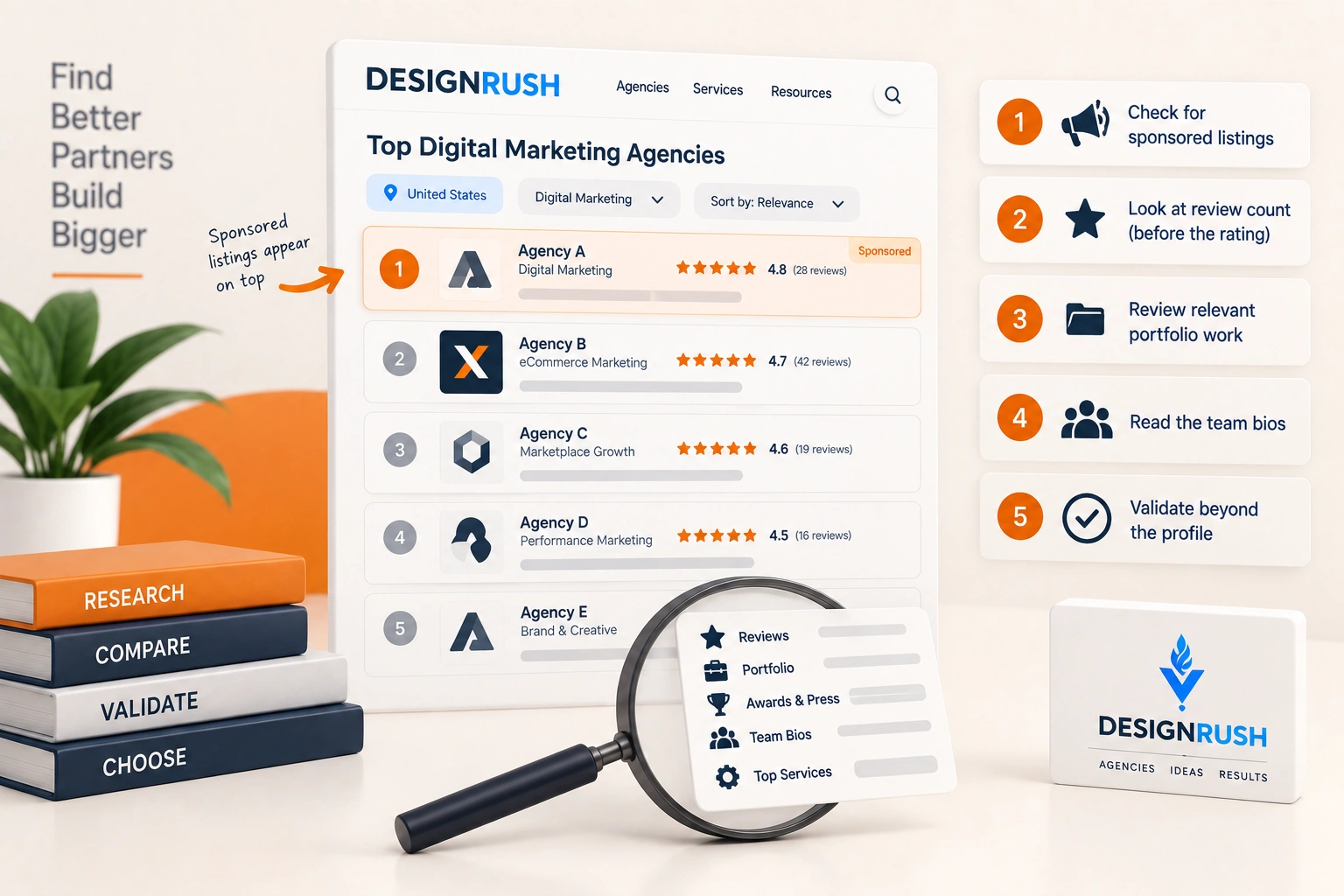
A shortlist usually begins on a directory, and a directory hands you something a review page does not: an order. Ten agencies, numbered, most of them saying the same six adjectives. DesignRush describes itself as "the premier agency directory, awards platform, and media hub", and the ordered list is the thing people act on, usually without asking what put it in that order.
It is worth asking, because the answer is published. What follows is from DesignRush's own category and methodology pages, read on 22 September 2026, and it changes how the list should be used.
What the order on a list actually is
DesignRush says the ranking is "established on a Base Score consisting of many factors", and names five as the most important: reviews, portfolio, awards and press, team bios, and top services. Four of those five are things an agency puts on its own profile.
That is not a criticism, it is the thing to understand. A high position rewards a complete profile as much as a good one: an agency with its portfolio linked to real work, its team named, its services declared and its reviews collected will sit above an agency that has done the same work and filled in half a page. Read a top position as "this agency has shown its working", not as "this agency is better than the one below it".
There is also a second kind of placement. The category page states that "Sponsored listings pay for a placement that appears above organic positions" and, in the same breath, that "Sponsorship does not affect star ratings or review content". Both halves matter. A paid slot buys the top of the page and nothing else, so the first row on a list may be an advertisement and the rating beside it is still the rating everybody else gets.
The star rating is smoothed, on purpose
The most useful thing on the methodology page is the rating calculation, because it explains a number that otherwise looks wrong. DesignRush says it considers "the overall distribution of ratings for each agency using the Bayesian Statistical Method", which "will prevent skewed or inflated agency scores by adding a 3.5-star rating to all profile reviews as a smoothing baseline factor".
In plain terms: every agency starts with an invisible 3.5 star review attached, and real reviews pull the average away from it. Three perfect reviews cannot produce a 5.0, because the baseline is still in the average. Forty perfect reviews nearly can, because forty outweigh one.
So a 4.7 from a long list of reviews is a stronger signal than a 5.0 from three, and on this platform the 5.0 from three will not even be displayed as a 5.0. If you have been mentally ranking directories by who has the most perfect scores, this is the platform where that habit misleads you least.
What Verified means here
DesignRush publishes more of its verification than most directories do. It says reviewers are authorised "through their LinkedIn profile, which ensures authenticity and reliability", that it may "verify reviewers via email or call to complete our legitimacy check", and that reviews "undergo a stringent verification process: evaluating the reviewer and fact-checking any claims made".
A Verified badge on an agency is a separate thing from a verified review. The badge says the DesignRush team has checked the company is what it says it is. It says nothing about whether the company has done your particular job, and no directory badge ever does.
Category is the whole context, and it is easy to miss
A DesignRush list is always a list of something: a service, and usually a country with it. Our own entry is in the digital marketing category, and that is a broad room. It contains brand agencies, performance agencies, content shops and marketplace operators, ranked against each other as though they competed for the same brief.
They do not. An agency that runs paid social for consumer brands and an agency that runs an Amazon and Walmart operation are both digital marketing agencies and are not substitutes. Before comparing positions on a list, compare the services declared on the profiles: DesignRush's own ranking uses "top services" as a factor, which means an agency has told you, on the record, what it wants to be judged on.
The five checks, in order
One: ignore the first row until you have checked whether it is sponsored, then judge it on the same terms as the rest. Two: open the portfolio links rather than counting them, and look for work in your channel, on your marketplace, at your size. Three: read the review count before the star rating, because the rating is smoothed and the count is what moves it. Four: read the team bios, since the ranking rewards naming people and naming people is what lets you ask who will run your account. Five: leave the directory and ask the agency for something no profile contains, which is what happened on an account that went wrong.
That last one is the whole exercise compressed, and it is the same on every directory. A profile is what an agency chose to publish. The interesting question is what happened afterwards.
Where we sit on it
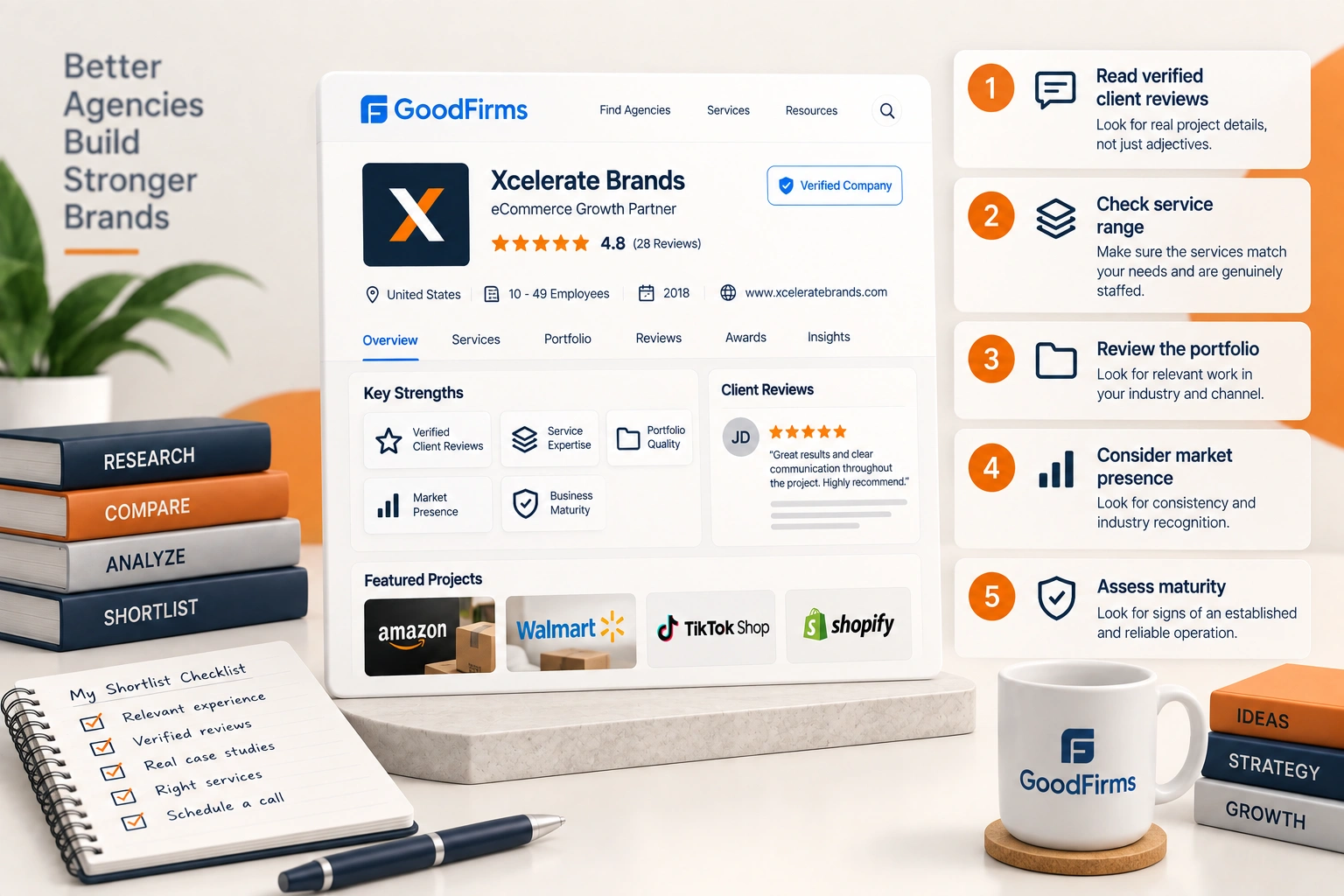
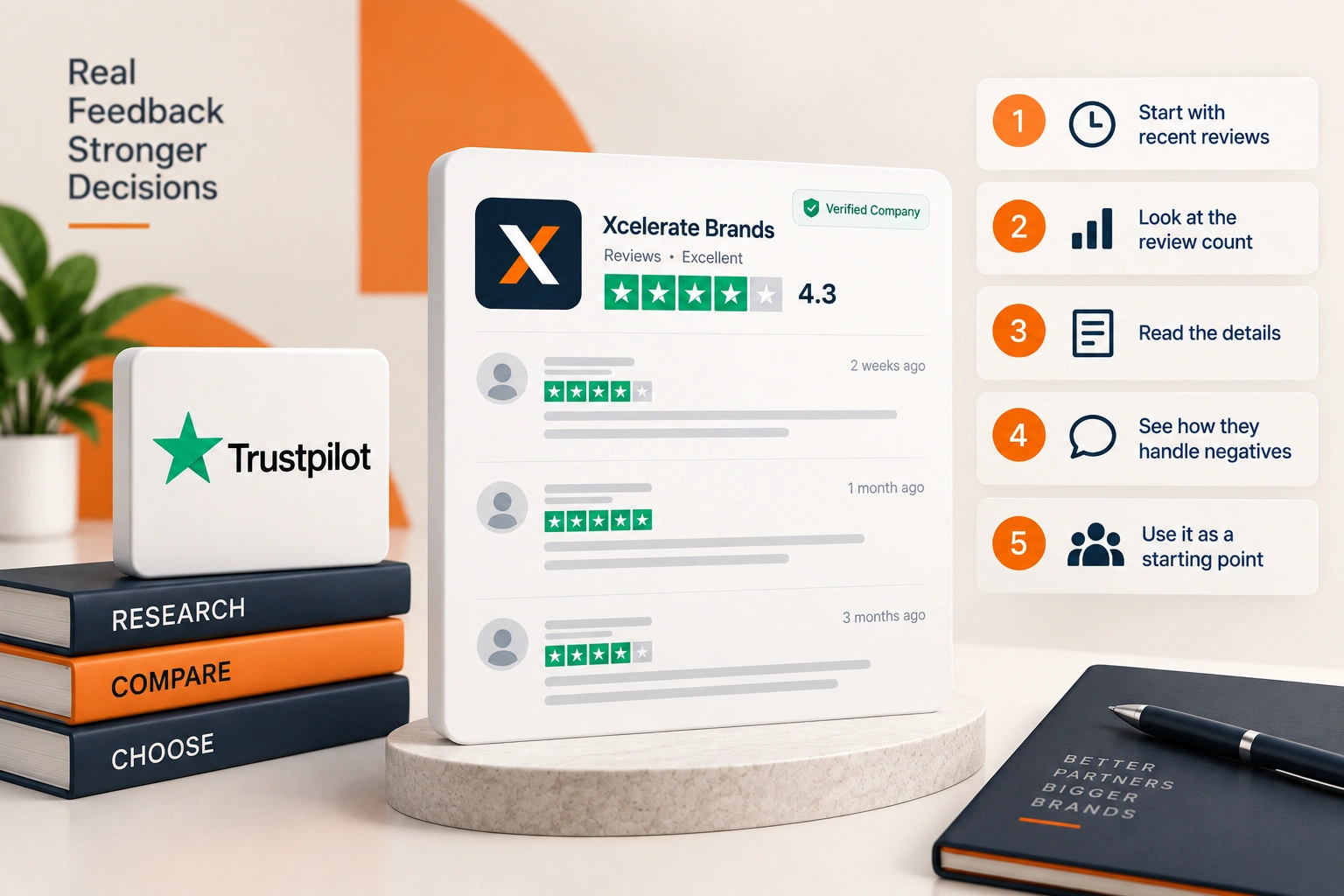
Our own profile is at designrush.com/agency/profile/xcelerate-brands, and everything above applies to reading it: check the services declared, open the work, read the review count, then ask the question the profile cannot answer. We are listed on four other platforms as well, and each rewards a different kind of reading. Clutch is built around project details, Trustpilot around a single score with a distribution under it, GoodFirms around a research methodology, and a Google Business Profile around proximity.
If what you are weighing up is marketplace management across Amazon, Walmart, eBay, TikTok Shop and Shopify, the list is a way to build a shortlist and a poor way to finish one. The full guide to choosing an agency covers the rest of it: the contract, the reporting, the access, and the questions that separate an agency that manages an account from one that reports on it.
Frequently asked questions
The questions that come up most often on this subject.