Carrier Shipping Adjustments on Amazon Buy Shipping: Why You Were Charged and How to Dispute
Months after the label, a line appears in the transaction view: USPS assessed shipping correction charges. What an adjustment is, the reasons Amazon lists, where to see each one, what a dispute needs, and the measuring routine that stops most of them.


Loading Article banner
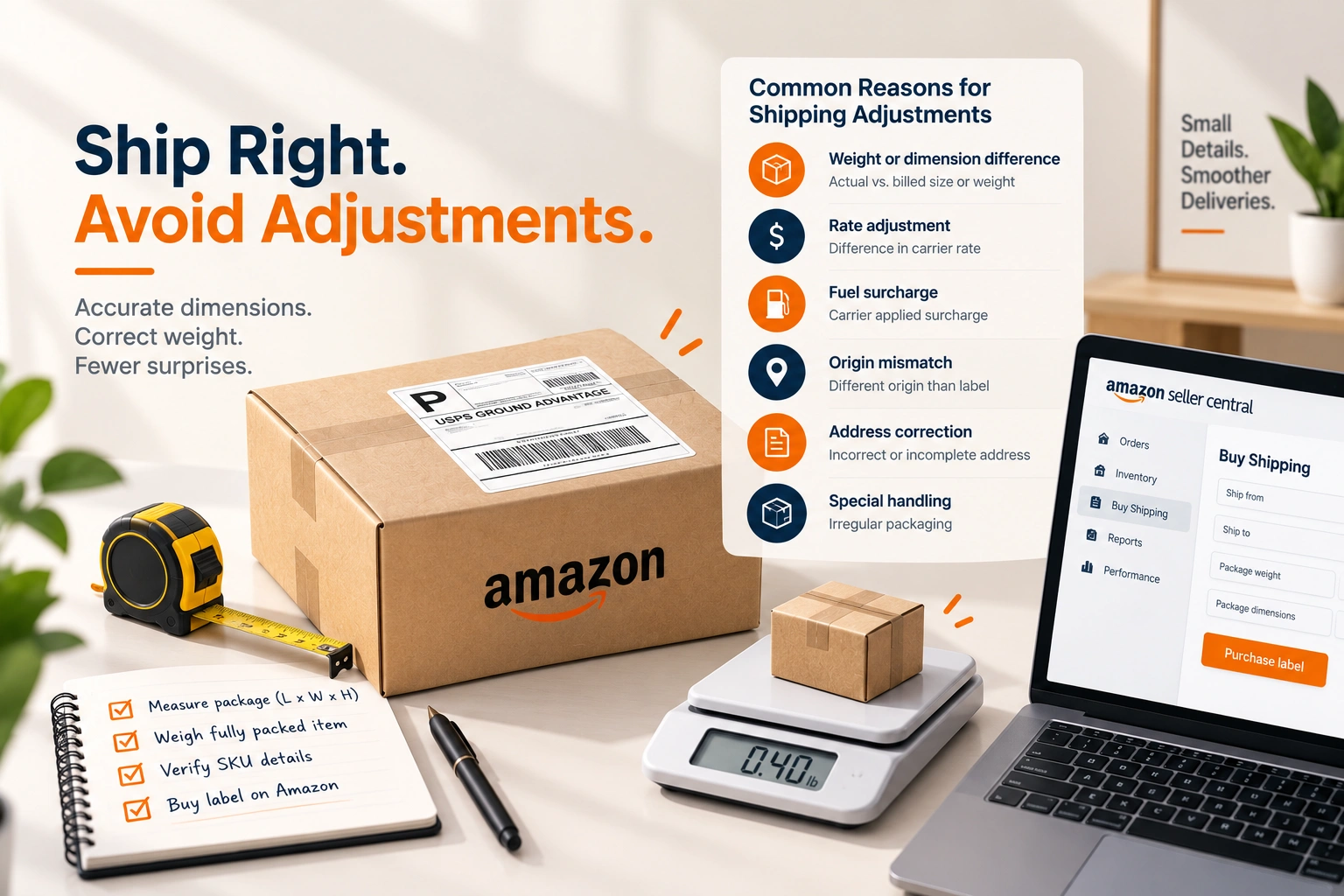
The email says: USPS assessed shipping correction charges totaling 19.92 on Fulfilled by Merchant labels you purchased on Buy Shipping between 01/01/2026 and 03/31/2026. The seller who posted it ships a flat seven by five inch mailer that weighs four ounces, every time, with no returns and no address changes, and the thread under it ran to a hundred and forty replies: one seller at $112.18, one at $174 for labels six months old, one at fifty adjustments in a year. Those figures are theirs. The mechanism behind them is Amazon's, and it is documented.
This is what an adjustment is, why it appears when it does, where to read each one, what a dispute needs to contain, and the routine at the packing bench that prevents most of them.
What an adjustment is
Amazon's own guide on the subject puts it plainly: an adjustment is a charge applied after shipment when the carrier finds a difference between the information on the label and the package it handled, and Amazon passes the carrier's charge to the seller. It can apply to an outbound label or a return label, and the carriers audit in batches, which is why the charges arrive weeks or months after the label and why one email covers a quarter.
The reasons Amazon lists, in the order they occur: a difference in dimensions or weight, which is the most common; a rate adjustment; a fuel surcharge; a difference between the origin on the label and where the package actually entered the network; an address correction fee, most often on returns; and special handling for irregular packaging. Dimensional weight is inside the first reason. A carrier charges the greater of actual weight and the weight its formula assigns to the box's volume, and a light item in a large box is billed for the box.
Where to see each one
Every adjustment sits in the payments transaction view. Amazon's path is Transaction View, then Transaction Type: Shipping Services, then Product Details: Adjustments. Each adjustment links to the order ID it belongs to, and the detail shows what the carrier billed against what the label declared. The email that announces a batch gives the total; the transaction view gives the lines, and the lines are what a dispute is built from.
Read them before disputing anything. A seller in the thread who ships one mailer at one weight and still sees a charge is looking at one of the other reasons, and the line says which. An address correction on a return is not a measuring error; a fuel surcharge is not disputable at all; a dimension difference on a package that was measured at the bench is the one worth the case.
What a dispute needs
Disputes go to Seller Support, and Amazon's guide says what works: photographs of the packed parcel on a scale showing the weight and against a tape showing the dimensions, with the order ID and the adjustment line. A dispute without evidence is a request to take the seller's word against the carrier's scanner, and it fails. The one exception in the guide is FedEx Ground Economy, formerly SmartPost, where the claim goes to FedEx directly and the seller's name and address on the claim have to match the shipper information on the label.
Sellers in the thread describe the process as more effort than the refund is worth, and for a single $3 line it is. For a pattern it is not. Fifty adjustments in a year on one package type is one dispute with fifty order IDs attached and one set of photographs, and it is also the signal that the declared dimensions on that SKU are wrong in the system. The routine for a support case that gets read is in the Seller Support cases article; the money side is the same work as FBA reimbursements, which is why we run both under cost recovery.
The routine that prevents them
Amazon's prevention list is short and it is the whole answer for the dimension and weight reason. Measure and weigh the package fully packed, not the product: the manufacturer's dimensions describe the item or the inner box, and the carrier measures the outer one with the packing in it. Round each dimension up to the next whole inch. Check the SKU's stored attributes, because Buy Shipping fills the label from them and a SKU entered as seven by five by one with a mailer that puffs to two inches is a dimensional weight adjustment every time it ships. Check the entries before buying the label.
Two carrier specifics from the same guide. UPS bills a minimum of ninety pounds for a shipment it classes as oversize, so a large, light parcel is billed as ninety pounds whatever the scale says. FedEx One Rate has maximums of fifty pounds and 2,200 cubic inches, and a package over either is repriced. Cubic pricing on USPS works the other way, in the seller's favour, when the box is small enough to qualify, and a mailer that is measured honestly often costs less than one that is guessed.
When it is not the package
One explanation in the thread, from a seller who had read their adjustment lines carefully, was that the negotiated rate was not applied at all: the label was priced at the discounted rate Amazon offers, the carrier billed the retail rate, and the difference came back as an adjustment. That is a rate adjustment in Amazon's list, and it is not something a tape measure fixes. The tell is an adjustment line whose billed dimensions and weight match the label exactly; the dispute for that one names the rate, not the package.
The threads end, every time, with someone asking whether to stop using Buy Shipping. The answer we give clients is no for the orders where it matters: a label bought through Buy Shipping with tracking uploaded on time is what protects an order against an item not received claim, and the fee stack that decision sits inside is in Amazon seller fees explained. Buy the label, measure the package, read the lines, and dispute the pattern.
Frequently asked questions
The questions that come up most often on this subject.
Carriers audit packages in batches and bill the differences after the fact, and Amazon passes the charge through when it arrives. One email covers a period, often a quarter, and each line in the transaction view links to the order it belongs to.
In the payments transaction view: Transaction Type: Shipping Services, then Product Details: Adjustments. Each line links to its order ID and shows what the carrier billed against what the label declared.
Open a case with Seller Support with the order ID, the adjustment line, and photographs of the packed parcel on a scale and against a tape. FedEx Ground Economy claims go to FedEx directly, with the seller's name and address matching the label. Group a pattern into one case rather than fifty.
Carriers bill the greater of the actual weight and a weight assigned to the package's volume. A light item in a large or puffed package is billed for the volume, and a label bought against the item's weight is adjusted to the package's.
No. A Buy Shipping label with tracking uploaded on time protects the order against item not received claims, which is worth more than the adjustments. Measure the packed parcel, store the real dimensions on the SKU, round up to the inch, and dispute patterns with photographs.
Because the carrier audits the parcel after it ships and Amazon passes the charge through when the carrier assesses it, which can land in a later settlement than the order. In September 2026 sellers on the Seller Forums reported USPS correction charges for labels bought between 1 January and 31 March, applied between 7 and 10 September, with the notice naming the same three causes Amazon lists: a weight or dimensions that did not match the label, or a return address that was wrong or invalid. The order is still the evidence: open it in Transaction View, filter Shipping services purchased through Amazon, and search Adjustment to see the carrier's audited figures against the label.
Amazon's moderators have said there is no fixed deadline, but that the information gets harder to reach as time passes. Dispute while the order, the label and a photo of the packed parcel on a scale and beside a tape are still to hand, and send them with the case to Seller Support; a dispute with no photo is a request the carrier can refuse on its own audit.
No. A rate change applies at purchase, to the price you see on the label. An adjustment is the difference between what the label said and what the carrier's audit found: weight, dimensions, service or return address. If every parcel is the same size and the same weight and the charges still arrive, dispute them with one photo set that shows it; several sellers reported dozens in a year on identical mailers, and that pattern is the case to put to Seller Support rather than a reason to stop buying labels.