Amazon's Frequently Returned Item Badge: How It Is Set, Why Your Numbers Differ, and How to Lose It
Amazon sets the Frequently returned item label by comparing an ASIN's return rate with similar products in its category, over a window tied to when units shipped. How Amazon's moderators describe the calculation, why sellers' figures rarely match it, and the listing and product work that brings the rate down.


Loading Article banner
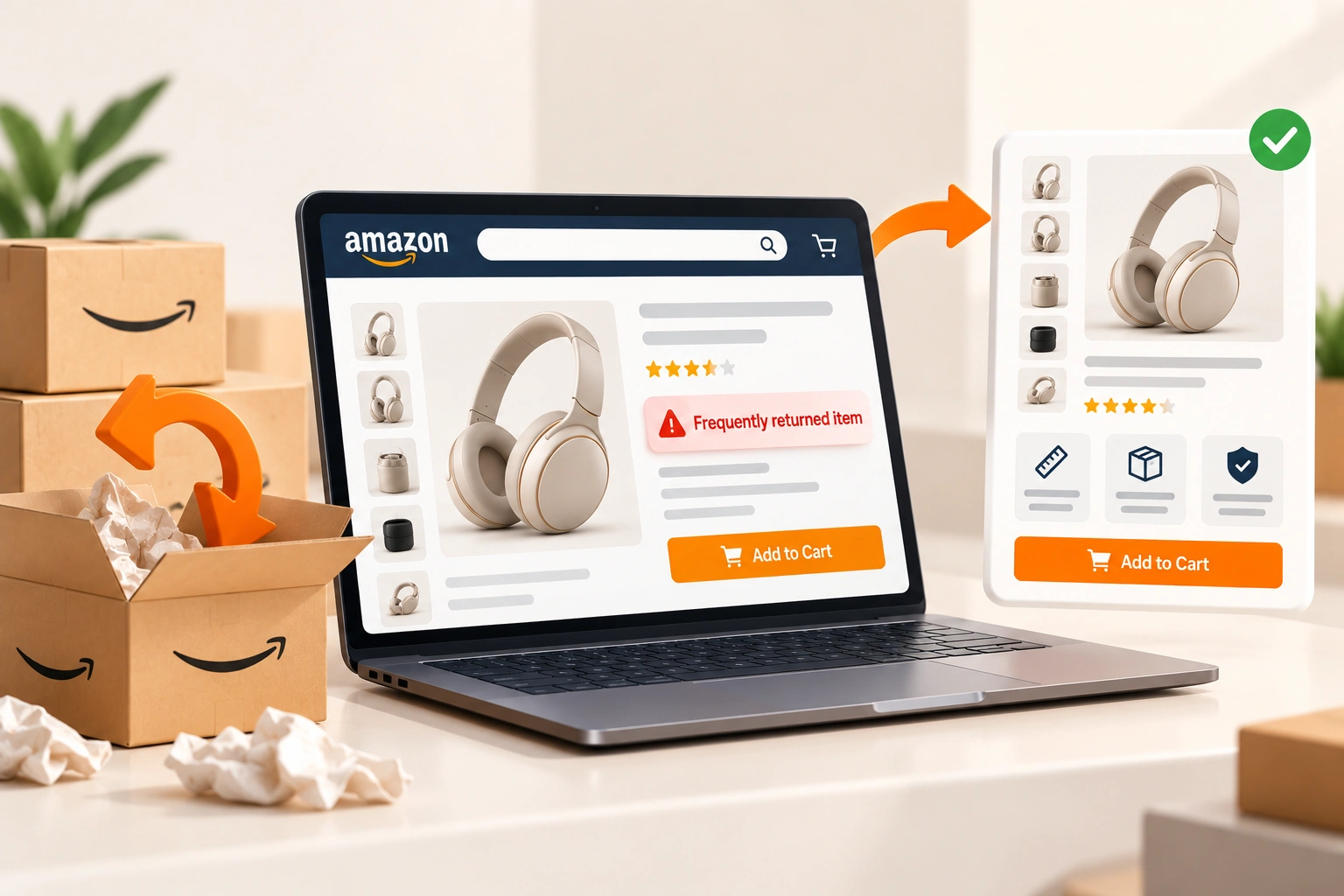
An Amazon detail page can carry a warning that the item is frequently returned. Shoppers read it at the moment they are deciding, and sellers who have had the Amazon frequently returned item badge describe what it does to conversion in strong terms. It is set by Amazon, for each ASIN, and there is no appeal button beside it. What a seller controls is the return rate behind it, and that starts with understanding how Amazon counts.
Amazon's help pages behind the sign in were not read for this article. The calculation and the rules below are as Amazon's moderators have described them on the Seller Forums, with how old each statement is; the experiences are sellers', labelled as such.
How Amazon decides an item is frequently returned
Xander_Amazon, answering a seller in late 2025, gave the rule: Amazon "determines this badge by comparing your product's return rate with similar products in the same category", using the share of shipped units that are returned over a three month period. Ken_Amazon, in mid 2026, added that the return rate thresholds "are set separately for each product fee category and are refreshed annually", and described the label as a feature of the retail detail page. Bryce_Amazon confirmed in 2024 that it is calculated at the ASIN level, so each variation is judged on its own returns.
So the badge is relative. A return rate that is ordinary in one category is an outlier in another, and the line moves once a year. How Amazon chooses the similar products is not published, and one seller reported unrelated products in the same niche being grouped together; that is a seller's observation, not Amazon's description.
How the rate is calculated, and why yours differs
This is where most of the frustration in the threads comes from. Ken_Amazon explained that the rate is units refunded divided by units ordered, and that "the calculation depends on the order date, not the refund or return date": each month's rate takes the units shipped in one full calendar month and counts the returns of those units through the end of the third month. He added that this may differ from what a seller sees when checking returns or payments by hand.
That produces three differences. A seller adding up the last ninety days of returns against the last ninety days of sales is counting different units from Amazon. Returns from a busy month keep counting for up to three months, so a peak can hold the rate up long after sales fall. And Bryce_Amazon described the rate as based on shipped units "for which customers initiated returns": a return requested counts, whether or not the item ever reaches the warehouse, which a report of returns received will not show.
The figures sellers post show the size of the gap. One counted 7 returns from 97 units, 7.2 percent, against the 13.64 percent Amazon showed; another counted about 3 percent in their own reports against 8.2 percent in Amazon's. If your figures and Amazon's still disagree after counting Amazon's way, open a case naming the ASIN, the two figures and the period, and ask for the date range and order volume used, as Ken_Amazon advised. In the 7.2 percent case, Josh_Amazon replied that fulfilment centres were inspecting returned units and the first had found no defect, but that the review was still open: these cases take weeks.
Customer mistakes count too
Xander_Amazon was explicit that Amazon's system does not distinguish between returns the customer caused, ordered by mistake for example, and returns caused by the product. Every return counts. Showing that half the returns were the buyer's fault, which the seller in that thread did, does not change the rate. The work is in reducing returns of both kinds, and a surprising share of returns logged as the buyer's mistake trace back to the listing.
How to bring the rate down
Read the reasons, for each ASIN. Return reasons and buyer comments, read together, usually point at one or two causes. The Seller Central reports worth reading covers where they are and how to read them: not the rate, the reasons.
Fix what the listing promised. Wrong size, not as described, did not fit, not compatible, looked different: these are listing problems before they are product problems. A size chart that matches how the product actually fits; dimensions and capacity in the title or the first bullet; compatibility stated as a list rather than implied; images that show the real scale, colour and contents of the box. The fields that win the click are the same fields that set the expectation a return is measured against, and what moves rank on an Amazon listing sets out the rules for each.
Fix what the product does. Defective, damaged, stopped working: these belong to the product or its packaging, and the answer is with the factory and an inspection before stock ships. A batch problem shows as a cluster of the same complaint in the same weeks.
Decide whether the product belongs. Some products carry a return rate no listing will fix. What it costs to sell on Amazon sets out how returns enter the margin, and an item that is frequently returned may be costing more than the badge.
How long it takes to lose the badge
Amazon's moderators say the badge is removed automatically once the return rate comes back toward the threshold for the category; there is no request to make. Because each month's rate counts returns for three months after the units shipped, an improvement made today shows in the rate over the following months, not the following week.
Seasonal sellers feel this most. The seller with the 7.2 percent figure was selling a summer product and carrying the badge into the summer peak. The time to fix a listing is the quarter before the season, not the month of it.
How we work on it
We start with the return reasons for the ASIN, sort them into the ones the listing caused and the ones the product caused, and rewrite the listing for the first kind: the title, the bullets, the images and the size or compatibility information that set what the buyer expects. The second kind goes back to the brand and its factory with the evidence. That is the product listing optimisation work we do, and on a badged ASIN it is measured by the return rate three months later, not by how the listing reads.
Frequently asked questions
The questions that come up most often on this subject.
It is a label on the product detail page that Amazon adds when an ASIN's return rate is high compared with similar products in its category. Amazon's moderators describe it as calculated over three months of shipped units, against thresholds set for each product fee category and refreshed every year.
As an Amazon moderator described it in 2026: units refunded divided by units ordered, by order date rather than return date. Each month's rate takes the units shipped in one calendar month and counts their returns through the end of the third month.
Usually because it counts different units. Returns are matched to the month the units shipped, not the month they came back, and the rate counts returns customers initiated, including items never sent back. If the figures still differ when counted Amazon's way, open a case asking for the date range and order volume used.
Not by request. Amazon's moderators say it is removed automatically when the return rate comes back toward the category's threshold. Because returns are counted for three months after the units ship, that takes months after the cause is fixed.
An Amazon moderator has said the badge is calculated at the ASIN level, so each variation is assessed on its own return rate. A size or colour with a high return rate can carry the badge while its siblings do not.