Amazon's 75 Character Title Limit and Item Highlights: What Changed and What to Write
Amazon capped product titles at 75 characters on 27 July 2026 and gave back 125 characters in Item Highlights. What the rule covers, what Amazon rewrites for you, and how to spend seventy five characters properly.


Loading Article banner
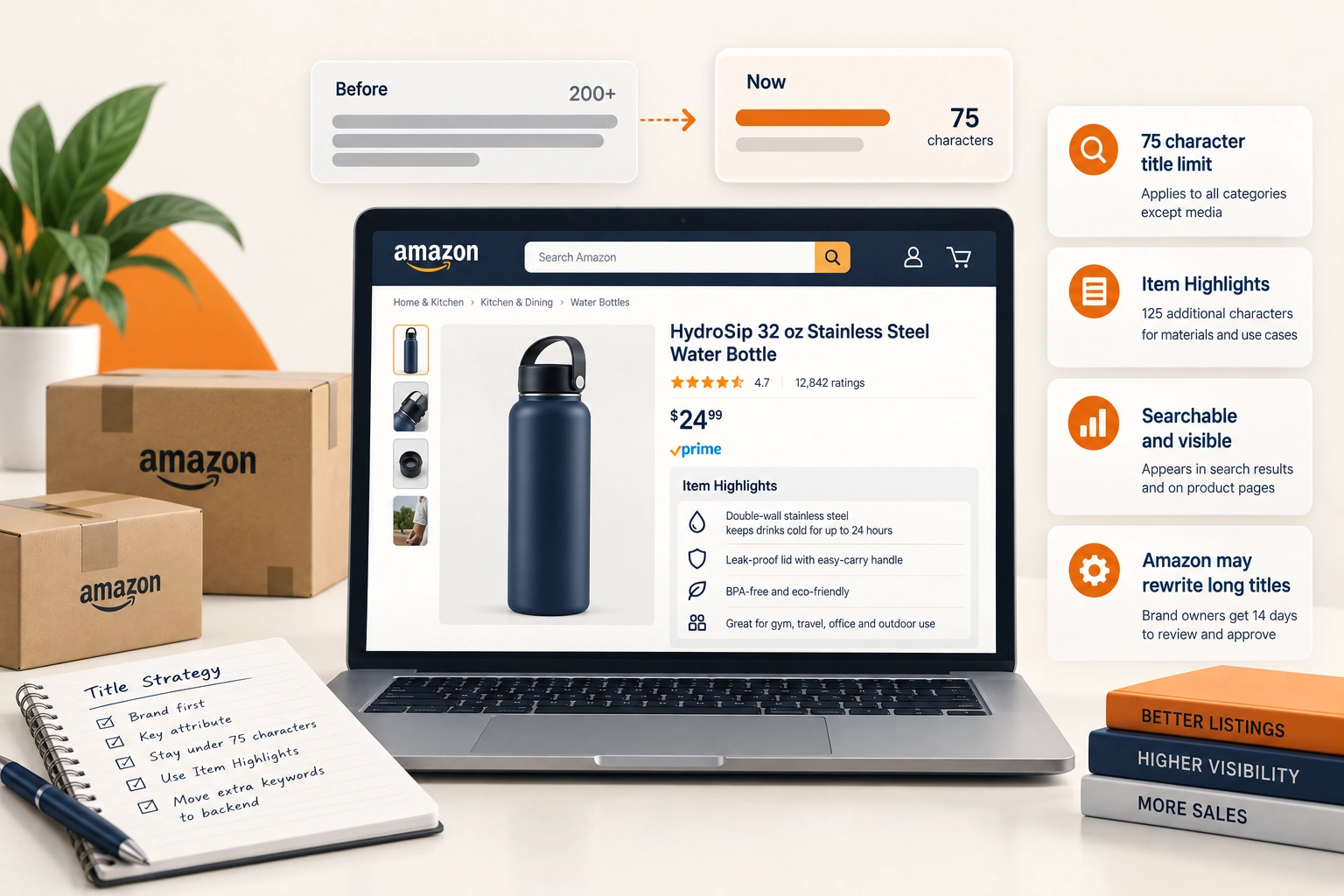
On 27 July 2026 Amazon capped product titles at 75 characters, including spaces, in every category except media. Two months later it is still working through the catalogue, and the listings it has not reached yet are not safe. They are queued.
This is worth being precise about, because it was not a recommendation with a deadline attached. Amazon announced that titles still over the limit after that date would be replaced with a title its own tools wrote, gradually. The field that does more for relevance than any other on a listing is being rewritten at Amazon's pace, and the only way to decide what it says is to write the seventy five characters yourself before your turn comes up.
What the rule actually says
Amazon's wording in its Seller Central announcement is that from 27 July 2026, titles in all categories except for media need to be 75 characters or less including spaces. Two details in that sentence are the ones people miss.
Including spaces. A title of twelve words is already close to the ceiling, and most sellers count words rather than characters when they estimate. Except for media is the only carve out: books, music and video keep their longer titles, and nothing else does. If you sell in a category where long, specification heavy titles were the norm, that norm is gone.
It is worth checking what your listings actually hold rather than what you think they hold. A catalogue built over three years usually contains titles nobody has read since the day they were written, and a supplier feed will have contributed a few that run past two hundred characters on their own.
Item Highlights, and the 125 characters it gives back
Alongside the cap, Amazon introduced Item Highlights, which in its own words provides an additional 125 characters for sharing materials or recommended use cases that help customers compare options.
The line that matters more is the next one: this content is searchable and visible with titles in search results and on product detail pages. Item Highlights is not a consolation field tucked into the back end. It is indexed, and it appears next to the title where a shopper comparing four listings is actually looking.
So the change is better read as a restructure than a cut. The title carries identification. Item Highlights carries the comparison. Sellers who treat the 125 characters as an afterthought are handing that comparison to whoever did not.
What Amazon does to a title that is still too long
Amazon said that after 27 July, any titles still over 75 characters will be updated to the AI recommendation gradually, and that listings stay active throughout. Nothing is suppressed for being long. It is replaced.
Brand owners get one protection the rest do not. Amazon's announcement says that when changes are made to your listings, brand owners have 14 days before implementation to review, modify, and approve the AI generated recommendations, in the Review Listing Changes section. Fourteen days is not long if nobody is watching that queue, and it starts when Amazon decides, not when you are ready.
That window is one more thing Brand Registry buys you that does not appear on the feature list. A seller without it finds out what the new title says by reading the detail page.
Where to find your own recommendations
You do not have to wait to be processed. Amazon's own instruction is to go to Manage All Inventory, select Edit on a listing, and click View enhancements on the left of the page. The recommended title and Item Highlights are there to accept, edit or ignore.
Read a handful before you decide on an approach. The recommendations are usually competent at what a machine is good at, which is cutting, and indifferent to what it cannot know, which is which attribute your buyer actually chooses on.
How to spend seventy five characters
Brand, then the thing itself, then the one attribute that decides the purchase. That is the whole formula, and at 75 characters there is room for very little else.
The attribute is the part worth arguing about internally. For a consumable it is usually count or volume, because that is the unit a shopper compares on. For apparel it is material or fit. For anything that plugs into something else it is compatibility. Pick the one that a buyer would have to open the listing to find out, and put it in the title so they do not have to.
What comes out: the second and third keyword, every adjective describing the packaging, the words premium, professional and high quality, the phrase for men and women, and the compatibility list that ran to nine model numbers. None of them were earning their space even when the space was free. The title was already truncating on a phone well before 75 characters, which is where most of your traffic reads it.
What goes in Item Highlights instead
Materials and use cases, which is what Amazon says the field is for, written as things a shopper compares rather than as a second title. A stainless steel body, a machine washable cover, a thirty hour battery, use on a gas hob. Short, factual, each one a reason to pick this listing over the one beside it.
It is searchable, so the terms that lost their place in the title do have a home, but a keyword dump reads as one to a shopper looking at it next to your title. The field is visible. Treat it as copy, not as a back end.
The keywords you are about to lose
A long title was doing two jobs, and only one of them was for the reader. The other was carrying terms the listing needed to be found for, and those terms have to go somewhere.
Three places take them. Item Highlights, where they describe the product truthfully. Backend search terms, which is where the ones that do not belong in visible copy always should have been. And the bullets and A plus content, which carry more weight than most sellers give them credit for. Deciding which term goes where is ordinary keyword research work, done once per parent rather than per listing.
Then check the result. A shortened title changes what a listing is indexed for, and the way to find out is to test it rather than assume: search the term and see whether your ASIN comes back. Do it a week after the change, on your top twenty by revenue, not on the whole catalogue.
What to do this week
Export the catalogue and sort by title length. Everything over 75 characters is in the queue, and the order to work in is revenue, not alphabetical.
For the top twenty, write the title and the Item Highlights yourself and push them before Amazon does. For the rest, open View enhancements, read what Amazon proposes, and accept the ones that are right. For anything with a variation family, do the parent and the children together so the family still reads as a family.
Then update the assets the title used to carry. Bullets that repeated the title now have room to do their own job, and the parts of a listing that actually move rank did not change because the title got shorter. Neither did the image rules, which suppress listings far more often than titles ever did.
Where this goes next
Every catalogue has a handful of listings that earn most of the money and a long tail that nobody has opened in a year. The cap is an opportunity to treat them differently for the first time: write the important ones properly, let Amazon handle the tail, and stop pretending the tail was optimised.
That rewrite, across a catalogue, at the level of which attribute belongs in seventy five characters and which term belongs in the back end, is product listing optimization work, and it is the version of it that is worth paying for: not cosmetic, and on a deadline somebody else set.
Frequently asked questions
The questions that come up most often on this subject.
Yes. Amazon's wording is that titles need to be 75 characters or less including spaces. A title of roughly twelve words is already at the ceiling, which is why counting words rather than characters leads sellers to underestimate how many of their listings are affected.
Media only. Amazon's announcement applies the limit to titles in all categories except for media, which covers books, music and video. Every other category is included, whatever the norm in it used to be.
Amazon said that after 27 July 2026, titles still over the limit are updated to its AI recommendation gradually, and that listings stay active while this happens. Brand owners get 14 days before implementation to review, modify and approve the recommendation in Review Listing Changes. Sellers without Brand Registry are not offered that window.
In Manage All Inventory, select Edit on the listing and click View enhancements on the left of the page. The recommended title and Item Highlights appear there, and you can accept them, change them or write your own instead.
Both. Amazon states that the content is searchable and visible with titles in search results and on product detail pages. That makes it the right home for comparison attributes such as material, count or compatibility, and the wrong home for a list of keywords a shopper would notice.