Amazon Business Hour Delivery Rate: The 90% Rule for Seller-Fulfilled Orders From 30 September 2026
From 30 September 2026 a seller-fulfilled order to an Amazon Business customer has to arrive while that business is open, nine times in ten over a rolling fortnight. What the metric measures, what it does not touch, what the thread says about the arithmetic, and the three settings Amazon says meet it.


Loading Article banner
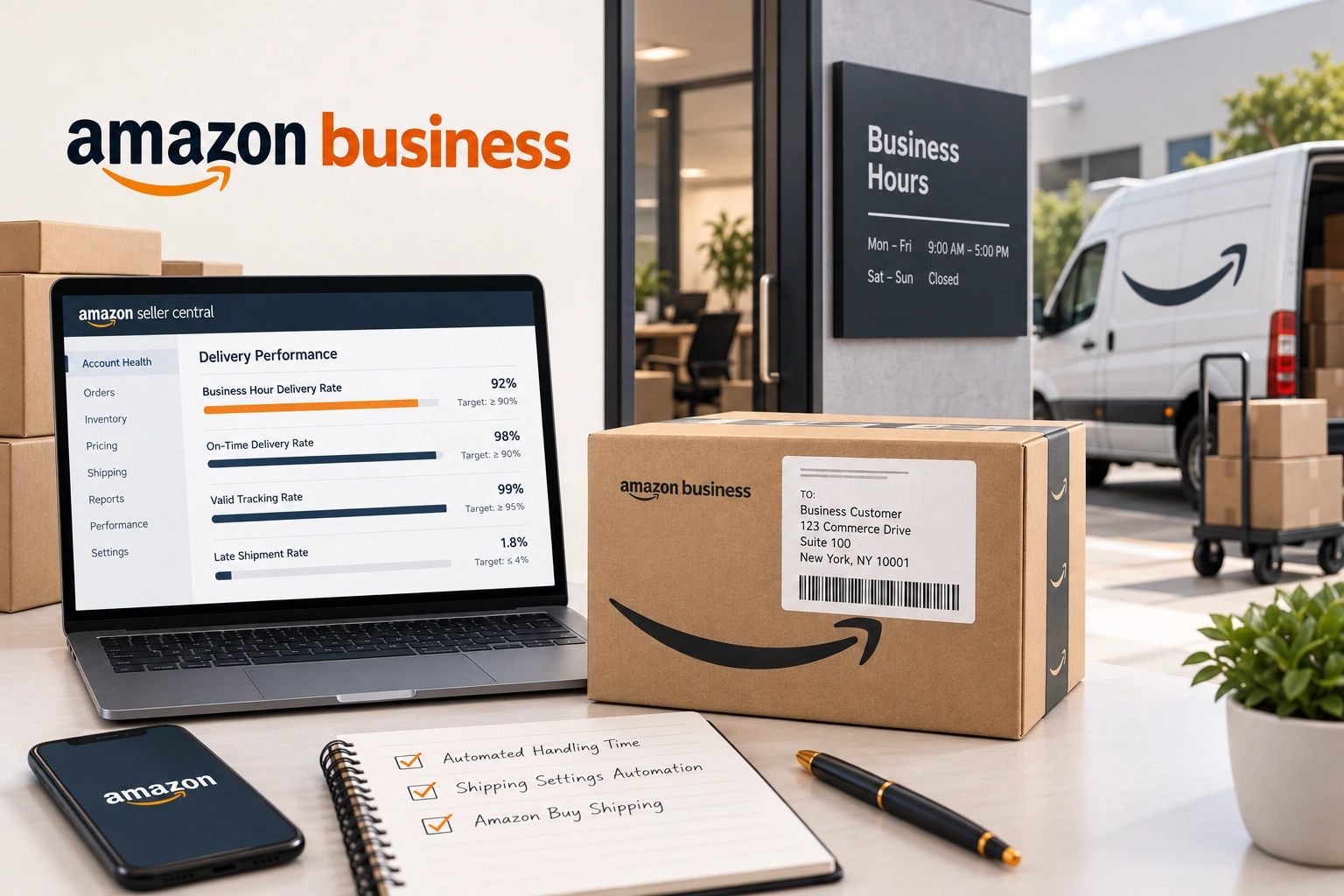
Amazon's announcement of the business hour delivery requirement has sat at the top of the Seller Forums since July, and by the middle of September it carried more than two hundred replies. The rule itself is short: from 30 September 2026, a seller who ships their own orders to Amazon Business customers has to deliver inside those customers' opening hours at least 90% of the time, measured over a rolling fourteen days, or their seller-fulfilled offers can be switched off for Business customers from 30 October.
The replies are long because the rule measures something a seller hands to a carrier. This article sets out what Amazon has said, in Amazon's words where the words matter, what the thread says about how the number is really behaving, and what a seller-fulfilled account should do in the two weeks before the date. It is written for the US store, which is where the announcement applies; the same requirement has been announced for the United Kingdom and Germany with their own dates, as the seller press reports, and a seller in those stores should read their own announcement for the day.
What the metric measures, in Amazon's words
Amazon defines the Business Hour Delivery Rate as "the percentage of your seller-fulfilled shipments delivered to Amazon Business customers within their operating hours over a rolling 14-day period." Three parts of that sentence carry the whole rule. Seller-fulfilled: the orders you ship yourself. Amazon Business customers: the buyers on a registered business account, the offices, clinics, schools and workshops that buy through Amazon Business rather than a personal account. Within their operating hours: the parcel has to arrive while the business is open, not merely by the promised date.
That last part is the change. Every other delivery metric a seller-fulfilled account already lives with, on-time delivery, valid tracking, late shipment, asks whether the parcel moved and arrived when Amazon said it would. This one asks what time of day the driver knocked. A parcel delivered at 7 pm to an office that closed at 5 pm is on time by the old measure and a failure by the new one, and Amazon's reasoning is the obvious one: a parcel left outside a locked door is a parcel that gets lost, refused or re-delivered.
The window is a rolling fourteen days, so the number a seller reads today is built from the last two weeks of Business deliveries and moves every day. A bad week takes two weeks to leave the figure, and a seller with few Business orders will see it swing hard on one or two parcels.
Who it applies to, and who it does not
The requirement applies to seller-fulfilled shipments to Amazon Business customers in the US store. Amazon states plainly that FBA offers and retail offers are unaffected: an order fulfilled by Amazon is Amazon's delivery to arrange, and an order from an ordinary consumer is not measured by this metric at all. A seller who has never switched on business pricing or seen a Business order is not in scope, and a seller whose Business orders all ship from FBA is not either.
The consequence is also narrower than the thread's anger suggests. Below 90%, Amazon says it will send a notification with recommendations; if the rate has not improved by 30 October, "your seller-fulfilled offers may be deactivated for Amazon Business customers." That is deactivation for Business buyers, not for the listing. A consumer would still see and buy the offer. What a seller loses is the Business channel on their self-fulfilled catalogue, which for a seller of office consumables, trade parts or bulk packs can be most of the volume, and for a seller of gifts is nothing at all.
The metric is read in Account Health, beside the other seller-fulfilled delivery figures. If you have not opened that page since July, that is the first thing to do, because the number has been calculating since before it had a consequence and it already says where you stand.
The dates: 30 September and 30 October
Two dates, one month apart. On 30 September 2026 the requirement takes effect: a seller below 90% is notified and told what to change. On 30 October, a seller still below 90% can have seller-fulfilled offers deactivated for Amazon Business customers. Amazon's wording is "may be," and the thread has no example yet of what the reactivation path looks like, because nobody has reached it. The safe reading is the one a seller-fulfilled account applies to every other Account Health metric: treat the line as the line, and do not plan on the appeal.
The fourteen day window makes the September date earlier than it looks. The figure Amazon reads on 30 September is built from deliveries made from about 16 September onward. A seller who changes carriers or settings on the 29th has changed nothing the first notification will see.
What the thread says about the arithmetic
Amazon's announcement gives the definition and the tools; the replies give the experience, and they are worth reading before believing the tools alone will do it. None of what follows is Amazon's statement; it is what sellers have reported on the thread, and it is reported here as that.
The objection raised most is control: the seller picks the service and hands over the parcel, and the carrier decides which street the van drives at 4 pm. A seller who reported using every setting Amazon recommends, with an on-time ship rate above 99%, also reported a Business Hour Delivery Rate of 83%. Others reported the metric counting deliveries as failures that no customer would call a failure: a parcel delivered a day early, a delivery to a PO box, and deliveries to businesses that never close, a hotel among them, marked as outside hours. Several described customers whose stated hours are a few mornings a week, so that no ground service could hit the window without a scheduled delivery. And a number said they would stop selling to Business customers rather than be measured on it.
Read those as a description of the metric's edges rather than as a reason to ignore it. If your Business orders go mainly to offices and warehouses open on weekdays, the tools below will move the number. If they go to businesses with unusual hours, or the failures in your report are early deliveries and 24 hour addresses, the number may not be yours to fix, and the decision at the end of this article is the one to make.
The three settings Amazon says meet it
Amazon's announcement names three tools and makes a strong claim for them together: shipments using Automated Handling Time, Shipping Settings Automation and Amazon Buy Shipping "are guaranteed to meet the Business Hour Delivery Rate requirement." Read that as it is written. The guarantee attaches to the combination, not to any one of the three, and it is Amazon's guarantee to make good on when the carrier fails, in the same way that Buy Shipping already protects a seller against a late delivery claim on an order shipped on time.
Automated Handling Time sets the handling time on each SKU from what your account actually does, so the promise shown to the buyer is one you keep rather than one you typed a year ago. Shipping Settings Automation lets Amazon set the transit time on each shipping template from the carrier's real performance to each region, so a two day promise is only made where two days is what the carrier delivers. Buy Shipping buys the label inside Seller Central on a service whose delivery date Amazon can see, and it is the piece that makes the other two provable: a label bought outside Amazon carries a promise Amazon cannot check.
If those three are on and the number is still short, the report in Account Health is the next place to look, because it tells you which deliveries failed and why. The sellers on the thread who found early deliveries and all-hours businesses in their failures found them there. A support case that names the order, the delivery scan and the customer's stated hours is the case that has a chance; one that says the metric is unfair does not.
What to do in the two weeks before the date
First, open Account Health and read the number and its report. Then count what is at stake: how many of your seller-fulfilled orders in the last month went to Business customers, and what share of revenue that is. A seller for whom Business is 3% of orders has a small problem with a large thread attached; a seller for whom it is 40% has a fortnight's work.
Second, switch on the three settings if they are not on, and buy every Business label through Buy Shipping from today, because the fourteen day window means the number on 30 September is being built now. Where a Business customer's hours are narrow, choose a service that delivers in the morning on weekdays rather than the cheapest ground service that arrives whenever the route reaches it.
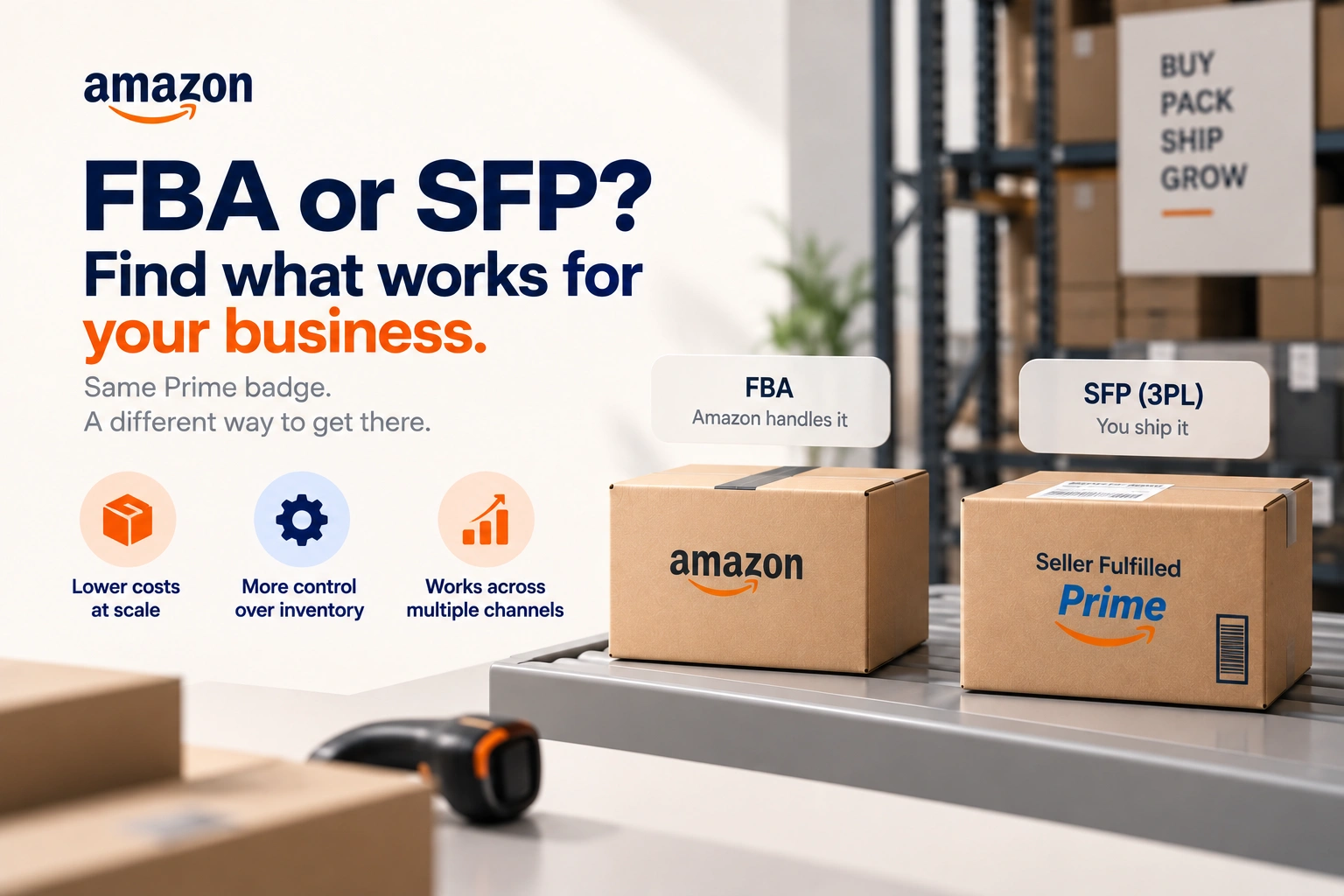
Third, decide about the ASINs that carry most of your Business volume. FBA offers are outside the metric, and for a product that sells in quantity to companies, sending that product to FBA moves the delivery, and the metric, to Amazon. That is not free: the inventory has to be planned and the fees paid, and for heavy, slow or oversized products FBA is often the wrong answer for reasons that have nothing to do with this rule. But for the ten ASINs that are 80% of your Business orders, it is the decision that removes the risk rather than manages it.
Fourth, if none of that fits, know what deactivation for Business customers would cost before 30 October rather than after, so that the notification, if it comes, is a number you have already seen.
Where this sits beside the other seller-fulfilled rules
A seller-fulfilled account already answers to Amazon's delivery targets: an on-time delivery rate of 90%, a valid tracking rate of 95%, a late shipment rate under 4%, and a pre-fulfilment cancellation rate under 2.5%. The Business Hour Delivery Rate is a fifth figure on the same page, with the same shape: a percentage, a rolling window, a line, and a consequence for the offers rather than the account. The account health rules, and what getting back takes, apply to it in the same way, and the habit that keeps an account clear of the others, Buy Shipping on a service you have watched perform, is the habit that keeps this one clear too.
For a brand that sells to companies through a seller-fulfilled catalogue, this is the month to have someone own that page. Our Amazon account management runs the seller-fulfilled settings, the carrier choices and the Account Health metrics as one job, and a free marketplace audit reads the report before the date does.
Frequently asked questions
The questions that come up most often on this subject.
Amazon's name for the percentage of your seller-fulfilled shipments delivered to Amazon Business customers within their operating hours, measured over a rolling fourteen day period. From 30 September 2026 it has to be 90% or higher in the US store, and it is read in Account Health.
No. Amazon states that FBA offers and retail offers are unaffected. It measures only the orders you ship yourself to Amazon Business customers. Moving the products that carry most of your Business volume to FBA takes those deliveries, and the metric, out of your hands.
From 30 September 2026 Amazon sends a notification with recommendations. If the rate has not improved by 30 October, Amazon says your seller-fulfilled offers may be deactivated for Amazon Business customers. Consumers can still buy the offer; the Business channel is what is switched off.
Amazon says shipments that use Automated Handling Time, Shipping Settings Automation and Amazon Buy Shipping together are guaranteed to meet it. Switch all three on, buy Business labels through Buy Shipping, choose weekday morning services for customers with narrow hours, and read the failure report in Account Health for the deliveries that still miss.
Amazon's announcement on the US Seller Forums applies to the US store. The seller press reports the same requirement announced for the United Kingdom and Germany with their own dates; a seller in those stores should read the announcement in their own Seller Central for the effective date that applies to them.