Amazon FBA Shipping Requirements: Boxes, Pallets, Weights and Labels
The box limit changed in June 2025 and AWD did not follow it. The current box dimensions and weight, the pallet grade, height and weight rules, the labels each box and pallet must carry, the 5,000 box ceiling, and what a fulfilment centre does with a shipment that breaks one of them.


Loading Article banner
A shipment to a fulfilment centre is accepted or refused at the dock by rules that are published, short and mostly about the box. Sellers meet them the expensive way: a container of cartons packed to a length Amazon no longer accepts, a pallet built on the wrong grade of wood, a shipment that arrives without the label on the side the forklift driver reads. Each of those is a refusal or a fee, and each was avoidable with one page of numbers.
This is that page, taken from Amazon's own announcements and its post on LTL, FTL and FCL deliveries, current as of September 2026. The dates matter, because the box limit changed last year and the change did not reach every part of the network.
The box
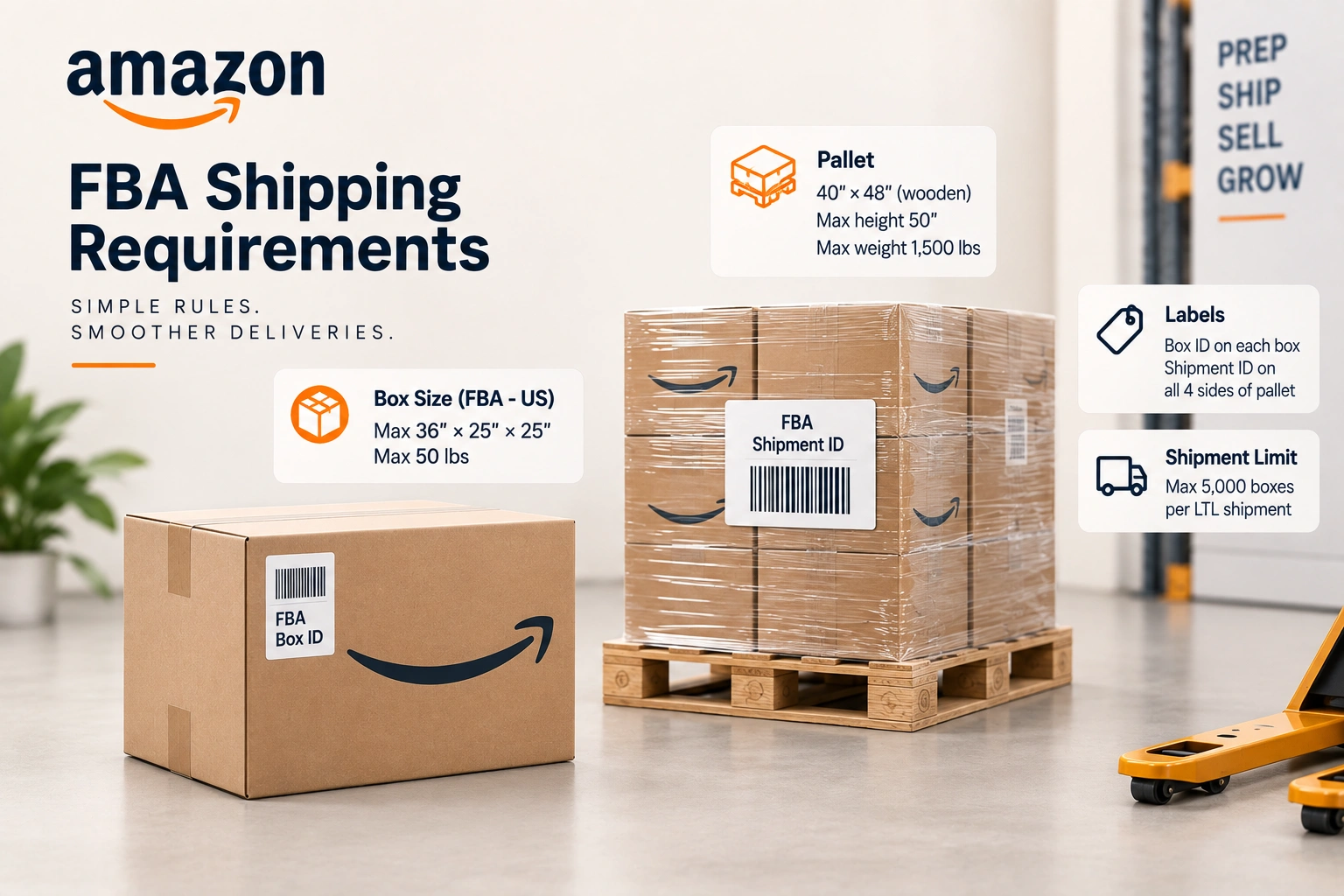
Since 20 June 2025 the maximum box for an FBA shipment in the US is 36 inches long, 25 inches wide, 25 inches high, and 50 pounds. Before that date every side was limited to 25 inches, and Amazon raised the length so that sellers could use the longer cartons other channels and carriers already take. The weight limit stays at 50 pounds for a standard box; a box heavier than that has to contain a single item that is itself over the limit, and is marked as a team lift.
Amazon Warehousing and Distribution did not change. An AWD shipment keeps the 25 by 25 by 25 inch, 50 pound limit, and a seller who packs to the FBA carton for an AWD inbound has a container of oversize boxes. The distinction is easy to miss because the same product often goes to both.
Inside the box, the prep rules are the ones the product's category sets: poly bags with suffocation warnings, bubble wrap on fragile items, sets bundled and marked as one unit, expiry dates where they apply. Those are per product, and the inventory management article covers how they are recorded on the SKU so the shipment plan carries them.
The pallet
Amazon's requirements for a palletised delivery are specific about the wood. Pallets are 40 by 48 inches, four way access, wooden; plastic, cardboard and particle board are not accepted. The grade is GMA standard B or better for most products, GMA 1A only for grocery, and GMA 1A or 1B for health and personal care and beauty. A pallet weighs no more than 1,500 pounds in total. The pack height should be no higher than 50 inches, which Amazon describes as 45 inches of boxes on a 5 inch pallet, and the pallets should be stackable.
The build rules are about the forklift driver and the receiver. Boxes stacked stable and flush on all sides, with no overhang. Every box on a pallet under one shipment ID. On a single ASIN pallet, every box stacked the same way. At least three inches between pallets in the trailer. Stretch wrapped, with the FBA box ID labels facing outwards, and the shipment ID label on all four sides of the wrap. A pallet that meets every rule but has its labels on the inside is a pallet that is unwrapped at the dock at the seller's expense.
The shipment
A single LTL shipment cannot exceed 5,000 boxes. Every box carries its own unique FBA box ID label, generated in the shipment workflow, on a flat side and not across a seam. A carton with more than one label, or a label from a previous shipment, is received against whichever the scanner reads first, and the discrepancy appears as a shortage weeks later in the reconciliation that the reimbursements article describes. The scheduling rules for the delivery itself, which in the holiday run to seven days for a standard delivery and fourteen for a partnered carrier, sit on top.
A delivery that breaks the rules is refused at the seller's expense, or accepted and charged: unplanned prep for a product that needed a bag, a fee for a box over the weight limit, a fee for a pallet that had to be rebuilt. Amazon's post on LTL deliveries says non compliant shipments may be rejected and the seller charged for return or disposal. The refusal is the cheaper outcome, because the disposal is final.
The checklist at the dock
Before a shipment leaves: every box within 36 by 25 by 25 and 50 pounds for FBA, or 25 cubed for AWD; every box labelled once, on a flat side; every pallet 40 by 48 wooden four way, the right GMA grade for the category, under 50 inches and 1,500 pounds, wrapped, labels out, shipment ID on four sides; the shipment under 5,000 boxes; the appointment booked. It is a ten minute check and it is the difference between a receive date and a refusal.
Keep reading
For the brands we run under Amazon marketplace management, the checklist is printed for the supplier and the freight forwarder, because the box is usually packed by neither the seller nor us. The cost of the shipment, and of the fees a wrong one attracts, sits in the fee stack in Amazon seller fees explained; the calendar it has to make is in the holiday deadlines Amazon publishes each July.
Frequently asked questions
The questions that come up most often on this subject.
Since 20 June 2025, 36 inches long by 25 wide by 25 high and 50 pounds for FBA in the US. A box over 50 pounds must contain a single item that itself exceeds the limit. AWD shipments keep the older 25 by 25 by 25 inch, 50 pound limit.
A 40 by 48 inch, four way access wooden pallet, GMA grade B or better for most products, GMA 1A for grocery, GMA 1A or 1B for health, personal care and beauty. No plastic, cardboard or particle board.
No more than 1,500 pounds in total, and a pack height ideally no higher than 50 inches: 45 inches of boxes on a 5 inch pallet. Pallets should be stackable, stable and flush on all sides.
An FBA box ID label on a flat side of every box, not across a seam, and on a pallet the box labels face outwards with the shipment ID label on all four sides of the stretch wrap. Every box on a pallet belongs to one shipment ID.
Amazon may refuse the delivery at the seller's expense, or accept it and charge for the correction: unplanned prep, an overweight box, a rebuilt pallet. A refused shipment can be returned or disposed of, and disposal is charged and final.