How Amazon Decides Where Your Stock Goes
Sellers send inventory to Amazon and assume it stays where it landed. What happens next decides delivery speed, storage cost and whether stock is available at all.


Loading Article banner

The mental model most sellers start with is a warehouse: stock goes to Amazon, sits there, and ships when somebody orders. The reality is a network that moves inventory around according to where it expects demand, and understanding that changes several decisions that otherwise look arbitrary.
The first encounter with it is usually the shipment split, where a single shipment of one product is directed to three different centres on opposite sides of the country, and it reads as an inconvenience invented to annoy sellers. It is not, and the reason matters.
Why a shipment gets split
Delivery speed is decided by distance. A unit in a centre near the buyer can promise next day; the same unit two thousand miles away cannot, whatever the seller does. So the network distributes inventory towards where it expects that product to sell, and it does that at the point stock enters rather than afterwards, because moving it later costs Amazon money.
The split is therefore a forecast made visible. Amazon is placing bets on where demand for that product will appear, using history for that product and that category. It is often right and it is not always right.
The alternative is to pay a placement fee and send everything to one location, which is the option that exists precisely because splitting has a real cost to the seller: more boxes, more labels, more freight legs and more that can go wrong in transit.
What the placement fee actually buys
It buys simplicity at the seller's end and it does not buy the same outcome. Stock consolidated in one place still gets distributed afterwards, by Amazon, at Amazon's pace, and during that period the delivery promise is what a single location can support.
So the calculation is not fee against no fee. It is the fee against the freight saving of one destination, plus the operational saving of one shipment, minus whatever the slower distribution costs in delivery promise during the window it takes.
For a small or slow moving product the fee is often worse value than it looks, because the distribution happens quickly when volumes are low. For a large first shipment ahead of a peak it is often better value than it looks, because the freight and handling savings are real and the peak is what matters.
What distribution does to the buy box and the promise
Delivery speed is a competitive input rather than a service detail. Two listings at the same price with different promises do not convert the same, and the faster one usually wins, which means where stock sits is a conversion lever.
It also means a listing's performance can change without anything on the listing changing. Stock that has drifted to a corner of the network, or is concentrated in one region because a shipment was consolidated, quietly lengthens the promise for everybody else. That is one of the traffic side explanations for a conversion rate that fell for no visible reason, and it is worth checking before rewriting the page.
Availability at a regional level is invisible in the headline number too. A product showing healthy total inventory can be effectively out of stock for a third of the country, and the headline figure will never say so.
What a seller can actually control
Not where units end up, and not directly. What is controllable is what goes in, when, and how well described.
Sending earlier is the largest lever, because distribution takes time and a shipment arriving the week demand starts will spend that week in the wrong places. Peak planning is mostly this.
Accurate dimensions and weights matter more than they appear to, because they decide which centres can take a product at all and they decide the fulfilment fee. A product misdeclared into a larger size band pays that difference on every unit until somebody notices.
And keeping the catalogue tidy, so a product is not split across duplicate ASINs each holding a fraction of the stock, which produces exactly the regional gaps described above while the totals look fine. How supplier feeds create duplicates is the usual origin of that.
Beyond that it is a planning discipline rather than a lever: forecast, ship early, keep the data clean, and check availability by region rather than in total. That is a large part of the operational side of Amazon account management, and it is the part that shows up in delivery promises rather than in a report anybody reads.
What storage actually costs, and when
Storage is charged by volume rather than by unit, which is the first thing that surprises sellers coming from a warehouse arrangement. A light bulky product costs far more to hold than a heavy small one, and the difference is large enough to decide whether a product is worth selling at all.
It is also seasonal. Rates rise for the final quarter, which is exactly when most sellers are holding the most stock, so the same inventory position costs materially more in November than it did in June. Planning a peak on summer storage rates understates the cost of it.
On top of that sit the surcharges for stock that has been there too long, which escalate the longer a unit sits. That is the mechanism that turns a bad forecast into a compounding cost rather than a one off one: the units that did not sell are the ones accruing the highest rate, and they are the hardest to shift precisely because they did not sell.
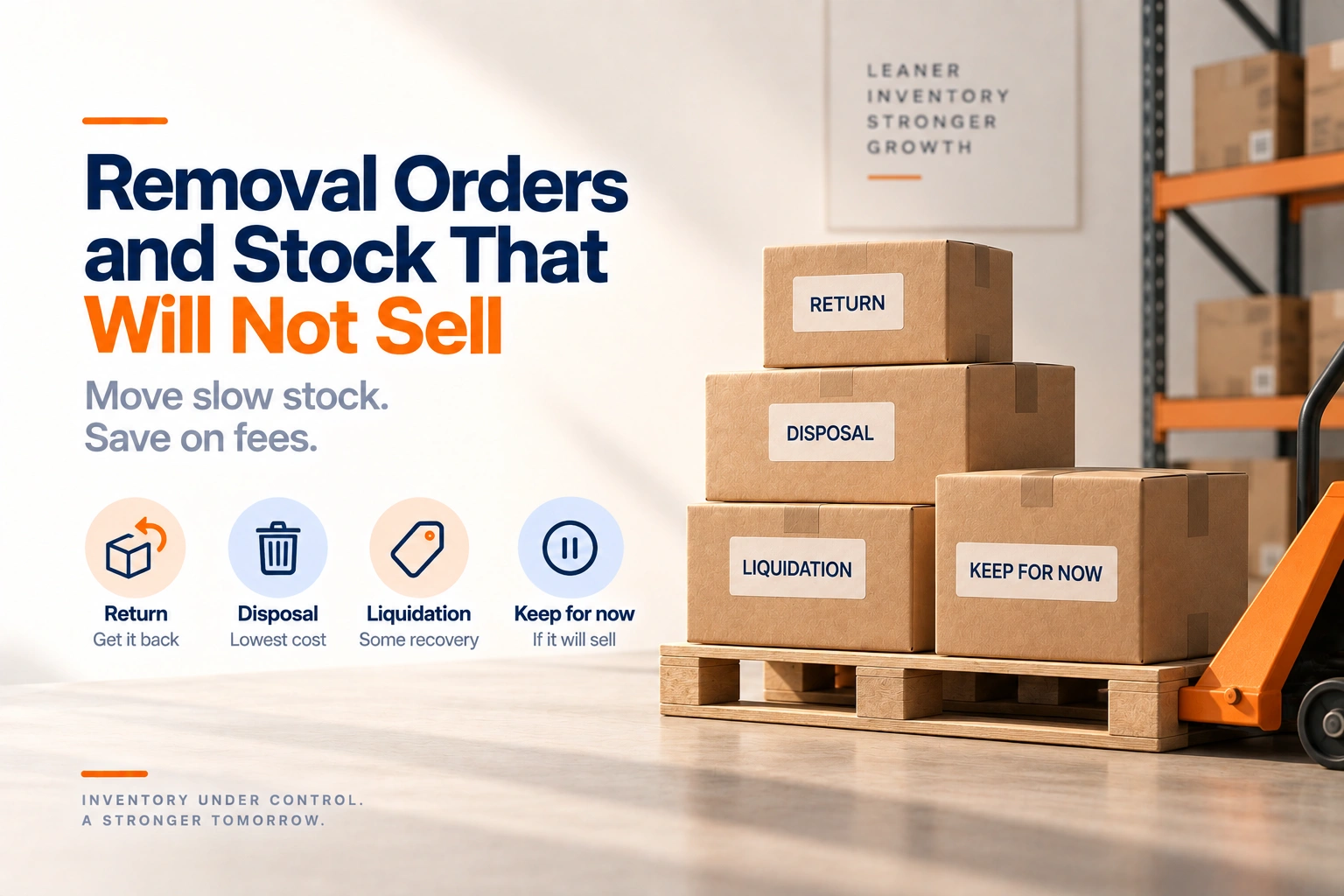
The way out is usually a removal or a disposal rather than a discount, and deciding which is an arithmetic question about what the units are worth against what holding them costs. The whole fee picture is worth having in front of you before that decision, and what it actually costs to sell on Amazon sets it out in the order the charges arrive.
Why this matters more than it sounds
None of this is visible on a product page, which is why it gets neglected. A seller looking at a listing that has stopped performing will rewrite the bullets, change the main image and adjust the price, and none of those addresses a stock position that has drifted so that half the country is being quoted a slower delivery.
It is also the constraint that binds first when a product starts working. Demand that outruns the inventory plan produces exactly the pattern sellers describe as the algorithm turning against them: a listing that was climbing goes quiet, and the cause is a stockout that cost the ranking rather than anything anybody did to the page.
Recovering from that is slower than causing it. Ranking built over months can be lost in a fortnight of unavailability and is not handed straight back when stock returns, which is why availability is treated as a ranking input rather than an operational detail by anybody who has been through it once. Pricing behaves the same way under pressure, and a repricing strategy that survives contact is the other half of holding a position while stock is tight.
Frequently asked questions
The questions that come up most often on this subject.
Because delivery speed is decided by distance, and the network places inventory towards where it expects that product to sell. The split is a forecast made visible, using history for that product and category, and it is done as stock enters because moving it later costs Amazon money.
It depends on the shipment rather than being a general answer. It buys one destination and the freight and handling savings that come with it, but stock still gets distributed afterwards at Amazon's pace, and the delivery promise during that window is what one location supports. For a large shipment ahead of a peak it often pays; for a small slow moving product it often does not.
Not directly. What a seller controls is what goes in, when it arrives, and how accurately it is described. Sending earlier is the largest lever, because distribution takes time and stock arriving the week demand starts will spend that week in the wrong places.
Yes, and it is a common blind spot. Total inventory can look comfortable while a product is effectively unavailable for a third of the country, which lengthens the delivery promise there and costs conversion without anything on the listing changing.