Why Supplier Product Descriptions Cost You Rankings
The copy that came with the product is on every other retailer's site too. Google has nothing to choose between you on.


Loading Article banner
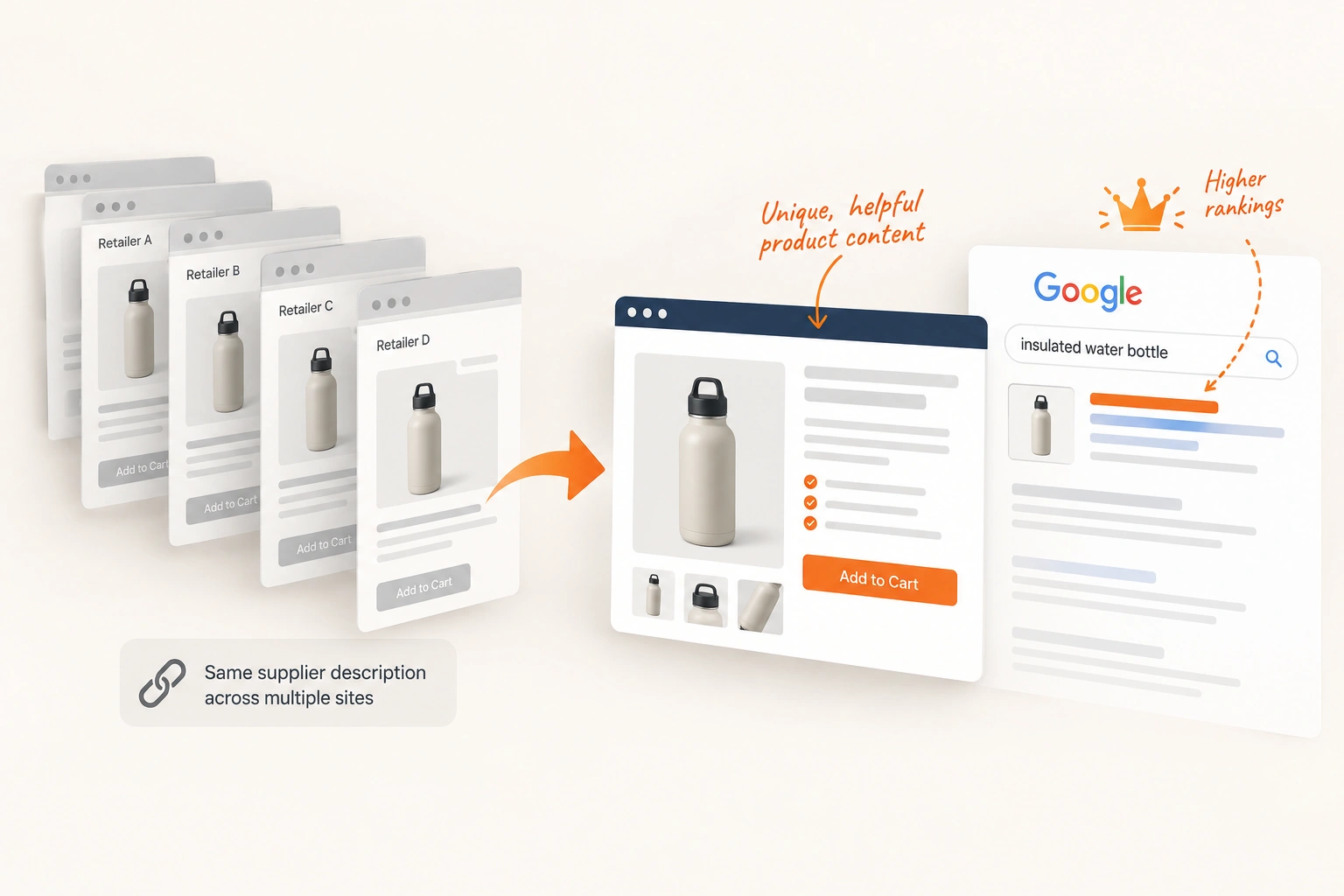
Most stores import product data from a supplier feed and publish it. The titles, the descriptions and the specifications arrive already written, which saves an enormous amount of time and quietly removes the store's ability to rank.
The problem is not that the copy is bad. It is that it is identical to the copy on every other retailer selling the same product.
What Google is being asked to decide
On a marketplace the same problem has a different shape, because everybody is on one detail page rather than forty: the difference between running a Shopify catalogue and an Amazon one. When forty retailers publish the same paragraph about the same product, Google has to pick which of them to show. It cannot pick on the basis of the description, because they are the same, so it picks on everything else: domain authority, links, site quality, and whatever else it has.
A newer or smaller store loses that comparison every time. Not because it did anything wrong, but because it gave Google no reason to prefer it.
What a product description actually has to do
It has two jobs and the supplier's copy usually does neither. It has to answer the questions that stop somebody buying, and it has to contain the words people actually use when they search for this thing.
The questions are knowable. They are in your customer service inbox, in the reviews on competing products, and in the questions section of a marketplace listing for the same item. Those are the paragraphs worth writing.
The words are knowable too, and they are frequently not the manufacturer's words. A supplier writes "thermal regulation membrane" and customers search for "waterproof breathable".
Which products to rewrite first
Not all of them, and this is where most rewriting projects fail. A store with four thousand products cannot rewrite four thousand descriptions, so it rewrites nothing.
Start with the products that already get impressions and few clicks, which Search Console will show you. Those are pages Google is already willing to show and buyers are not choosing. Then the products with the most commercial demand behind them regardless of current performance.
Everything else can keep the supplier copy indefinitely. A long tail of products nobody searches for is not a ranking problem.
The specification trap
There is a real exception worth naming. Specifications should be identical to the supplier's, because they are facts and inventing variation in them is how a store ends up publishing the wrong dimensions.
Structured specifications also belong in structured data rather than in prose, where they can be read by search engines and by assistants answering a question about the product. That is a separate job from the description and is frequently the one delivering the visible result, because it is what puts a price and availability into the search listing.
Both are part of our Shopify SEO work, and the structured data is usually quicker to fix than the copy.
A workable process for a large catalogue
Take the top fifty products by impressions from Search Console and rewrite those. It is a week of work rather than a quarter, and it addresses the pages Google is already willing to show.
Write a template rather than fifty individual briefs: what a description on this store contains, in what order, at roughly what length. That keeps the fiftieth as good as the first and makes the job delegable.
Rewriting a catalogue at scale is ordinary, unglamorous work that goes faster with people on it, which is what our BPO team does, and the marketplace version of the same job is Amazon listing content. Then set a rule for new products, because a catalogue that grows faster than it is rewritten never catches up. Anything added from now on gets a real description before it goes live, which costs minutes at the point of adding and hours if left.
Related reading: Why Shopify Collection Pages Do Not Rank, Shopify Site Speed: What Actually Slows a Store Down and eCommerce SEO and Marketplace Optimisation Are Not the Same Job.
Related reading: Shopify SEO: The Complete Guide for a Store That Has to Rank.
Frequently asked questions
The questions that come up most often on this subject.
Rarely. Variants of one product usually share a description and differ on the attributes, which belong in structured data rather than in prose. Writing a description per colour produces near-duplicate pages competing with each other, which is the problem you were trying to solve.
Not for SEO reasons alone. A long tail of low-demand products is not a ranking problem as long as they are not duplicated and not consuming crawl budget through filter combinations. Remove them when they cost money to hold, not because they do not rank.
Write them separately. A marketplace listing rewards scannable bullets for a shopper comparing options, and a product page frequently rewards depth because Google prefers pages that cover a topic. Pasting one into the other produces copy that underperforms in both places.
It should contain the words your customers actually use, which are frequently not the manufacturer's words. A supplier writes thermal regulation membrane and buyers search for waterproof breathable. Write for the second and the first can appear in the specifications.
The customer service inbox, the reviews on competing products, and the questions section of a marketplace listing for the same item. All three are records of what real buyers were unsure about, which is better evidence than any keyword tool.
It is a problem when it is thin and duplicated, which is the usual combination. A short unique description that answers the real objection outperforms a long generic one, so the fix is specificity rather than length.
On the products you want to rank, yes. Supplier copy appears on every retailer selling that item, so Google has nothing to distinguish you on and falls back to authority, which a smaller store loses. On long-tail products nobody searches for, supplier copy is fine indefinitely.
Long enough to answer the questions that stop the purchase, which is usually 150 to 400 words. Length is not the ranking factor. A short description that answers the real objection beats a thousand words written to satisfy a word count.
The ones already getting impressions and few clicks in Search Console, because Google is willing to show them and buyers are not choosing them. Then the products with the most commercial demand behind them. Rewriting an entire catalogue is how a rewriting project stalls and produces nothing.
No. Specifications are facts and should match the supplier exactly, because inventing variation is how a store publishes wrong dimensions. Put them in structured data as well as on the page, which is where a search engine or an assistant can read them.
It can produce text quickly, and the risk is producing text that is fluent, generic and answers none of the questions your customers actually ask. Used with real inputs, the customer service inbox, reviews, and the actual objections, it is a useful drafting tool. Used to generate variation for its own sake it produces a different kind of thin page.
There is no penalty in the sense of a punishment. What happens is more mundane and more damaging: Google picks one version to show and it is usually not the smaller store's. The result looks like a penalty and is really a filter.