Structured Data for Online Stores, and Why Your Results Look Plain
Two results side by side, one showing a price, stars and availability and one showing neither, do not get the same clicks.


Loading Article banner
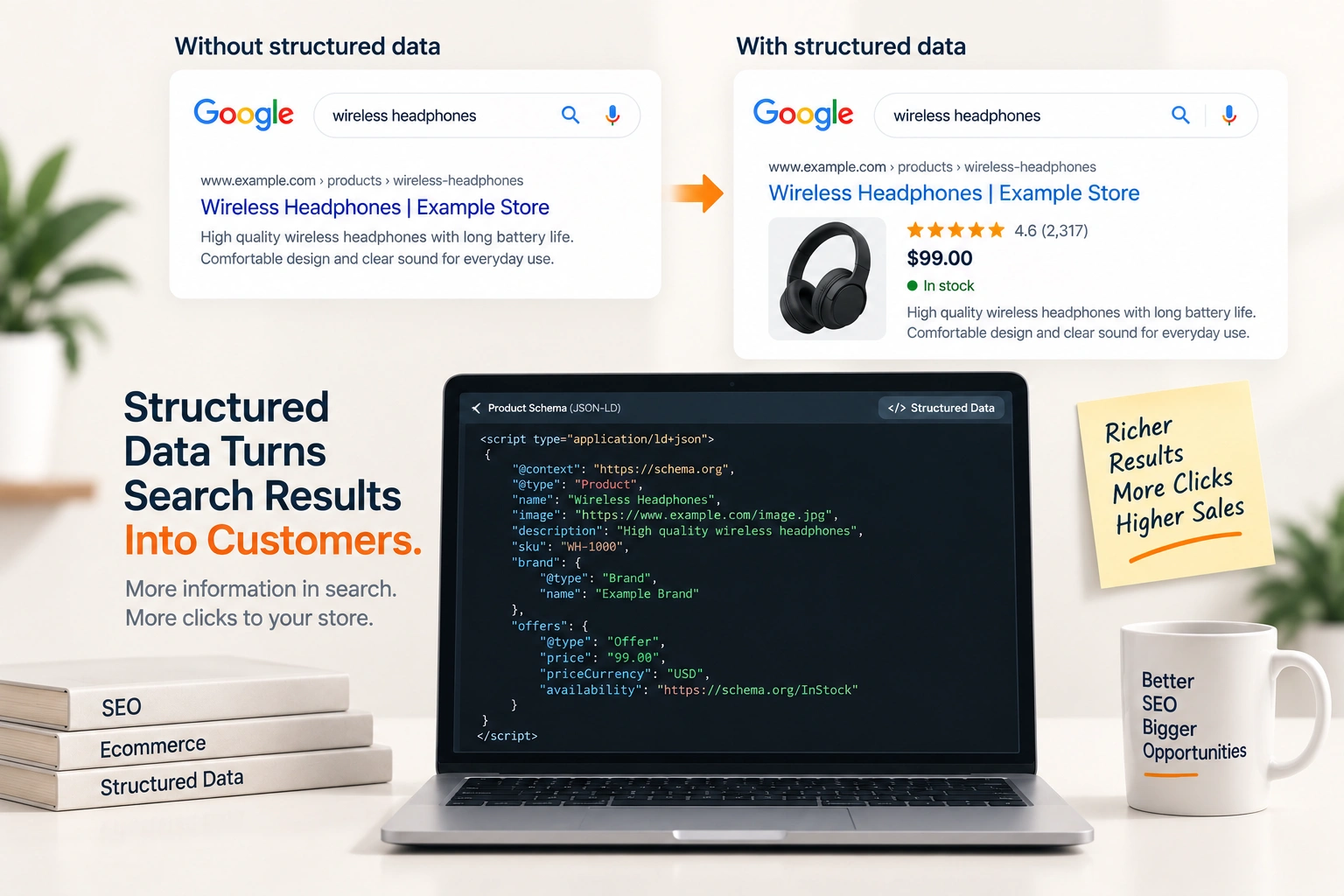
Search a product you sell and look at the results. Some carry a price, a star rating and whether the item is in stock. Others are a blue link and two lines of text.
The difference is structured data, and it is one of the few SEO improvements whose effect you can see with your own eyes rather than infer from a chart. Marketplace listings have no equivalent, because the marketplace owns the markup on its own pages: speed and content work.
What it is
Structured data is markup in the page that states plainly what the page contains: this is a product, this is its name, this is its price in this currency, this is its availability, this is its rating and how many reviews it is drawn from.
Search engines read pages reasonably well without it. What they cannot do reliably is know which number on a page is the price rather than a shipping threshold or a discount. Structured data removes the guess, and in exchange the result can display those facts.
What matters for a store
Product, with offer details: price, currency, availability, condition. This is the one that produces the visible difference in a search result.
Review and AggregateRating, where genuine reviews exist. Rules here are strict and enforced, and marking up ratings you do not really have is a way to lose rich results entirely.
BreadcrumbList, which replaces the raw URL in the result with a readable path.
Organization, which tells search engines who the business is, its logo and its profiles, and which increasingly feeds how a brand is described rather than only how it is listed.
FAQPage, where a page genuinely answers questions.
Why it is often broken
Most Shopify themes ship with some structured data. Then an app adds its own, and a developer adds a snippet, and the page ends up with two Product blocks that disagree, or one that references a price the page does not show.
Errors of that kind stop rich results appearing entirely, and they do so silently. Search Console reports them, which is the fastest place to find out, and it is checked far less often than it should be.
The other common failure is markup that does not match the visible page, which is against the guidelines regardless of intent. A price in the markup that differs from the price on the page is a problem even when it was a caching accident.
The part that is becoming more important
Assistants answering a product question read structured data for the same reason search engines do: it states facts unambiguously. A page whose specifications, price and availability are marked up is a page that can be quoted accurately. One where all of that is inside a marketing paragraph frequently is not.
That is a reason to treat structured data as content work rather than as a technical afterthought, and it is part of what our Shopify SEO work covers alongside the crawl and speed side.
Where to start if none of it exists
Check what is already there before adding anything. Most Shopify themes ship with partial Product markup, and adding a second set produces conflicts rather than coverage.
Then fix the errors Search Console is already reporting, which are usually a handful of patterns repeated across the catalogue rather than hundreds of individual problems. One template fix clears them all.
Then add what is missing, in the order of what shows in a result: Product with offers first, then breadcrumbs, then Organization. Reviews last and only where genuine ones are on the page.
The whole exercise is usually a day of work on a template rather than a project, which makes it one of the better returns available on a store that has never had it done. It is part of what our Shopify account management covers, alongside the speed and content work that decides whether the improved result converts once somebody presses it, and it has no equivalent on Amazon or Walmart, where the marketplace writes the markup itself.
Related reading: Why Shopify Collection Pages Do Not Rank.
Related reading: Shopify Site Speed: What Actually Slows a Store Down, Why Supplier Product Descriptions Cost You Rankings and eCommerce SEO and Marketplace Optimisation Are Not the Same Job.
Related reading: Shopify SEO: The Complete Guide for a Store That Has to Rank.
Frequently asked questions
The questions that come up most often on this subject.
Product with offer details on product pages, BreadcrumbList throughout, Organization once for the business, and FAQPage where a page genuinely answers questions. Review and AggregateRating only where real reviews are visible on the page.
Search Console reports errors and warnings across the site, which is the fastest way to find problems at scale. Google's Rich Results Test checks a single URL and shows what would be eligible. Both are worth using: one finds the pattern, the other confirms the fix.
Yes, and it is common on Shopify. A theme adds Product schema, an app adds its own, and the two disagree on price or availability. The result is usually no rich result at all, which is why verifying what is already on the page matters before adding more.
Yes, and this is enforced. Markup describing a price, rating or availability that the page does not show is against the guidelines regardless of intent, including when it is a caching accident rather than a deliberate one.
Product schema is structured data stating that a page describes a product, along with its name, price, currency, availability, condition and rating. It lets a search result display those details rather than only a title and description.
Not directly. It improves how a result looks, which improves click-through rate, and click-through rate on a result you already hold is often more valuable than moving up a position. It also makes a page easier for assistants to quote accurately.
Usually a validation error, conflicting markup from a theme and an app both adding Product schema, or markup that does not match what is visible on the page. Search Console reports these and is the fastest place to find out. Rich results are also never guaranteed even when the markup is valid.
No. Review and rating markup must reflect genuine reviews visible on the page, and the guidelines are enforced. Marking up ratings you do not have risks losing rich results across the whole site, which is a large penalty for a small gain.
Most themes add some, and its completeness and correctness vary considerably. It is also common for an app to add a second, conflicting set. Verifying what is actually on the page is worth doing before adding anything new.
It helps an assistant read facts unambiguously, which makes a page easier to quote accurately. That matters more as product research moves into assistants, and it is a reason to treat structured data as content work rather than as a technical afterthought.