Why Shopify Collection Pages Do Not Rank
Collections are the highest-value pages on most Shopify stores and the most commonly broken. Usually by the platform rather than by the shop owner.


Loading Article banner
Collection pages should be the strongest commercial pages on a Shopify store. There is no equivalent page to own on a marketplace, which is one of the differences worth knowing before carrying a marketplace habit across. They match how people search, which is by category rather than by product, and they can rank for terms no single product page can hold.
Most of them rank for nothing at all, and the cause is usually structural rather than editorial.
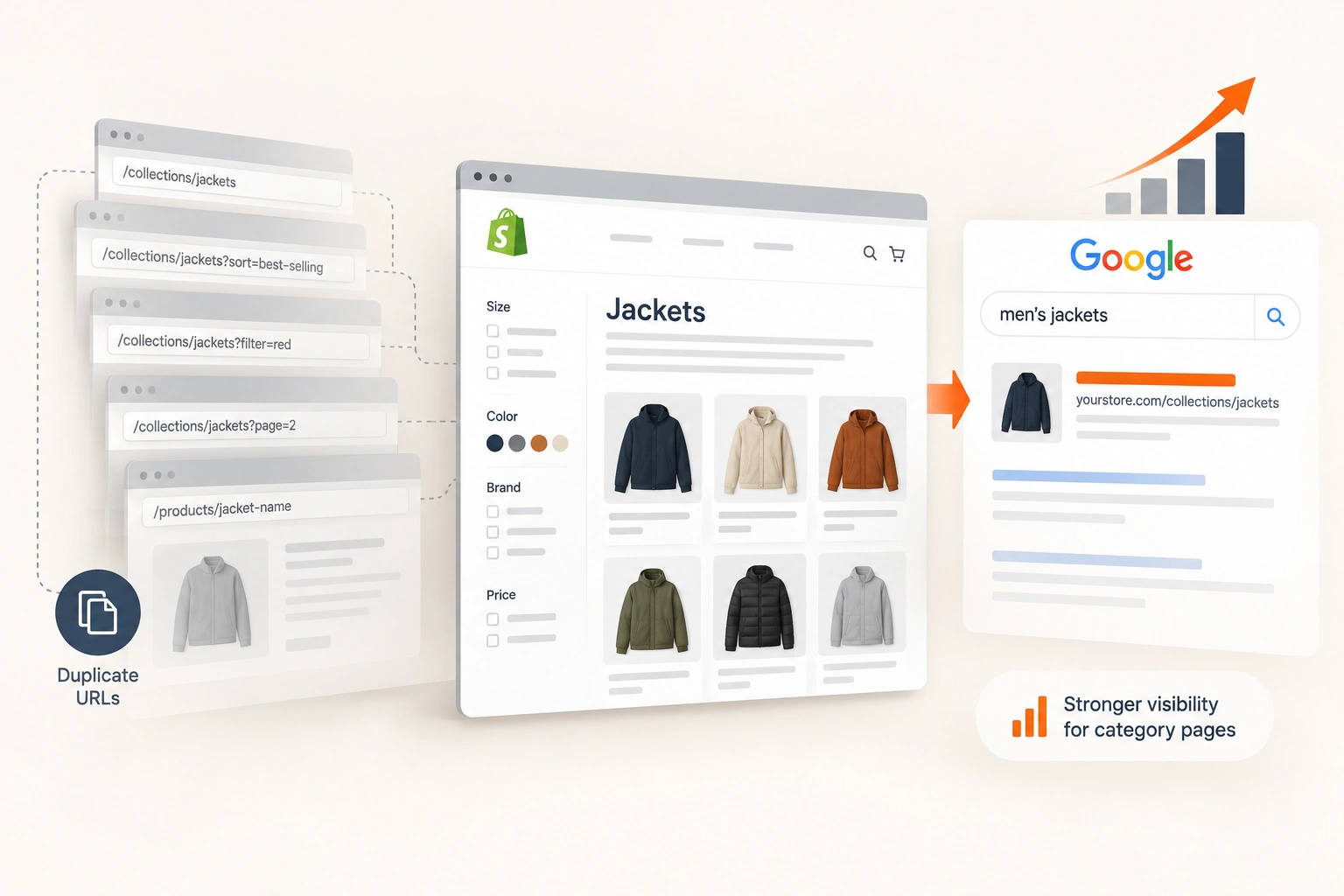
Shopify generates duplicates on its own
A single collection can be reachable at several addresses. The collection itself, the same collection filtered by tag, the same collection sorted differently, and every product inside it available both at its own URL and at a nested URL underneath the collection.
Google sees several near-identical pages and has to choose. Sometimes it chooses one, sometimes it chooses none, and the authority that should have accumulated on one page is spread thinly across many.
Canonical tags handle part of this and are frequently wrong or missing on tag and filter pages, which is where the leak is largest.
The page has nothing on it
A default collection page is a heading and a grid of products. There is no text that describes the category, answers a buying question or distinguishes it from the same category on every competitor's store.
Google is being asked to rank a page for a term when nothing on the page discusses the term. A few hundred words that genuinely help somebody choose within the category is usually enough, and it does not need to be a wall of copy under the fold that nobody reads.
Pagination splits the collection
A collection with three hundred products becomes a dozen paginated URLs, each holding a slice of the range. Crawl budget goes into page seven of a collection while the products at the bottom are barely visited.
The fix depends on the store: fewer, better-organised collections, sensible page sizes, and making sure the crawlable path to every important product does not run through six pages of pagination.
Pages compete with each other
This is the most common and least noticed. A collection, a blog post about the same category and a product page all target the same term. Google picks whichever it thinks is most relevant, which is frequently the blog post, so the page that could have sold something ranks below the page that cannot.
The fix is ownership: one page owns one intent, other pages link to it rather than competing, and the blog post targets the question rather than the category. Establishing that across a whole catalogue is where our Shopify account management starts, and the marketplace version of the same question is in what our Amazon and Walmart teams settle for a catalogue.
What to do about it, in order
Crawl the store and count how many URLs exist for each collection. Fix canonicals on tag and filter pages first, because that is where the largest number of duplicates is generated for the least effort.
Then decide ownership: one URL per commercial intent, written down, so future content has somewhere to point rather than somewhere to compete.
Then write the collections that matter. Not all of them: the five or ten with real commercial demand behind them.
That order matters because content published onto a structure that cannot be indexed properly is content Google may never read. It is the sequence our Shopify SEO work follows for the same reason.
How to tell whether it is working
Indexation first, because it is binary and immediate. Search Console's page indexing report will show collections excluded as duplicates or as alternates with a canonical, and that number falling is the first evidence the structural work landed.
Then impressions rather than position. A collection that was ranking for nothing starts appearing for a widening set of terms before it ranks well for any of them, and the query report shows that weeks before the position report does.
Then clicks and revenue by landing page, which is the only number that settles whether the work paid. A collection ranking third for a term nobody buys on is a worse outcome than one ranking eighth for a term that converts, and only the revenue view separates the two.
Related reading: Structured Data for Online Stores, and Why Your Results Look Plain.
Related reading: Shopify Site Speed: What Actually Slows a Store Down, Why Supplier Product Descriptions Cost You Rankings and eCommerce SEO and Marketplace Optimisation Are Not the Same Job.
Keep reading
Related reading: Shopify SEO: The Complete Guide for a Store That Has to Rank.
Frequently asked questions
The questions that come up most often on this subject.
No. Collections created for merchandising convenience, seasonal groupings and automated tag collections often have no search demand behind them. They still get crawled and still compete. Index the collections that match how customers search and let the rest exist for navigation only.
By what somebody typing it wants. A category term wants a collection, a specific product term wants a product page, and a question wants an article. Write the decision down per term, because ownership that lives in somebody's head is ownership two pages will eventually both claim.
They help in two ways: they give Google a clear hierarchy to read, and with breadcrumb structured data they replace the raw URL in the search result with a readable path. Neither is dramatic on its own and both are cheap.
Most commonly because several URLs exist for the same collection through tags, filters and sorting, because the page has no content beyond a product grid, because pagination splits the range across many URLs, or because a blog post and a product page are competing for the same term. Usually more than one of those at once.
Yes, on the collections that matter commercially. Google is being asked to rank a page for a term that nothing on the page discusses. A few hundred words that genuinely help somebody choose within the category is enough, and it does not need to be an unread wall of copy under the grid.
Check the canonical tags on tag, filter and sorted variants, since these are the largest source of duplicates and are often wrong or absent in a theme. Decide which URL should own the term, make every internal link point at it, and let the canonicals agree with that decision.
They create a second address for every product, which is a duplicate unless the canonical points back at the product's own URL. Most themes handle it correctly and it is worth verifying rather than assuming, because when it is wrong it is wrong across the whole catalogue.
As many as there are genuine ways a customer would narrow the range, and no more. Collections created for merchandising convenience that nobody searches for still get crawled, still compete, and still dilute the ones that matter.
Usually yes for filter and sort combinations, which generate large numbers of near-identical pages and consume crawl budget without ranking. The exception is a filter that matches a real search, such as a size or colour people genuinely look for, which may deserve its own indexed page.