Shopify Payments Holds and Reserves: Why Funds Are Held and What to Do
The email says a reserve has been placed and the payout page shows a number you cannot reach. Why Shopify holds funds, the two kinds of reserve and how long they run, what releases them, what an appeal can and cannot do, and the four habits that keep a store off the list.


Loading Article banner
Three threads on the Shopify Community in one day from one merchant, each angrier than the last: $4,350 held, support not escalating, an account locked over a subscription fee. Behind the anger is a mechanism most merchants meet for the first time when it happens to them, and it is documented. Shopify Payments holds funds in reserve when its risk assessment says the store might generate refunds or chargebacks it cannot cover, and the reserve runs on its own timetable whatever support says.
This is the mechanism as Shopify describes it: why a reserve is placed, the two kinds, how long they run, what ends them, what an appeal is for, and what keeps a store from being assessed as a risk in the first place.
Why a reserve is placed
Shopify's help gives the reasons plainly. A reserve protects Shopify Payments against losses from disputes and refunds, and it is placed when a risk assessment finds one or more of: extended billing cycles, such as annual subscriptions, where the customer pays long before the service is delivered; elevated chargebacks; a rising refund rate; an industry with a long delivery timeline, where the money arrives months before the goods; and a significant surge in volume, which is the one that catches growing stores.
The last two are the ones that surprise honest merchants. A pre-order campaign is a long delivery timeline. A product that goes viral is a volume surge. Neither is wrongdoing; both are, from a payment processor's side of the table, money collected for goods not yet delivered, at a scale the store has not shown it can deliver.
The two kinds of reserve, and how long they run
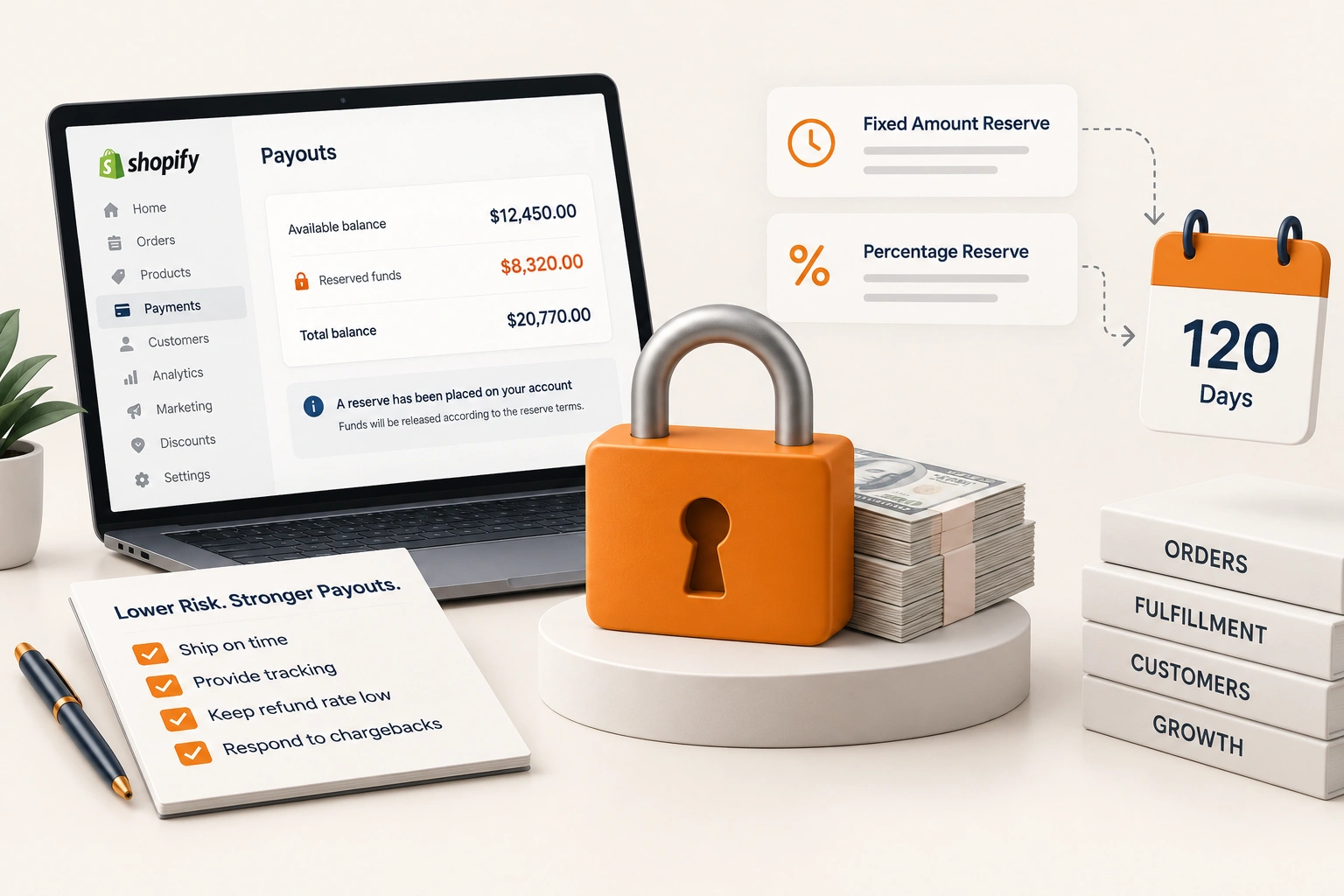
A fixed amount reserve holds a set sum for a set period: Shopify's example is $1,000 for 120 days. A percentage reserve holds a share of every transaction for a period after it: Shopify's example is 10% for 120 days, meaning 10% of each sale processed through Shopify Payments is held for the following 120 days. The percentage kind is the one a growing store usually gets, and its effect is a permanent gap between sales and cash for as long as it runs, because every day's sales add to the reserve as an earlier day's leaves it.
The period is typically 120 days, and Shopify reviews the account before it expires to decide whether the reserve is kept, reduced or lifted. At the end, the funds no longer needed for refunds or disputes are returned in full, with the release taking several business days after expiry. The payouts page shows the payout balance and the reserved funds as separate figures, which is where to read what is held and when.
What a reserve does to cash, in numbers
Take a store selling $60,000 a month through Shopify Payments with a 10% reserve for 120 days. Each month $6,000 is held, and nothing is released for four months, so by the end of the fourth month the reserve holds $24,000 and stays there, with each new day's 10% replacing the day that falls out of the window. The store's cash is $24,000 lower for as long as the reserve runs, which for a business buying stock on thirty day terms is the difference between ordering and not ordering.
A fixed reserve is simpler and often smaller: $1,000 for 120 days is $1,000 the store does without, once. The percentage kind scales with sales, which is why a growing store feels it most in the month it least expects to, the month sales doubled.
What an appeal is for
The reserve arrives by email with its terms, and the appeal is a reply to that email within the timeframe it states. Shopify's help is candid that some reserves cannot be appealed: those state the conditions that have to be met for the reserve to be removed automatically, and the only route is to meet them. An appeal that works is one that answers the risk the reserve names: proof of delivery for the pre-orders, a chargeback rate that has fallen, a refund policy that has changed, a fulfilment operation that can carry the new volume.
What does not work is the thread. A reserve is a risk decision made from the account's numbers, and a support agent cannot lift it on the strength of a complaint, which is what the merchant with $4,350 held discovered across three posts. The complaint is understandable; the reply that changes the outcome is the evidence.
The four habits that keep a store off the list
Ship on time and upload tracking, so the delivery timeline Shopify sees is short and provable. Answer chargebacks with evidence, every one, because the rate is counted whether or not the dispute is won. Keep the refund rate down by describing products accurately and fixing the ones that come back, which is the same discipline the product descriptions article describes from the listing side. And grow the fulfilment before the sales: a store that can show it delivered last month's surge is a store the next surge does not flag.
For a store that sells pre-orders or subscriptions by design, the reserve is part of the business model and belongs in the cash flow plan, the way Amazon's payout cycle belongs in an FBA plan. For the stores we run under Shopify management, the payouts page is read weekly with the chargeback and refund figures beside it, and a rising refund rate is treated as the warning it is a month before a reserve makes it one. The same rule of cash against sales applies on every channel: Amazon's payout cycle, Walmart's, and eBay's holds on new sellers are the same story with different dates, and the Walmart fees and reimbursements article is where that channel's version sits. The store's own speed, which decides how quickly a held customer becomes a chargeback, is the subject of the site speed article.
Related reading: Shopify SEO: The Complete Guide for a Store That Has to Rank.
Frequently asked questions
The questions that come up most often on this subject.
Because a reserve was placed after a risk assessment found one of the factors Shopify names: long billing cycles such as annual subscriptions, elevated chargebacks, a rising refund rate, a long delivery timeline, or a sudden surge in volume. The reserve email states the terms, and the payouts page shows the reserved amount separately.
Typically 120 days, as a fixed amount for the period or a percentage of each transaction held for the 120 days after it. Shopify reviews the account before expiry and may keep, reduce or lift the reserve; funds no longer needed are returned in full a few business days after it ends.
By replying to the reserve email within the timeframe it states, with evidence that answers the risk it names. Some reserves cannot be appealed and instead state the conditions for automatic removal; meeting them is the only route.
No. It means the processor is covering itself against refunds and disputes it might have to fund. A pre-order launch or a viral product can trigger one on an honest store. Chargeback and refund rates, shipping on time with tracking, and fulfilment that keeps up with growth are what keep a store off the list.