Walmart Seller Reimbursements: What to Claim and When
Money owed back on a marketplace is rarely returned automatically. Walmart has claim routes for fulfilment losses, wrong fees and returns that never arrived.


Loading Article banner
Every marketplace loses some of your stock and charges some of your fees wrong. That is not an accusation, it is arithmetic at volume: items are handled by people and machines, weights and dimensions are measured once and applied thereafter, and returns travel back through a system with more steps than the outbound journey.
What differs between sellers is whether any of it is claimed back. Most of it is not, because nobody owns the task and the amounts are individually small.
The four things worth claiming
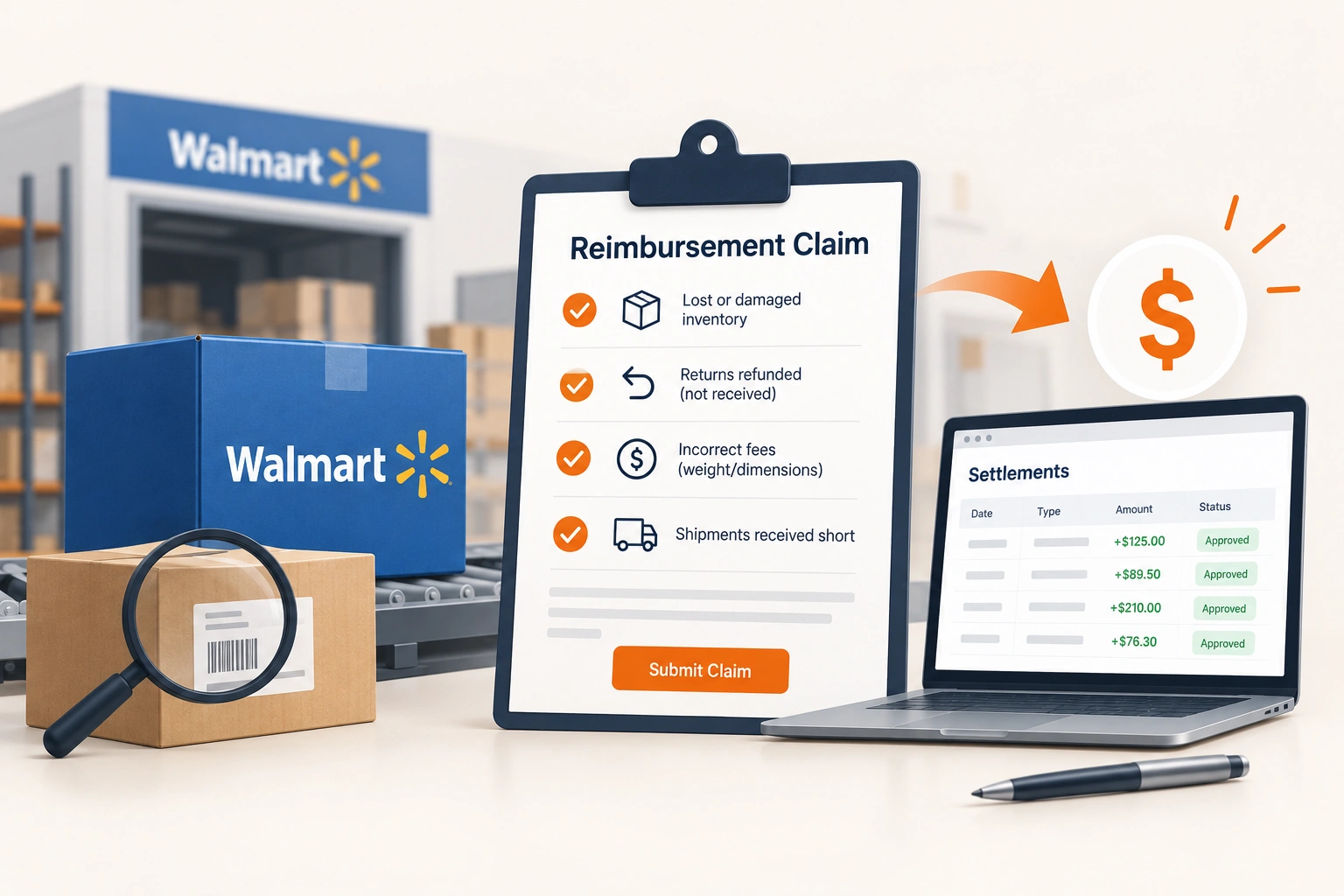
Inventory lost or damaged in fulfilment. Items that arrived at the warehouse and cannot be accounted for, or were damaged while held.
Returns refunded and never received back. A customer is refunded, the item is supposed to come back, and it does not. The refund has already left your account.
Fees charged on the wrong measurements. Fulfilment fees follow weight and dimensions. If either was recorded wrong, every unit shipped since has been charged wrong.
Shipments received short. You sent a hundred, the receiving record says ninety four, and six units exist somewhere between the two records.
Why fee errors are worth more than they look
A single mismeasured item is a few cents per unit. The same error applied across a year of shipments on a fast mover is a different number entirely, and it recurs until somebody corrects the record.
This is the category most sellers skip, because it looks like an accounting rounding difference rather than a claim. It is worth measuring your own items rather than trusting the recorded figures, particularly for anything in a category where a fraction of an inch moves it into a larger size band.
The equivalent on Amazon works the same way, and the same measuring exercise is worth doing there before trusting the recorded figures.
Claim windows are the whole game
Every claim type has a period after which it cannot be made. The exact windows change and are published in the seller help documentation, so the number to rely on is the current one rather than one written in an article.
What does not change is the consequence: a discrepancy found late is a discrepancy you own. This is the entire argument for checking on a schedule rather than when somebody remembers.
Monthly is enough for most sellers. Weekly is better for anyone with significant volume through fulfilment, because the reconciliation is easier when the shipments are recent.
What a claim actually needs
Evidence that the item existed, that it reached them, and that it did not come back. In practice: the shipment record, the receiving record, the order or return identifier, and the settlement line showing what was charged or refunded.
Claims fail on missing references far more often than on merit. A claim naming the wrong identifier is refused, and the refusal is usually read as the claim being wrong rather than the reference being wrong.
Keep the trail as you go. Reconstructing a shipment from six months ago is where the time goes, and it is the reason the exercise is abandoned.
Doing it yourself, with software, or with a service
By hand works at low volume and stops working quickly. It is a reconciliation across several reports, and the effort does not scale with the value recovered.
Software finds the discrepancies and prepares the claims. It is the right answer for most sellers with steady fulfilment volume.
A service on a share of what it recovers costs nothing if it finds nothing, which is a fair arrangement, though it is worth knowing what proportion you are giving away on money that a report would have shown you.
The same three-way choice applies to advertising and the reasoning transfers: in-house vs agency vs software.
How this connects to the rest of the account
Reimbursements are a symptom report as much as a revenue line. Repeated losses at one warehouse, or one item that is always damaged, are telling you something about packaging or handling that is worth fixing rather than claiming repeatedly.
Returns never received back can indicate a product problem rather than a logistics one: items that are genuinely returned but never sent back are often items people keep and dispute.
So read the pattern, not only the total. A recurring loss on one item is worth more attention than the claim it generates, and the same reading applies to returns on eBay and to fulfilment on Amazon. Our Walmart marketplace management treats it as part of the operational review rather than an accounting task.
Business models change the exposure
Wholesale and private label through fulfilment carry the most exposure, because the most stock sits in somebody else's building for the longest.
Seller-fulfilled shifts the risk to carrier claims instead, which is a different process with its own windows.
Dropshipping has almost no fulfilment exposure and correspondingly little to claim, which is one of the few unambiguous advantages of the model.
B2B and bulk orders concentrate the risk: a single lost pallet is a claim worth pursuing properly rather than one worth batching.
Related reading: FBA Reimbursements: What Amazon Owes You and How to Claim It.
Related reading: Walmart Fulfillment Services: What WFS Changes and Walmart Inventory Management: The Numbers That Decide Visibility.
Keep reading
Frequently asked questions
The questions that come up most often on this subject.