Walmart Business for Marketplace Sellers: Business Pricing, Volume Tiers and the New Business Hub
Most Walmart Marketplace sellers are already listed on Business.Walmart.com. How enrolment works, what a business price does and does not do, volume tiers and the rule that pauses them, advertising, and the Business Hub Walmart added in September 2026.


Loading Article banner
Walmart runs a second storefront for companies, Business.Walmart.com, and a large share of Walmart Marketplace sellers are already on it, some without having decided to be. Walmart's own guide says that "most sellers have an enrolled status 60 days after becoming a Walmart Marketplace seller", and once enrolled, published and in-stock items appear there within 72 hours "without any action needed from you."
On 24 September 2026, Walmart's release notes announced that "Walmart Business sellers can now manage their business from one centralized location in Seller Center": the Business Hub, which gathers bulk pricing, performance metrics, customer insights, sales reporting and learning in one place. It is a good moment to look at what the program is doing with your catalogue, because the defaults were chosen by Walmart and the useful parts are the ones a seller has to switch on.
Are you enrolled, and can you be?
To sell on Business.Walmart.com, Walmart says you "must be an active Walmart Marketplace seller with an account in good standing." Beyond that, its guides do not quite agree with each other. The getting started guide describes enrolment as something most sellers reach automatically after 60 days, with an application for those who have not. The volume pricing guide says participation "is by invitation-only and not available to all Marketplace sellers", and that an application "will be reviewed on a first-come, first-served basis."
The practical answer is the same either way: check the program's status in Seller Center before planning anything around it, and apply if the card is not there. An account under a performance warning is worth fixing first, for the same reasons it matters to Walmart's Pro Seller tiers.
What changes, and what does not
Less than most sellers expect. Walmart's guide is plain about it: order management and fulfilment "will be the same as orders generated on walmart.com marketplace". There is no separate inventory feed, and "both your WFS and seller-fulfilled inventory are automatically included", so stock sent to Walmart Fulfillment Services serves business orders exactly as it serves consumer ones.
There are "no additional costs to joining the program, however, standard Walmart Marketplace Referral Fees apply." Business sales are included in your total sales on your statements in Seller Center, and Walmart Business has its own reports for watching them separately. On the customer side, Walmart Business+ is a paid membership for buyers; a business can also shop with a free Walmart Business account.
One thing that does change is the shape of an order. Walmart describes business customers as buyers who "often buy products in larger quantities". A single order for forty units of a product that normally sells in ones and twos can empty a location, which is worth building into how you plan Walmart inventory before you start encouraging it with volume pricing.
Business pricing: what it can and cannot do
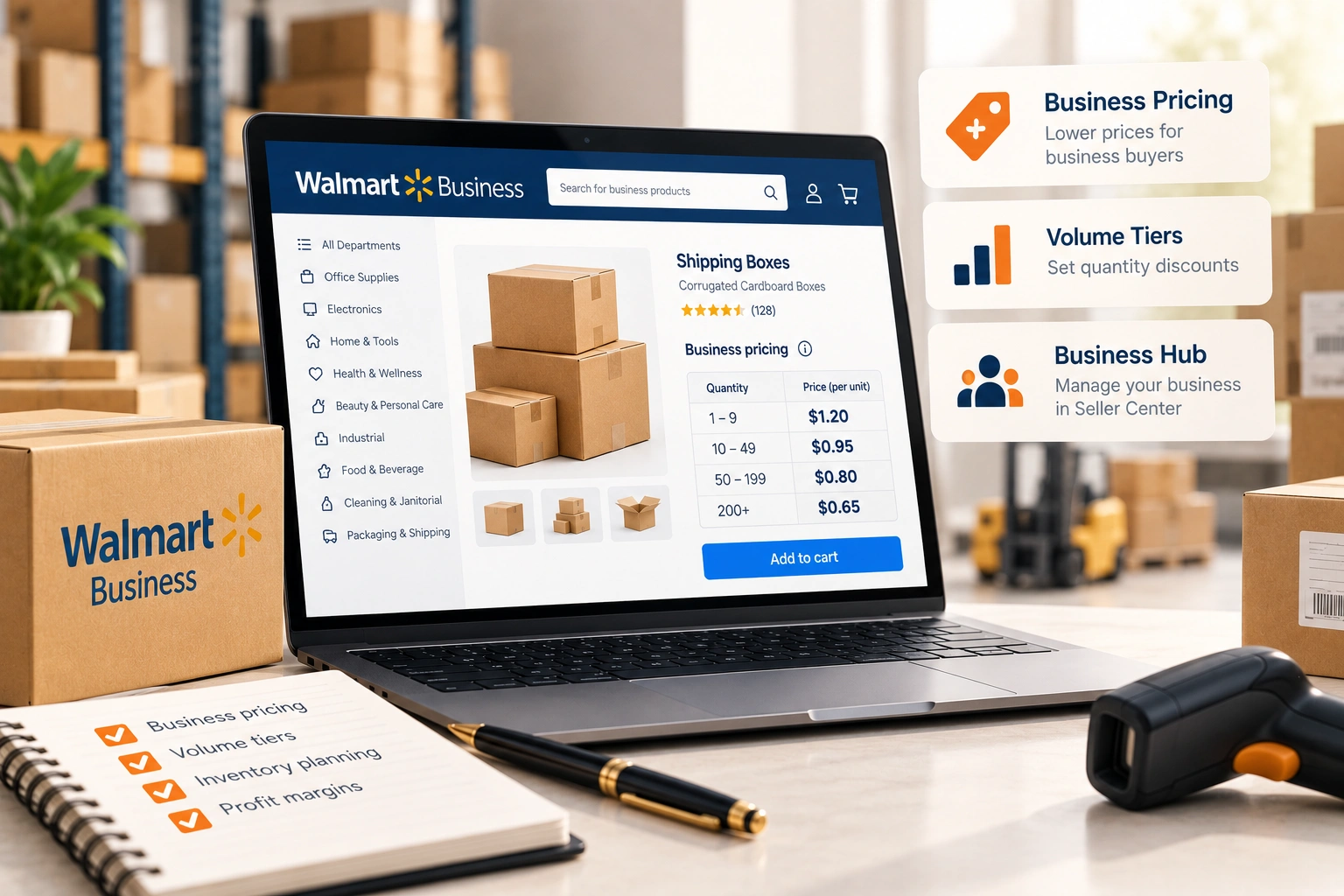
"By default, the items you sell on Walmart.com will also be available on Business.Walmart.com for the same price." You can change the business price for an item from the Business price column in your Catalog, or in bulk with Update with file, where a basic price update needs only the SKU and the business price.
Three rules decide whether a business price is worth setting. First, "if your Walmart.com price is lower than your Business.Walmart.com price, Walmart Business will display the lower price." A business price above your consumer price does nothing, so the only business price with a purpose is a lower one. Second, "only logged-in customers can view and purchase items at the Business.Walmart.com price", which is what makes a lower business price possible without dropping your public price for everybody. Third, updates "can appear in as quickly as 15 minutes or can take up to four hours", and some items are excluded by product type; the B2B item report shows which of yours are eligible.
A lower business price is still a price, and it has to hold the margin your Walmart pricing strategy is built on once the referral fee and fulfilment are paid. The reason to offer one is volume you would not otherwise have had, not a discount for its own sake.
Volume tiers, and the rule that pauses them
Volume pricing is set up as a business strategy: a named set of quantities and discount amounts. You can create one from the Business strategy column in your Catalog or from the Automate pricing page, and assign items to it in bulk with the B2B Volume pricing spreadsheet, where only the SKU and the strategy name are required. Every change appears in the Activity feed.
The rule to know before setting tiers is this one. "Walmart may automatically pause offers that are too low to protect you from unintended loss." A paused offer shows as a Pricing error, and the fix is to adjust the discount tiers, or the item price within the strategy, so the price does not fall too far as quantities rise. Once it meets the pricing rules, Walmart says the offer comes back, "which could take up to 48 hours."
So work the tiers out on paper first: the unit price at each quantity, less the referral fee and fulfilment, against your landed cost. A tier structure that looked generous in the strategy screen and then paused your offer for two days in a busy week is a worse result than no tiers at all. Amazon Business works on the same idea, and sellers already running quantity discounts there have a head start on the arithmetic.
Advertising on Walmart Business
"Sponsored Product ads aren't currently available" on Walmart Business, according to Walmart's guide, though there are display opportunities through a Walmart Connect manager. So the Sponsored Products campaigns you run on Walmart.com are not what brings business buyers to your listings. For most sellers, the business price and volume tiers do that work, and the listing itself has to carry the rest.
Leaving, or leaving some items out
Offering a business price is optional, and individual offers can be excluded from Walmart Business; Walmart has a guide for it. Leaving the program entirely is done with a request form, and "it could take up to 30 days to complete your opt-out request", so a seller who wants out before a particular date should ask well ahead of it.
What we do with it
For the Walmart sellers we run, Walmart Business is checked rather than assumed: whether the account is enrolled, which items are eligible, whether a business price is worth setting on the products business buyers actually order, and tier structures worked out against landed cost before they go into a strategy, so none of them trips the pricing rule. It sits inside the same monthly review as the rest of Walmart account management, now that the Business Hub puts its numbers in one place.
Frequently asked questions
The questions that come up most often on this subject.
Often not. Walmart's guide says most sellers have an enrolled status 60 days after becoming a Walmart Marketplace seller, and you must be an active seller in good standing. Another Walmart guide describes the program as invitation only with applications reviewed first come, first served. Check the program status in Seller Center and apply if it is not showing.
Walmart says there are no additional costs to joining the program, but standard Walmart Marketplace referral fees apply to business orders, as they do to Walmart.com orders.
Updates can take from 15 minutes to four hours to appear, only logged-in business customers see the business price, some items are excluded by product type, and if your Walmart.com price is lower, Walmart Business displays the lower price instead. The B2B item report shows which of your items are eligible.
Walmart may automatically pause offers whose volume pricing goes too low, to protect you from unintended loss. Adjust the discount tiers or the item price within your business strategy so the price does not fall too far as quantities rise. Once the pricing rules are met, the offer can take up to 48 hours to return.
Not currently. Walmart says Sponsored Product ads are not available on Walmart Business, though there are display opportunities you can ask a Walmart Connect manager about.