Walmart Inventory Management: The Numbers That Decide Visibility
Stock on Walmart is not only about not running out. Quantity, lag time and cancellations feed the delivery promise, and the delivery promise feeds ranking.


Loading Article banner
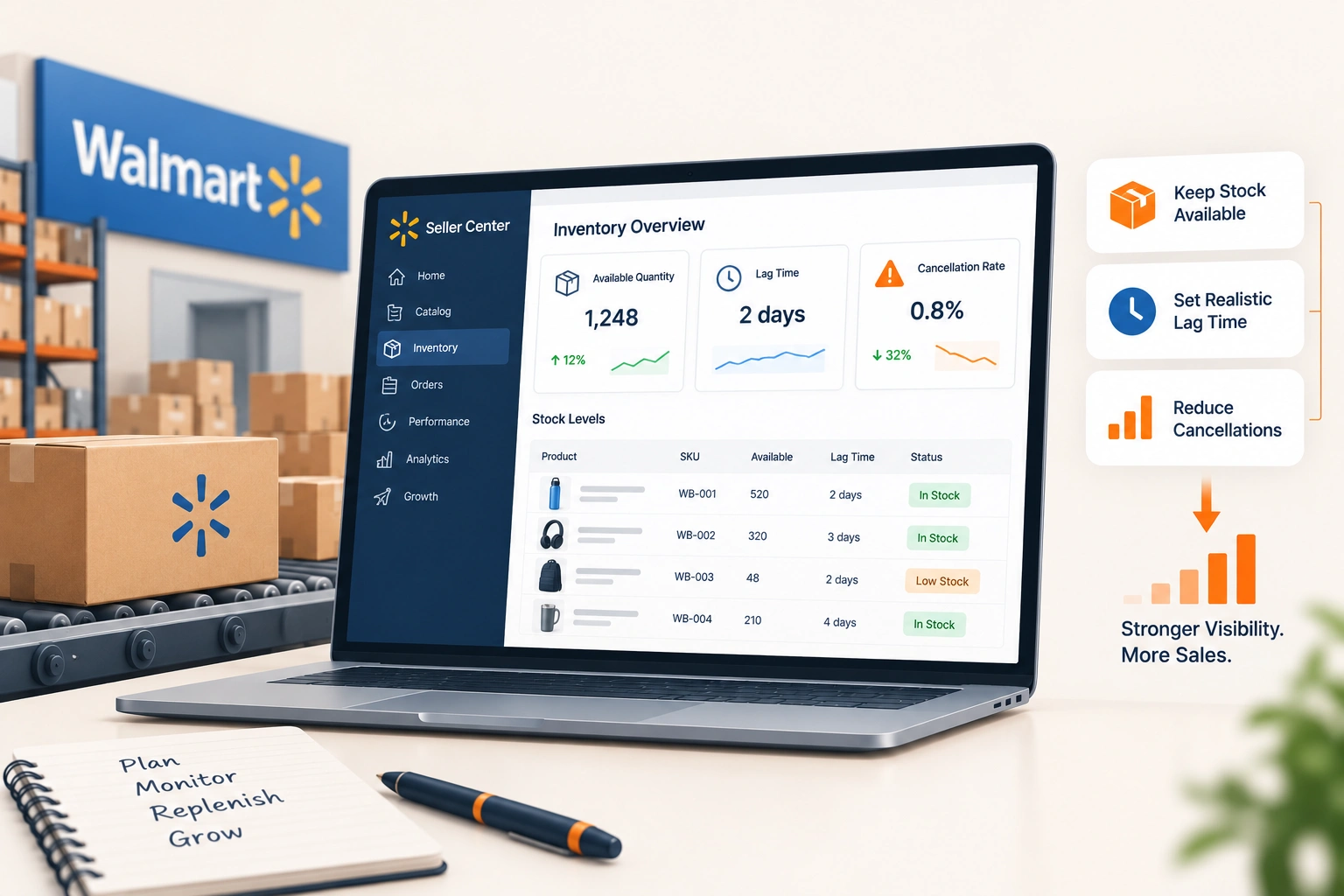
Inventory management on a marketplace is usually described as a stock problem: do not run out, do not oversell. On Walmart it is closer to a performance problem, because three inventory fields feed directly into what shoppers are promised and how the listing is ranked.
Sellers who treat stock as a number to keep above zero find their listings gradually losing to competitors with identical products and worse prices, and there is nothing in the listing itself to explain it.
The three numbers that matter
Available quantity. The obvious one. Zero means invisible; a low number can also affect how confidently the item is promoted.
Lag time. How many days between an order and it shipping. This is the number most sellers set once during onboarding and never look at again, and it is the one that sets the delivery date shown to the shopper.
Cancellation rate. What happens when the first two are wrong. Cancellations are counted against seller performance, and a poor score affects buy box eligibility across the whole account rather than just the item that caused it.
The three compound. A lag time set optimistically produces late shipments, late shipments produce cancellations and defects, and the account score falls for a reason that started as an inventory setting.
Lag time is a promise, not a preference
A shopper choosing between two identical items chooses the one arriving sooner more often than the one costing slightly less, which is why the delivery date is displayed as prominently as the price.
Setting a shorter lag time makes the listing more attractive and makes every order harder to meet. Setting a longer one makes it easier to meet and less attractive. The correct value is the one you actually hit consistently, not the one you hit on a good week.
The honest test is simple: over the last hundred orders, what proportion shipped within the lag time currently set? If it is not close to all of them, the setting is wrong and the account is paying for it in defects.
Where overselling actually comes from
Almost never from a single channel. Overselling is a multi-channel arithmetic problem: the same physical stock is listed on Walmart, Amazon, a Shopify store and possibly eBay, and each channel is told a quantity that assumes it has all of it.
There are two honest solutions and one that sounds clever and fails. Allocate stock per channel so each has its own ring-fenced quantity, or synchronise from one source of truth in something close to real time. The clever failure is syncing every few hours and hoping the gaps do not matter, which works until an item sells quickly.
Ring-fencing wastes stock and never oversells. Syncing uses stock efficiently and oversells occasionally. Which is right depends on whether your defect rate has room in it.
Fulfilment choice changes the whole picture
With Walmart Fulfilment Services the stock is held by Walmart, so the lag time question disappears, the delivery promise improves, and the cancellation risk moves largely to whether the item arrived at the warehouse.
Seller-fulfilled keeps control and the whole of the operational burden. It suits items that are slow, heavy, fragile or seasonal, where storage economics beat delivery speed.
Most established sellers run both, and the decision is usually made per item rather than per account. The comparable choice on Amazon works the same way and is made by the same reasoning.
What to automate and what to keep human
Automate the arithmetic. Quantity synchronisation across channels is a mechanical task that software does perfectly and people do badly, especially at the end of a long day.
Automate the alerts. Low stock on a fast mover, a lag time being missed repeatedly, a spike in cancellations. All three are patterns a machine spots sooner than a person reading a dashboard weekly.
Keep the buying human. How much to order, and when, depends on things no inventory system knows: a supplier's real lead time this month, a promotion planned for next quarter, whether the category is about to be seasonal.
The same division applies to advertising, and the reasoning is worked through in Amazon PPC automation: when manual management stops working.
Business models change what good looks like
Wholesale. Deep stock in fewer lines. The risk is capital tied up in slow movers, so turn matters more than availability.
Private label. Long lead times and no second source. Running out is expensive twice, because ranking built over months is lost in weeks.
Dropshipping. You are publishing somebody else's stock position as though it were yours. Supplier feed reliability is the whole of the inventory problem, and lag time has to include their handling.
Arbitrage. Stock is whatever you found, so quantities are small and accurate. The failure mode is listing something you can no longer source and cancelling.
B2B and bulk. Large orders against the same pool as retail, which is where ring-fencing earns its keep.
A weekly routine worth keeping
Read the cancellation report before anything else, because it is the score that affects everything and the one nobody looks at until it is a problem.
Check lag time performance against what is set, not against how it feels.
Look at what is out of stock and how long it has been, then at what has too much and has not moved.
Reconcile the channels against the source of truth, and investigate any difference rather than correcting it silently. A discrepancy is usually a symptom.
This is the same shape as the weekly advertising routine, and for the same reason: small regular attention beats occasional large intervention. The people who run it week to week are usually a back office team rather than the person who owns the account, which is what our BPO service exists for. Our Walmart marketplace management runs both.
Related reading: Walmart Marketplace SEO: What the Search Actually Reads and Walmart PPC: What Changes When You Come From Amazon.
Keep reading
Frequently asked questions
The questions that come up most often on this subject.
The number of days between an order being placed and it shipping. It sets the delivery date shown to the shopper, so a shorter lag time makes the listing more attractive and every order harder to meet. The right value is the one you hit consistently, not the one you hit on a good week.
Usually the delivery promise rather than the listing. A competitor with a shorter lag time or Walmart fulfilment shows a sooner arrival date, and shoppers choose that more often than they choose a small price saving.
Either ring-fence a quantity per channel so each has stock that is only its own, or synchronise from one source of truth close to real time. Ring-fencing wastes stock and never oversells; syncing uses stock efficiently and oversells occasionally.
Yes. Cancellations count against seller performance at the account level, so a problem that started with one item's stock setting can affect buy box eligibility across everything you sell.
For fast-moving items where delivery speed decides the sale, usually yes: it removes the lag time question and improves the promise. For slow, heavy, fragile or seasonal items, storage economics often beat delivery speed and seller-fulfilled wins.
Something that holds one source of truth and pushes quantities to every channel, and that alerts on low stock, missed lag times and cancellation spikes. The specific tool matters less than whether one system is authoritative; two systems that both think they are is worse than a spreadsheet.
Enough to cover the supplier's real lead time at the item's current rate of sale, plus room for the variability you actually see rather than the variability you would like. For private label with long lead times that is considerably more than it feels like it should be.
For a handful of items on one channel, yes. The moment the same stock is listed on more than one marketplace it stops being a list and becomes an arithmetic problem that runs continuously, which is what software is for.
As close to nothing as the operation allows. Rather than aiming at a threshold, treat every cancellation as having a cause worth finding, because the causes repeat: an optimistic lag time, a channel sync gap, or a supplier who is less reliable than the feed suggests.
Daily for fast movers, weekly for everything else, and a full reconciliation whenever the numbers disagree. A discrepancy corrected silently is a symptom nobody investigated.