Walmart's Listing Quality Score: The Five Parts, the New Recommendations, and the Order to Fix Them In
On 14 September 2026 Walmart's Listing Quality dashboard started recommending fixes across many listings at once, from content to pricing to restocking. The five parts of the score in Walmart's words, what moves each one, why content comes first, and how September's changes to speed, badges and reviews feed in.


Loading Article banner
A Walmart listing is graded, and the grade is not a secret. Seller Center's Listing Quality dashboard scores every published item, the score decides whether a seller qualifies for the Pro Seller tiers, and the dashboard has always said which part of a listing was dragging it down. What it did not do was tell a seller with four thousand items where to start.
On 14 September 2026 Walmart changed that. Its release note says sellers now get "personalized recommendations to help improve multiple listings more efficiently" through the dashboard, supporting actions such as "automating pricing, restocking inventory and enhancing content with GenAI". This is the score as Walmart defines it, part by part, what actually moves each part, and the order to work them in, which is not the order the dashboard lists them.
The five parts, in Walmart's words
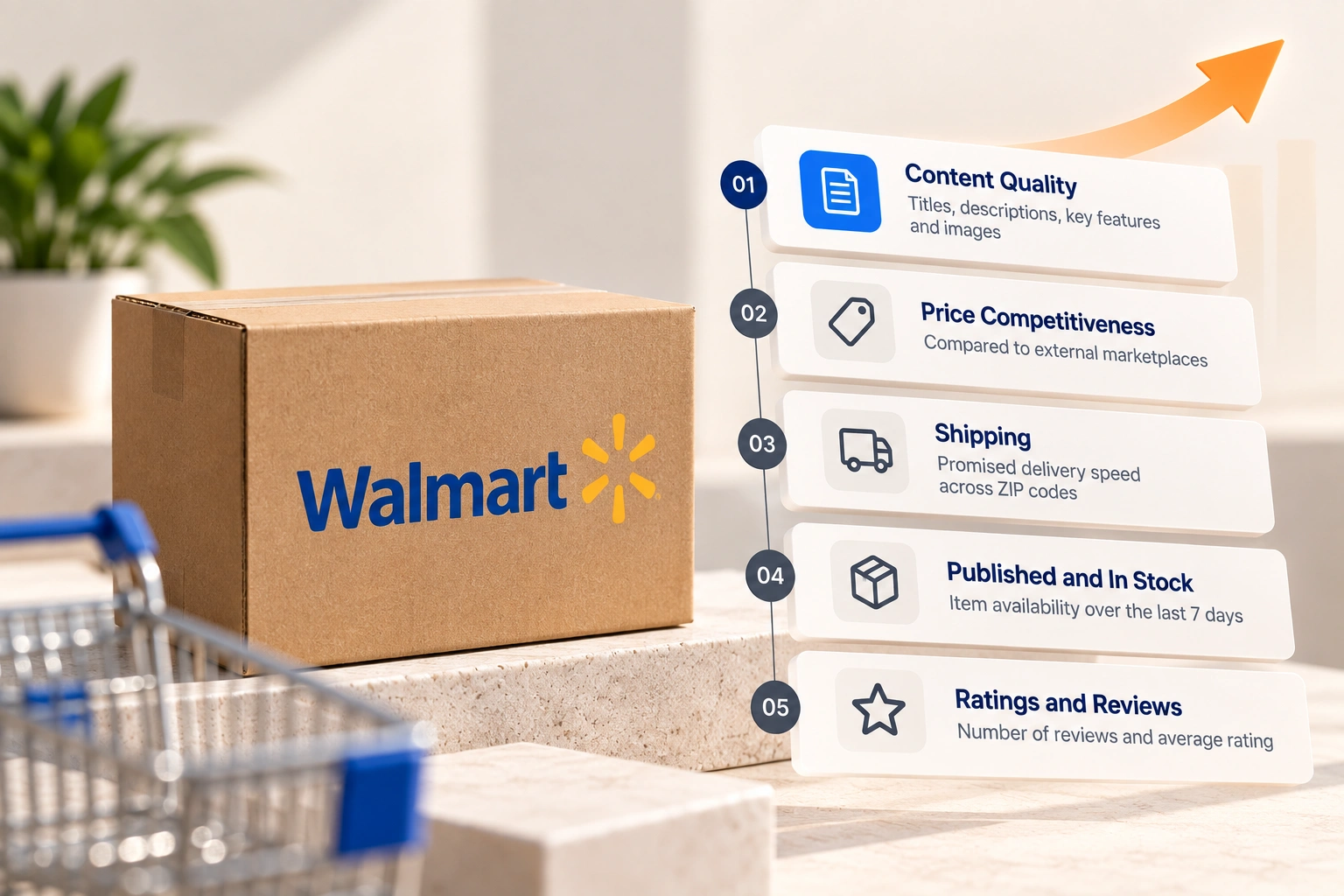
Walmart's guide to the dashboard describes a score with five components. Content quality "measures the efficacy of your listing's item name, item description, key features and images". Price competitiveness "compares your price against similar products on external marketplaces". Shipping "measures your promised delivery speed across ZIP codes", and excludes items over 50 pounds or priced at ten dollars or less. Published and in stock "shows how often your item is available to customers and is based on the last seven days". Ratings and reviews "measures an item based on the number of customer reviews and its average rating".
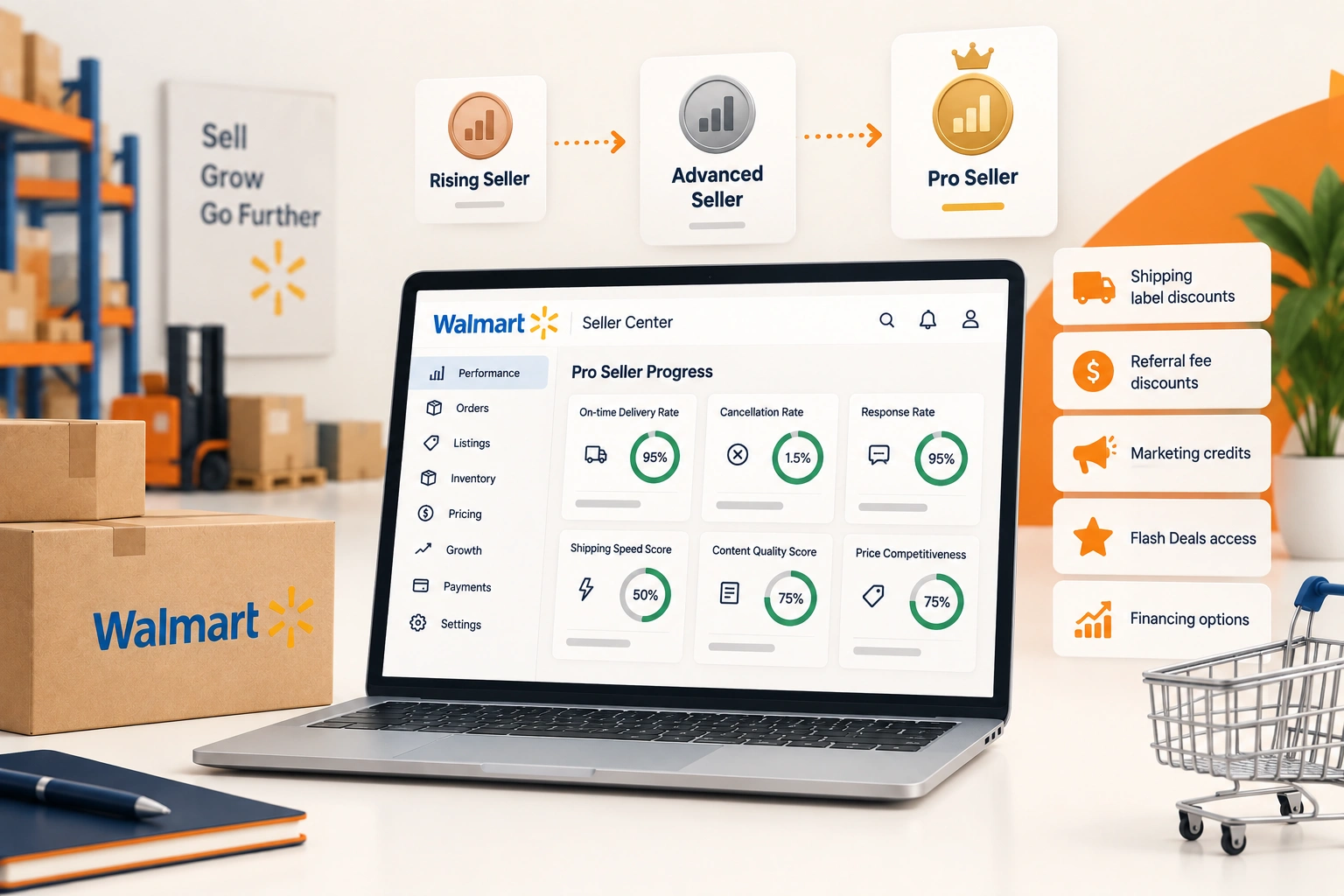
Walmart does not publish the weights, and nothing here guesses them. What it does publish is what the score unlocks: the guide says quality listings can "unlock growth opportunities such as the Pro Seller badge", and the Pro Seller tiers carry the listing quality thresholds each tier requires. So the score is not an abstraction; it is one of the gates to the tier that now carries label discounts and badge eligibility.
What the September recommendations do and do not do
The new recommendations are a triage layer: the dashboard reads the catalogue and proposes actions across many items rather than one. The three Walmart names are telling. Automating pricing addresses the price competitiveness part. Restocking inventory addresses published and in stock. Enhancing content with GenAI addresses content quality.
What a recommendation cannot do is know the margin, the supplier lead time or whether the generated content is true of the product. Automating a price to match an external marketplace is a margin decision, and Walmart pricing strategy is where that decision is made before any tool is allowed to make it. A restock recommendation is an inventory plan the seller already has or does not. And generated content lifts the content score only if it is accurate; a key feature the product does not have is a return, not an improvement.
The order to work them in
Content quality first. It is the only part the seller controls completely, today, at no cost but time. Item name, description, key features and images are attributes in Walmart's item spec, which moved to version 5.0 on 15 September 2026, and the score responds to completeness: the attributes filled, the images present, the key features stated. Walmart marketplace SEO and listing optimisation covers how the same attributes decide search; the content score is the dashboard's reading of the same work.
Published and in stock second. A seven-day availability measure punishes a listing that goes out of stock for two days a week, however good its content. Fixing it is an inventory discipline rather than a listing edit, which is why the dashboard's restocking recommendation exists, and Walmart inventory management is the longer answer.
Shipping third. Promised delivery speed across ZIP codes is a fulfilment decision: where the stock sits, which service is used, what the promise says. September's other changes make this part worth more than it was. The Walmart+ badge now qualifies on a 14-day lookback, and tiered sellers get discounts on Ship with Walmart labels when the shipping speed matches the delivery promise, both set out in what Walmart now pays for delivery speed. The same promise that lifts the shipping score earns the badge and the discount.
Price competitiveness fourth, and only where the margin allows. The comparison is against external marketplaces, so a product priced for Walmart's fees and shipped by WFS may score as uncompetitive against a price somewhere else that carries different costs. That is a reason to understand the gap, not necessarily to close it.
Ratings and reviews last, because they are the slowest to move and the only part a seller cannot act on directly. The one action that exists got easier on 25 September 2026: Walmart's Recognized Reviewer programme now accepts items with fewer than 15 reviews, effective immediately, which is the route for a new or slow-reviewing item to earn the count the score measures.
How this differs from the Amazon listing work
An Amazon listing is optimised for search and conversion, and the feedback is sales. A Walmart listing has those too, and also a published grade that gates programme eligibility, with two of its five parts (availability and shipping) measuring operations rather than the page. A brand that treats Walmart listing optimisation as a copywriting job fixes one part in five. The dashboard's September change is Walmart saying so: its recommendations are about pricing and stock as much as content, because the score is.
How we work it
We run the dashboard as a work order in that order: the attributes and images to the spec, then the availability, then the promise and the service behind it, then the price against the margin, then Recognized Reviewer for the items that qualify, reading the score weekly and the tier monthly. That is what our product listing optimisation looks like on Walmart, where the listing and the operation are graded together. If your dashboard is showing recommendations across hundreds of items and you do not know which to act on first, the order above is the answer, and we are glad to work it with you.
Frequently asked questions
The questions that come up most often on this subject.
Five parts, in Walmart's words: content quality (the efficacy of item name, description, key features and images), price competitiveness (your price against similar products on external marketplaces), shipping (promised delivery speed across ZIP codes, excluding items over 50 pounds or priced at ten dollars or less), published and in stock (availability over the last seven days) and ratings and reviews (the number of reviews and the average rating). Walmart does not publish the weights.
From 14 September 2026 the dashboard gives personalised recommendations to improve multiple listings at once, supporting actions Walmart names as automating pricing, restocking inventory and enhancing content with GenAI.
Content quality, because it is the only part the seller controls completely and immediately: the item name, description, key features and images as attributes in Walmart's item spec. Then availability, then shipping speed, then price where the margin allows, and reviews last because they move slowest.
Yes. Walmart's guide says quality listings can unlock growth opportunities such as the Pro Seller badge, and the Pro Seller tiers each carry a listing quality threshold. The score is one of the gates to the tier.
Through Walmart's Recognized Reviewer programme, which from 25 September 2026 accepts items with fewer than 15 reviews. It is the one direct route to the review count the score measures; everything else about that part of the score follows from sales and product quality over time.