The Walmart+ Badge and Delivery Speed: What Walmart Now Pays For
In September 2026 Walmart tied delivery speed to money three ways: the Walmart+ badge now qualifies on a 14-day window, Ship with Walmart labels are up to 35% cheaper when the speed matches the promise, and a Speed Insights dashboard shows where the gap is. Here is how the pieces fit and what to change first.


Loading Article banner
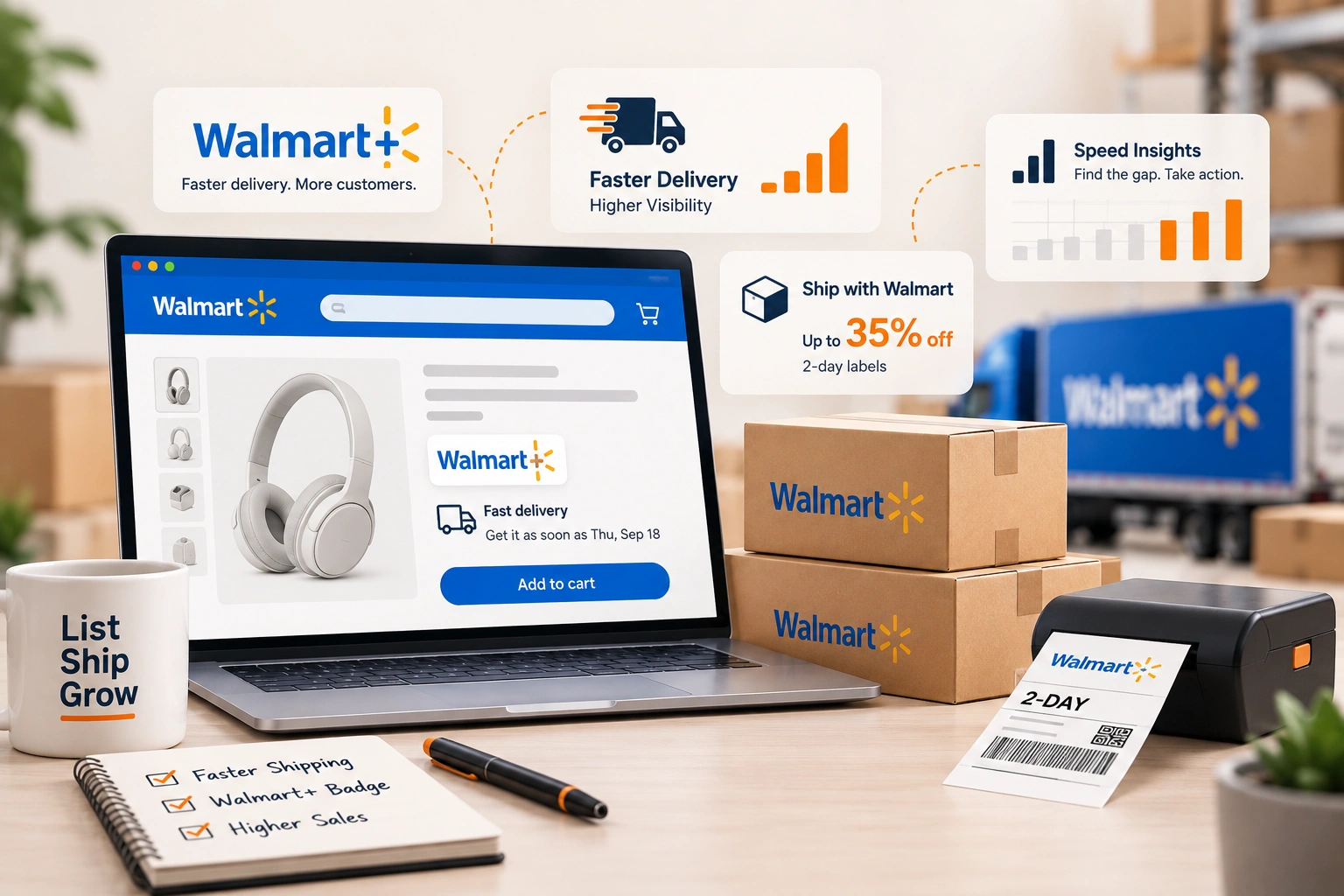
Walmart published nine release notes in the first three weeks of September 2026, and four of them are the same subject from different sides: how fast a seller-fulfilled order arrives, and what Walmart will give a seller who makes it arrive faster. The Walmart+ badge, the label discounts, a new dashboard and the international templates are one policy, which is that delivery speed is now a thing Walmart pays for directly rather than a standard it merely enforces.
That matters for the sellers who ship their own orders, which on Walmart is most of them. A seller who has treated fulfilment as a cost to keep down now has a reason to treat it as a lever, and the reason has numbers on it. This article puts the four notes together, says what each one asks for, and gives the order to work them in.
The Walmart+ badge, and the 14-day window
The Walmart+ badge marks an item that a Walmart+ member will get with the membership's delivery promise, and it sits on the listing where a member is deciding. Walmart Fulfillment Services items carry it by the nature of the service. A seller-fulfilled item earns it by performance, and on 9 September 2026 Walmart's release note said the qualification now looks at a 14-day window rather than the longer period it used before.
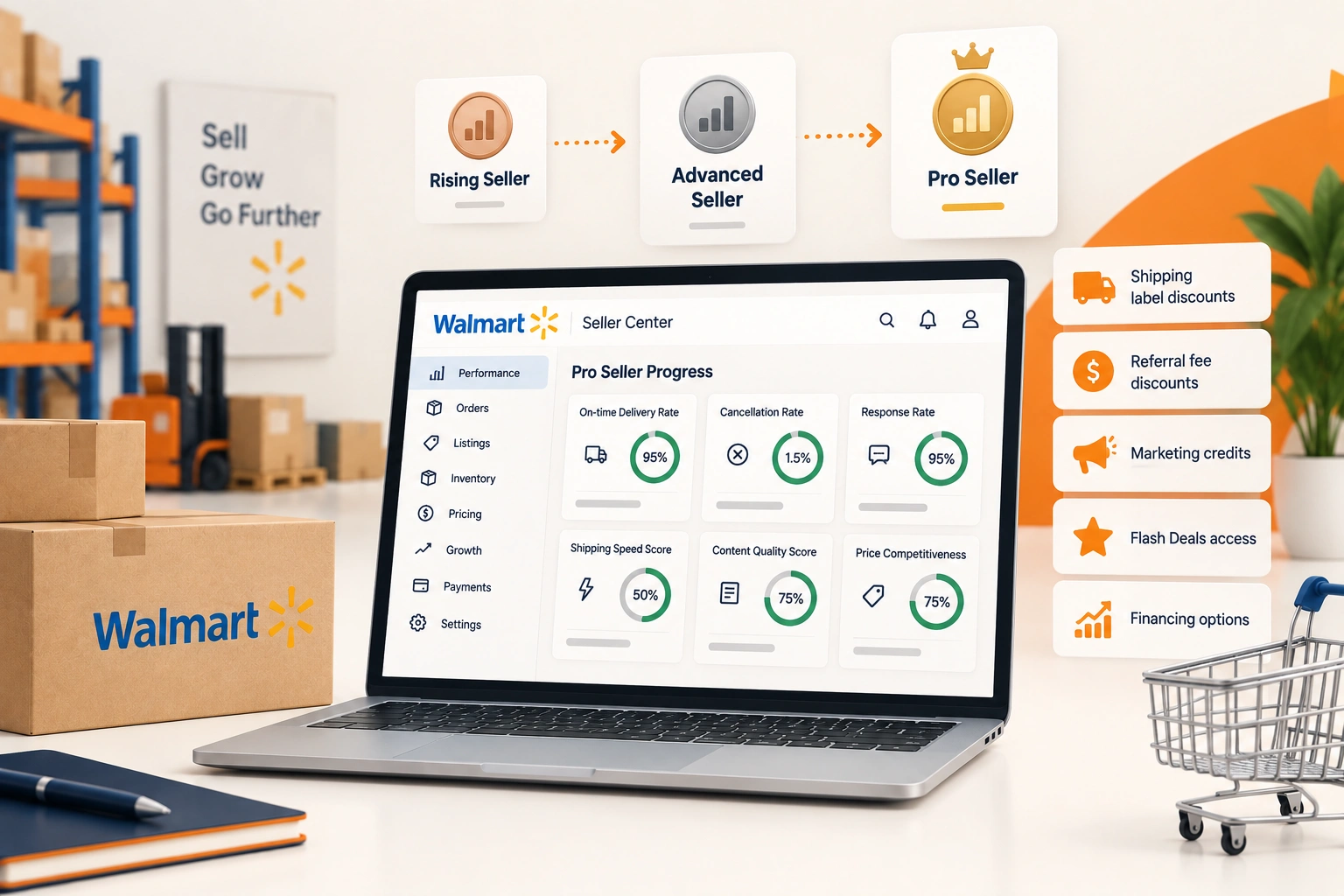
The thresholds, as the seller press reported them from that note, are an on-time delivery rate above 90% and a cancellation rate below 2.5% over the window; Walmart's own badge guide is the page to confirm them on, and the figures here are reported rather than quoted. What the change does is not in doubt: a seller who fixes a bad stretch is back on the badge in two weeks instead of a month, a new seller reaches it sooner, and a seller who tests a new carrier or a new handling time sees the result in the badge inside a fortnight.
The other edge is the same. A bad two weeks now drops an item off the badge faster than a bad two weeks used to, because the window that forgives quickly also punishes quickly. The badge is no longer a reward for a good quarter; it is a live reading of the last fourteen days, and it has to be watched that way.
Ship with Walmart, discounted for keeping the promise
Since 4 September 2026, Walmart's note says, eligible Pro, Rising and Advanced sellers get up to 35% off 2-day labels and up to 15% off 3-day labels bought through Ship with Walmart, applied automatically, on one condition: the shipping speed has to match the delivery promise the listing made to the customer. A 2-day label on an order promised in two days earns the discount. A 2-day label on an order promised in five does not.
Read that condition as the point of the programme rather than a catch. Walmart is not paying sellers to buy faster labels; it is paying them to promise faster and then keep the promise, which is the thing the badge measures from the other side. A seller who tightens the delivery promise on a listing, ships to it with a discounted label, and holds the on-time rate has moved the same number three ways at once.
The same week, Ship with Walmart labels became available inside ShipStation, which matters for a seller running several channels from one desk: the discount applies to a Walmart label bought where the other channels' labels are bought, with no second workflow.
Speed Insights, which says where the gap is
On 10 September Walmart added a Speed Insights dashboard to Seller Center that puts the shipping metrics in one place with recommendations against them. Before it, a seller diagnosing slow delivery read the on-time rate in Performance, the handling time in the shipping settings, the carrier's transit in the carrier's own reports, and worked out the gap by hand. The dashboard is that work done once.
The way to use it is to ask one question: where does the promise fail? A promise fails at handling (the order sat before it shipped), at the carrier (it shipped on time and arrived late), or at the promise itself (the listing offered a speed the operation cannot keep). Each has a different fix, and the dashboard is the first place that shows which one a seller has.
International templates, for the same reason
The 1 September note added international shipping templates for fifteen countries, each with customisable transit times. It reads as a separate feature and it is the same policy: a promise Walmart can display is a promise it can measure, and a seller shipping abroad from one template with one transit time was promising the same speed to a customer in Canada and a customer in Australia. Templates with their own transit times let the promise be true in each place, which is what keeps the on-time rate up on international orders.
What to change first
The order is the order of the notes read backwards. Open Speed Insights and find where the promise fails, because everything else depends on the answer. If it fails at handling, fix handling time before touching the promise: a shorter promise on a slow warehouse loses the badge in fourteen days. If it fails at the carrier, the label discount changes the arithmetic on a faster service, and a 2-day label at 35% off is often cheaper than the 3-day label was. If the operation already keeps its promises, tighten the promise, take the discount, and watch the badge arrive within the window.
Then hold it. The badge is a rolling fourteen days, so the routine that earns it is the routine that keeps it: the on-time rate and the cancellation rate read weekly, the handling time set to what the warehouse does on its worst day rather than its best, and a carrier mix reviewed before peak rather than during it. For a seller who would rather not run that routine, the honest alternative is Walmart Fulfillment Services, which carries the badge by the nature of the service and charges for it. The choice between the two is the subject of that article; this one is for the seller who ships their own orders and wants what Walmart is now offering for doing it well.
Keep reading
It is the same shape as the Amazon work. The badge and the label discount are Walmart's version of the Buy Box: a placement earned by performance the platform can measure, held by a routine, and lost by a bad fortnight. Sellers who run both channels will recognise the discipline, and it is the first thing we set up when we take on Walmart marketplace management for a brand that fulfils its own orders. Inventory that is where the order is is the other half of it, because the fastest label cannot ship stock that is in the wrong place.
Related reading: Selling on Walmart vs Amazon: What Really Differs.
Frequently asked questions
The questions that come up most often on this subject.
By performance over a rolling window, which Walmart's 9 September 2026 release note shortened to 14 days. As reported from that note, the item needs an on-time delivery rate above 90% and a cancellation rate below 2.5% over the window; Walmart's badge guide in Seller Center is the place to confirm the thresholds. Items fulfilled by Walmart Fulfillment Services carry the badge by the nature of the service.
Since 4 September 2026, eligible Pro, Rising and Advanced sellers get up to 35% off 2-day labels and up to 15% off 3-day labels bought through Ship with Walmart, applied automatically, provided the shipping speed matches the delivery promise the listing made. A 2-day label on an order promised in five days earns nothing.
Because the last fourteen days fell below the thresholds. The window that lets a seller recover in two weeks also drops an item in two weeks, so a bad fortnight of late deliveries or cancellations removes it. Open Speed Insights in Seller Center to see whether the promise failed at handling, at the carrier or at the promise itself, fix that one, and the badge returns within the next window.
Only if the operation keeps it. A shorter promise earns the badge and the label discount, and it also raises the standard the on-time rate is measured against, so a promise the warehouse cannot keep on its worst day loses both within fourteen days. Read Speed Insights first, fix handling if that is where the gap is, and tighten the promise on the listings the operation can honour.
Yes. Items fulfilled by Walmart Fulfillment Services carry the badge as part of the service, which is one of the things the WFS fee buys. The badge rules and the label discounts in this article are for seller-fulfilled items; the choice between the two is a fulfilment decision, covered in the WFS article.