Walmart Pro Seller Tiers: What Rising, Advanced and Pro Require
Walmart's badge is three tiers now, each with its own thresholds across six metrics. The numbers, the gate you have to clear before any of them count, what each tier is worth, and the metric that stops most sellers.


Loading Article banner
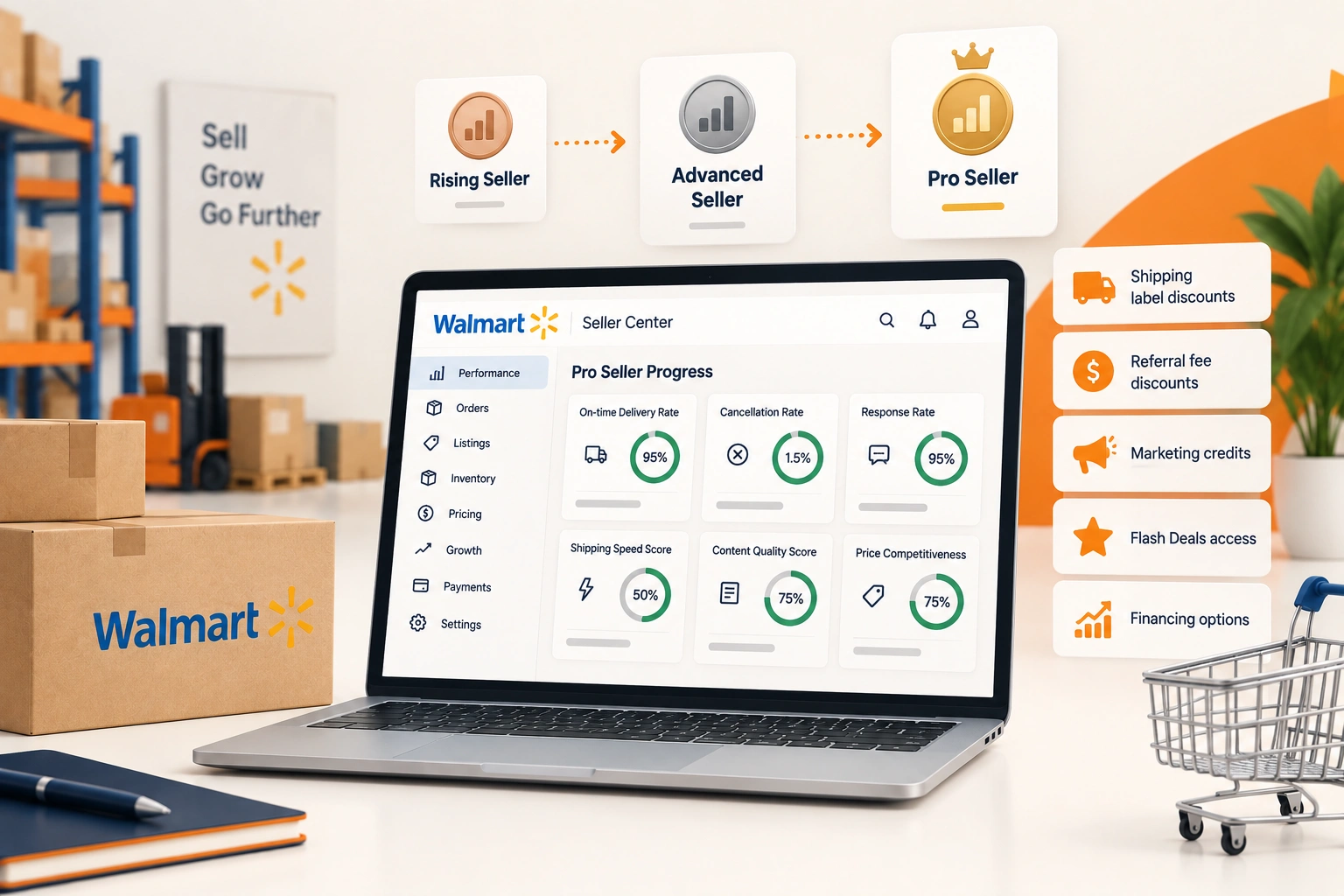
Walmart's Pro Seller badge used to be one thing you either had or did not. It is three tiers now: Rising Seller, Advanced Seller and Pro Seller, each with its own threshold on the same six metrics, and each unlocking a different amount of money.
That matters more than a badge normally would, because Walmart has started attaching real economics to the tier. The tiered Ship with Walmart label discounts announced on 4 September 2026 are offered to eligible Pro, Rising and Advanced sellers, which is the first time the tier has decided what you pay to ship rather than only what a shopper sees.
The gate before any of the metrics count
Three conditions apply to every tier, and failing any of them makes the rest academic. More than 100 orders in a rolling 90 day window. At least 90 days active since onboarding or since an account reinstatement. Full compliance with Marketplace policies.
The top tier adds one more: a seller rating of 4.0 or higher. That is the review score, not a performance metric, and it is the one thing on this list you cannot fix in a fortnight of operational effort.
The 90 day activity clock resetting on reinstatement is the detail worth knowing before you need it. An account that comes back from a suspension starts the clock again, which is one more reason the cost of a compliance problem is never only the suspension.
The six metrics, and the number at each tier
On time delivery rate: 90% or better for Rising, 92.5% for Advanced, 95% for Pro. This is measured against the delivery date the shopper was promised, not the one you hoped for.
Cancellation rate: 2.5% or lower for Rising, 2.0% for Advanced, 1.5% for Pro. Seller cancellations, which in practice means stock you did not have. On a hundred orders a quarter, the difference between Rising and Pro is one order.
Seller response rate: 90% for Rising, 92.5% for Advanced, 95% for Pro. Customer messages answered inside Walmart's window.
Shipping speed score: 5% for Rising, 25% for Advanced, 50% for Pro. This is the share of your catalogue available at the faster delivery speeds, and it is the one that separates the tiers in practice.
Content quality score: 65% for Rising, 70% for Advanced, 75% for Pro. The same score the Listing Quality dashboard reports, driven mostly by attributes rather than by copy.
Price competitiveness score: 65% for Rising, 70% for Advanced, 75% for Pro. How your prices compare to the same item elsewhere, as Walmart sees it.
Shipping speed is the one that stops people
Five of the six metrics are things a competent operation already does. Answer messages, hold stock, price sensibly, fill in attributes. A seller running well is usually close to Pro thresholds on all of them without trying.
Shipping speed score is different, because 50% is not an operational improvement. It is a fulfilment decision. Half the catalogue has to be available at the faster speeds, which means stock positioned to reach most of the country inside the window, and that usually means Walmart Fulfillment Services, a 3PL with the right footprint, or regional inventory you were not holding.
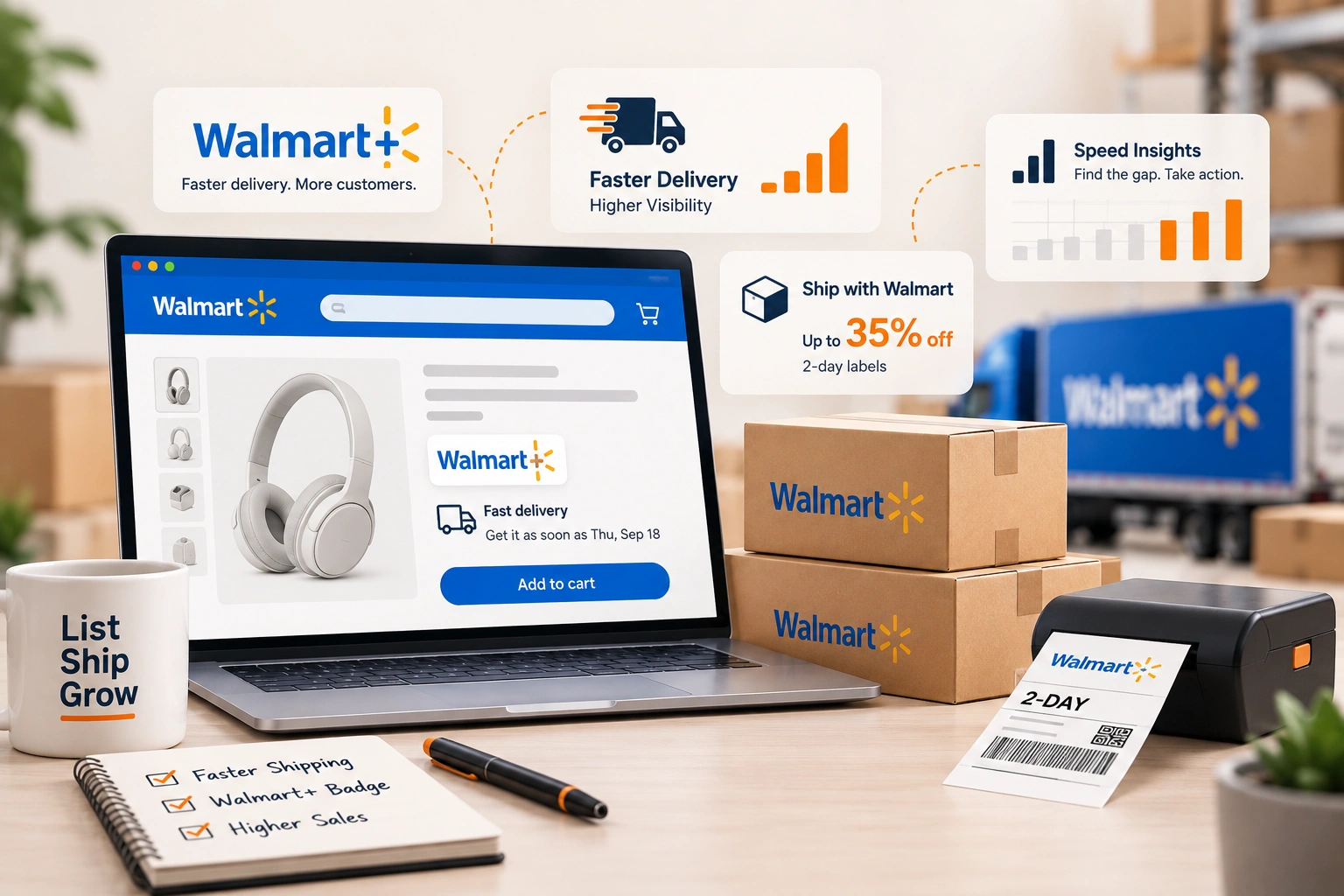
This is the same economics that the Walmart+ badge and the Speed Insights dashboard are built around, and it is not a coincidence. Walmart is paying for speed in several currencies at once now, and the tier is one of them.
Content quality is an attribute problem
Seventy five percent content quality sounds like a copywriting target and is not. Walmart's score leans heavily on structured attributes, and most catalogues imported from another marketplace arrive with the attribute fields empty because the source did not have them.
That is good news for the effort involved. Filling attributes is bulk work on a spreadsheet, not a rewrite, and it moves the score further than any amount of description polish. The detail is in what Walmart search actually reads, and the same fields do both jobs: the score and the ranking.
What each tier is worth
Walmart lists the benefits by tier. Rising Seller gets shipping label discounts and enhanced payout options. Advanced Seller adds a 5% referral fee discount, a 50 dollar Post Purchase Reviews credit and access to financing. Pro Seller gets a 10% referral fee discount, a 50 dollar search engine marketing credit, access to Flash Deals, invitations to exclusive training, and special financing terms.
The referral fee discount is the line that decides whether this is worth a project. Ten percent off referral fees is ten percent off the largest variable cost in the account, and on a catalogue doing meaningful volume it will pay for the fulfilment change that got you there. Run the arithmetic on your own numbers before you decide: the discount applies to the fee, not to the sale, so the margin per unit is where you see it.
Flash Deals access is the benefit sellers underrate. A deal placement on Walmart moves volume in a way the badge alone does not.
When the tier actually changes
Pro Seller status refreshes on the fifth and the twentieth of every month. Once the criteria are met, the next refresh grants the highest tier you qualify for.
Two refreshes a month is fast enough that a fix made in the first week of a month can show by the twentieth, and slow enough that it is not worth checking daily. It also means the metric window, not the refresh, is the thing to plan around: the order count is a rolling 90 days, so a quiet quarter can drop you below the hundred order gate while every performance number looks healthy.
The order to fix it in
Check the gate first. Orders in the last 90 days, days active, policy standing, and the seller rating if Pro is the target. There is no point optimising a metric if the gate is what is holding you.
Then take the cheapest metric first. Response rate is a staffing question and moves in a week. Cancellation rate is an inventory accuracy question and moves in a month. Content quality is a spreadsheet. On time delivery is a carrier and cutoff question.
Leave shipping speed score until last, because it is the one that costs money, and you want to arrive at it knowing exactly which tier it is buying you.
Where this goes next
The tiers reward the same thing Walmart has rewarded for two years, which is an account that behaves like a retailer rather than like a listing. The numbers are just the version with a discount attached.
Getting an account from Rising to Pro is a quarter of deliberate work across fulfilment, catalogue and service, and it is most of what Walmart marketplace management is for. The badge is the visible part. The referral fee discount is the part that pays for it.
Related reading: Selling on Walmart vs Amazon: What Really Differs.
Frequently asked questions
The questions that come up most often on this subject.
More than 100 orders in a rolling 90 day window, and the account must have been active for at least 90 days since onboarding or reinstatement. That gate applies to all three tiers, so a healthy but low volume account can be blocked by order count alone.
The same six metrics at rising thresholds. On time delivery moves from 90% to 92.5% to 95%, cancellation rate from 2.5% to 2.0% to 1.5%, response rate from 90% to 92.5% to 95%, shipping speed score from 5% to 25% to 50%, and both content quality and price competitiveness from 65% to 70% to 75%. Pro also requires a seller rating of 4.0 or higher.
In our experience it is shipping speed score. The other five respond to operational discipline, but 50% of the catalogue available at the faster speeds is a fulfilment decision about where stock sits, not a process fix.
On the fifth and the twentieth of every month. When the criteria are met you receive the highest tier you qualify for at the next refresh, so a fix made early in a month can be reflected within about two weeks.
The badge itself is a modest conversion signal. The referral fee discount is the real number: 5% at Advanced and 10% at Pro, taken off the largest variable cost in a marketplace account. Work out what that is worth on your own volume before committing to the fulfilment change that shipping speed score usually requires.