Walmart Pricing Strategy: Why Your Listing Went Unpublished
Walmart enforces price in a way Amazon does not. A listing can be taken off the site for being more expensive somewhere else, including on your own store.


Loading Article banner
Sellers arriving on Walmart from Amazon usually bring one assumption with them: that price affects how well a listing performs. On Walmart it decides whether the listing performs at all.
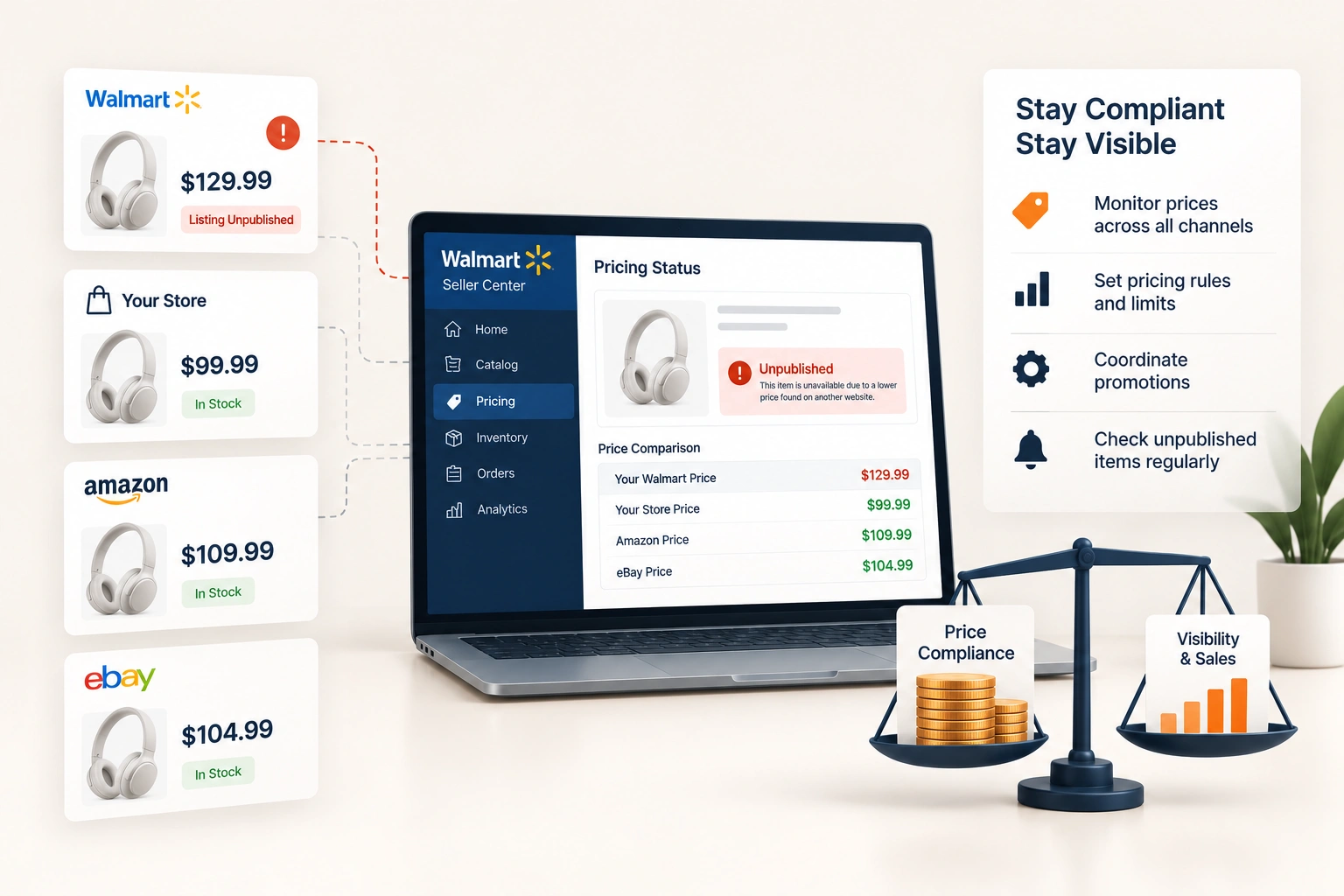
Walmart operates price rules that can remove an item from the site entirely. Not demote it, not lose it the Buy Box, but unpublish it, so the page still exists in the seller centre and shoppers cannot buy from it. Most sellers meet this the first time an item quietly stops selling and nothing in the advertising account explains why.
What the price rules actually compare
Two comparisons matter, and they are different problems.
The same item, cheaper somewhere else. Walmart compares your listing against the same product sold elsewhere on the open web, your own website included. An item priced higher on Walmart than a shopper can find it elsewhere is a candidate for being unpublished, and the comparison does not care that the other seller is you.
The same item, cheaper on Walmart. Where several sellers offer one item, the offer that wins the buy box is the one Walmart shows, and price is the largest input into that decision alongside fulfilment speed and seller performance.
The first catches people out far more often, because it depends on prices set on a channel they were not thinking about when they set them.
Why your own site is the usual culprit
A brand running a promotion on its own store, or a discount code an affiliate has published, has effectively set a lower public price for the same item. Walmart's comparison reads that as the product being available cheaper elsewhere.
This is the single most common cause of an unexplained unpublish for a brand selling across several channels, and it is entirely avoidable. Whoever runs the store promotions has to know that a site-wide 20% code moves the effective price on every channel that is watching.
The same applies to marketplaces you may not think of as competition. If the item is on eBay through a distributor, or on a comparison shopping engine at a lower price, it counts.
Repricing is not the same problem it is on Amazon
Amazon repricing is largely a contest between sellers of the same ASIN, and the aim is winning the buy box at the highest price that still wins it.
Walmart repricing has that contest in it, and a second one underneath: staying compliant with the external comparison at the same time. A repricer that only watches other Walmart offers will happily raise a price into a range that gets the listing unpublished, and it will report that as a win.
So the rule to give a repricer is a floor and a ceiling, where the ceiling is set by what the item costs anywhere else you or your distributors sell it, not by margin alone.
Price is also a ranking input, not only a compliance one
Walmart's search ranking weighs price more visibly than Amazon's does. Two comparable listings, one meaningfully cheaper, and the cheaper one tends to be placed better, which is consistent with a retailer whose whole brand is built on price.
That does not mean racing to the bottom. It means the pricing decision and the ranking decision are the same decision on this marketplace, and treating them separately is how a well-optimised listing ends up on page three.
This is one of several ways Walmart search behaves differently from Google, and the general distinction is worth reading in and from Amazon, which weighs price far less openly.
How to price across channels without tripping anything
Set the reference price once. Decide the public price of the item, then treat every channel as needing a reason to differ from it. Ad hoc channel pricing is what creates the mismatch.
Coordinate promotions. A discount on the brand site needs a matching decision on the marketplaces, or a decision that the marketplace listing comes down for the duration. Either is fine. Neither happening is what causes the surprise.
Give the repricer a real ceiling. Not the maximum margin you would like, but the maximum price that stays under the lowest public price for the item anywhere.
Watch the unpublished report. It exists in the seller centre and almost nobody reads it daily. It is the fastest signal that a price decision made somewhere else has reached this channel.
Business models change what this means
Private label. You control the price everywhere, so this is a coordination problem rather than a negotiation. It is also the easiest to get wrong, because the brand site is usually run by a different person from the marketplace channel.
Wholesale and distribution. You do not control what other sellers do with the same item, so the ceiling is set by them and needs monitoring rather than deciding.
Dropshipping. Supplier price changes move your cost without warning, so the floor moves under the repricer. A floor that is set once and forgotten is a floor that eventually sells at a loss.
Arbitrage. The external comparison is the whole risk. If you sourced it somewhere the public can also buy it, that public price is the ceiling.
What to do when a listing is already unpublished
Find the comparison first. The seller centre will usually say the item is unpublished for price, and the work is establishing which cheaper listing triggered it, because the fix depends on whether that listing is yours.
If it is yours, the choice is to raise it there or lower it here, and that is a commercial decision rather than a compliance one.
If it is not yours, either match it, or accept the item is not viable on this channel at a price you can live with. Both are legitimate answers, and pretending the second one does not exist is how sellers end up carrying items that make nothing.
Where this fits with everything else on the channel
Price sits underneath the rest of the work. There is no point optimising a listing that is unpublished, and no point advertising one that cannot win the buy box, so this is the first thing to settle rather than the last.
Once it is settled, the order is listing quality, then stock reliability, then advertising, which is roughly the order of how much each one changes. Sellers running the same catalogue on Amazon should expect the sequence to feel familiar and the price rule to have no equivalent there.
Our Walmart marketplace management service covers the whole of that sequence, and the advertising end of it is set out in ROAS standards for Amazon PPC, TikTok Shop and Walmart Connect.
Related reading: Repricing Without Racing to the Bottom.
Related reading: Walmart Fulfillment Services: What WFS Changes and Walmart Inventory Management: The Numbers That Decide Visibility.
Related reading: Selling on Walmart vs Amazon: What Really Differs.
Frequently asked questions
The questions that come up most often on this subject.