Walmart Seller Account Suspended: The Appeal, the Four Account Statuses and Walmart's New Termination Rule
A suspended Walmart seller account stops every listing and holds payments. What each of Walmart's four statuses stops, what an appeal must contain, where it goes, and why the 12 November 2026 policy update makes waiting a risk.

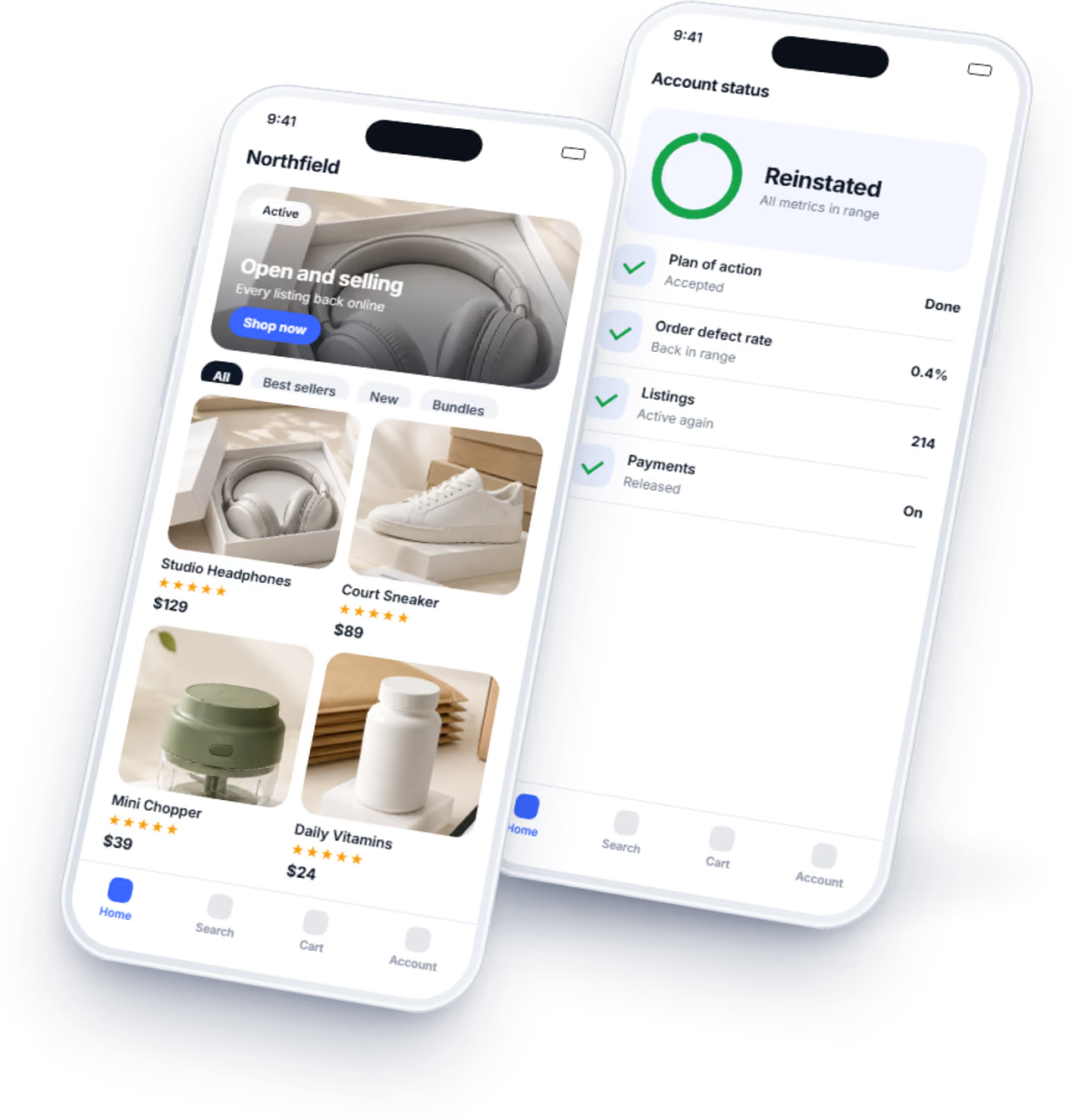
Walmart seller account suspended: in an email from Walmart, those words mean the business has stopped selling there, everywhere at once. Walmart's own guide says that under a suspension both seller-fulfilled and Walmart-fulfilled listings become "non-transactable and non-discoverable", access to Seller Center is restricted, and payments are put on hold. The way back is an appeal, sent through Seller Center with a written plan of action.
Since 12 November 2026 there is a new reason not to wait. Walmart's release notes now say it "reserves the right to terminate qualifying seller accounts that remain suspended beyond a reasonable threshold without a successful appeal or reinstatement", and a terminated account cannot appeal at all.
This guide covers the four account statuses, the causes, the appeal, what Walmart says about money and stock while you wait, and the item-level return rule starting in January 2027. Every rule below is quoted from Walmart's Marketplace Learn guides and release notes as they read on 15 November 2026.
Suppression, Pause, Suspension and Termination: What Each One Stops
Walmart uses four statuses. Each takes away something different, and only the first three leave a way back.
Suppression. Seller-fulfilled listings become non-transactable and items may show as out of stock. Listings fulfilled by Walmart stay on Walmart.com. A suppression has its own appeal button: a banner on the Performance page in Seller Center, then "Start appeal".
Pause. Both seller-fulfilled and Walmart-fulfilled listings become non-transactable.
Suspension. Both kinds of listing become non-transactable and non-discoverable, so they disappear from search as well as checkout. Walmart adds that you will face restrictions on Seller Center access and that your payments will be put on hold.
Termination. All listings are removed, and selling privileges and access to Seller Center are "permanently revoked". Payments are put on hold here too. The appeal guide is blunt about what follows: "If your selling privileges have been terminated, Walmart isn't required to provide a reason and appeals will not be granted."
Walmart sends every one of these notices through Seller Center and by email, and its guide notes that you cannot unsubscribe from them. If the address on the account is one nobody reads, change that before anything else, because the notice is where the reason and the appeal eligibility are written.
What Changed on 12 November 2026
Walmart's release note of 12 November, titled "Update to our suspension and termination policy", adds one sentence that changes how a suspension should be handled: the marketplace may terminate qualifying accounts that stay suspended "beyond a reasonable threshold" without a successful appeal or reinstatement. The same sentence now sits in the suspension and termination guide.
Walmart gives no number of days, and we will not guess one. What the sentence does settle is that a suspension is no longer a state an account can sit in while the business decides what to do. A suspension can be appealed. A termination cannot, and Walmart does not have to say why it happened.
Our reading: treat the day the suspension notice arrives as the start of a deadline whose length you do not know. The release note asks the same thing in Walmart's words, to "review the reason for the suspension and take the appropriate steps to rectify it or submit an appeal". A complete appeal sent in the first week is worth more than a perfect one sent after the threshold has passed.
This is a different rule from the one for accounts that simply stop selling. An account with no sales for a long stretch is handled by Walmart's inactivity rule, which we cover in our article on Walmart's 455-day rule and keeping a parked account alive.
Why Walmart Suspends a Seller: The Performance Standards
Most suspensions come from one of two places: the Seller Performance Standards, or a breach of Walmart's policies and agreement. The standards are numeric and published, which makes them the easier case to diagnose. Walmart evaluates them "over the last 30 days or 60 days", and the thresholds are these:
Cancellation Rate, orders cancelled by the seller: 2% or below. On-Time Delivery Rate, orders delivered on or before the expected delivery date: 90% or above. Valid Tracking Rate: 99% or above. Seller Response Rate, customer inquiries answered within 48 hours: 95% or above. Negative Feedback Rate, orders from the past 60 days with a one or two star rating: 2% or below. Return Rate, on orders delivered in the past 60 days: 6% or below, or 9% for resold inventory. Item Not Received Rate: 2% or below. The standards table also lists a Late Shipment Rate of 5% or below.
Walmart's wording on the consequence is the same for all of them: "Failure to do so may result in suppression, suspension or termination of your account." It notifies a seller who misses a standard by email and in Seller Center. The guide does not describe a formal warning stage or say how far below a threshold an account has to fall before it is suspended, so a seller should not count on a warning arriving first.
One line matters for anyone choosing how to fulfil: "If you use Walmart Fulfillment Services (WFS), most performance metrics will be met for you, with the exception of the Negative Feedback Rate." Orders Walmart ships cannot pull your on-time or tracking numbers down, but the product and the listing still decide the ratings. Our guide to what WFS changes covers the trade in full.
Policy Suspensions and the Documents Walmart May Ask For
The second route to a suspension is a breach of the Seller Retailer Policies, Walmart's terms of service or the Marketplace Retailer Agreement. These cases have no single number to fix, and the appeal guide's list of documents is the best clue to what Walmart is checking. It says an appeal may need current images of your warehouse, distributor or supplier invoices "(less than two months old)", or intellectual property documents, and that failing to provide them "may result in the denial of your appeal case."
Our reading of that list: warehouse images answer whether the business physically holds the stock it lists, invoices answer whether the goods are genuine and sourced from someone entitled to sell them, and intellectual property documents answer whether you have the right to use a brand, an image or a design. If the notice points at authenticity, a complaint from a rights owner or a question about the business itself, those are the papers to gather before writing a word.
The two month limit on invoices catches sellers out. An invoice from last spring does not meet it, even if the units on the shelf came from that order. A seller in that position needs a current invoice from the same supplier, and the invoice has to name products and quantities that match what was listed.
Read the Notice Before Writing Anything
Walmart's email says why the account was acted on and whether an appeal is possible. Read it for three things: which standard or policy it names, which period it measured, and whether it refers to particular orders or items. Every sentence of the appeal has to answer that notice, not suspensions in general.
For a performance suspension, the evidence is in Seller Center, on the Performance page. Pull the orders behind the metric that failed: the late ones, the ones without valid tracking, the cancelled ones, the messages answered after 48 hours. Group them by cause. A late delivery rate is rarely one problem. It is usually two or three, such as a carrier that missed pickups, a lag time set shorter than the warehouse could manage, and a few products shipped from a second location nobody had set up.
The common mistake is an appeal that promises in general terms, "we will improve our shipping", with no cause named. Walmart asks for a description of the violation and the steps to correct it, and a reviewer can only judge steps that answer a cause they can see.
What the Appeal Has to Contain
Walmart's appeal guide asks for a written business plan of action "with a description of the violation and the steps you plan to take to correct the issue." Where the suspension is for a breach of the Marketplace Retailer Agreement, it also asks for the "steps taken to prevent further policy violations." Those two sentences give the plan its shape.
We write it in four parts. What happened: the cause, named specifically, with the numbers from the notice and the orders behind them. What has already been fixed: the changes made since the notice, with the date each took effect. What stops it happening again: the process that now catches the problem before a customer sees it, and who owns it. Evidence: the invoices, settings, schedules or images that show the first three are true.
Keep it factual and short enough to be read. A reviewer working through a queue needs to see the cause, the fix and the proof without searching for them. The structure is the same one marketplaces in general ask for, and our complete plan of action example, written out line by line shows how each part reads in practice, even though it was written for Amazon.
Two things to leave out: blame on the customer or the marketplace, and anything you cannot show. A claim in the plan that the evidence does not support is the quickest way to make the rest of it read as untrue.
A Plan of Action for a Late Delivery Suspension, in Outline
As an illustration, not a real case: an account suspended because its On-Time Delivery Rate fell under 90% over the measured period.
What happened: of the orders that arrived late, most shipped from the main warehouse after it moved to a single carrier pickup a day, so orders placed after the morning pickup waited a full day. The rest were bulky items that the carrier's ground service could not deliver inside the promised window. The fulfilment lag time in Seller Center was still set to one day, which Walmart's release note of 3 November describes as the default maximum, and since Walmart bases the estimated shipping date on the lag time and the order cutoff, the dates shown to shoppers assumed a speed the warehouse was no longer achieving.
What has been fixed: a second daily pickup booked, the order cutoff moved to match it, and the bulky items moved to a faster service level. What stops it happening again: a daily report of unshipped orders against their ship-by date, checked before the afternoon pickup by a named person, and a rule that any change to pickups is followed by a check of the lag time setting. Evidence: the carrier's pickup confirmation, the new settings in Seller Center, and a week of the daily report.
Every claim in that outline can be shown, which is what makes it an appeal rather than a promise.
Where the Appeal Goes and How Long It Takes
For a suspension, the guide's route is the Help button in the Seller Center menu bar, which opens a contact with Seller Support, and from there the steps to submit the plan of action. For a suppression, the route is the banner on the Performance page and "Start appeal".
Walmart publishes no response time. The guide says only that "Appeals are handled and responded to in the order in which they're received", and that "Submitting an appeal doesn't guarantee that your account will be reinstated." So the first appeal should be complete when it is sent. Answer any request for documents quickly, because a missing document is a stated reason to deny the case.
While You Wait: Orders, Stock in WFS and Payouts
What Walmart states: during a suspension the listings cannot be bought or found, Seller Center access is restricted, and payments are held. What its guides do not state: what happens to orders already placed, to stock already in Walmart's fulfilment centres, or when held payments are released. We would rather say that plainly than fill the gap with a guess. Ask about each in the support case if it matters to your plan, and keep the answer in writing.
Plan the cash for several weeks without Walmart payouts. Stock bought for Walmart orders is still a cost while the listings are dark, and a business that needs those payouts to pay its supplier is under pressure to send a rushed appeal, which is the one most likely to be refused.
Item-Level Return Rates From January 2027
One more change is already announced. Walmart's release note of 6 November says: "Beginning in January 2027, items with high rates of seller-accountable returns may receive a warning or be temporarily unpublished, even if your overall Return Rate meets the Seller Performance Standard."
That moves the return rate from an account-wide number to a product-by-product one. An account at 4% overall, comfortably under the 6% standard, can still lose an item whose own rate is high. Walmart points to where the numbers are: the Returns page in Seller Center, then "View returns insight", which shows item-level return rate, units returned and the top return reasons.
The time to clear the worst items is before January. Our guide to the returns insights dashboard and what a return rate costs shows how to read that view and which fixes move a product's rate.
Keeping an Account Out of Suspension
The standards are measured over 30 or 60 days, so a bad fortnight shows up in the numbers before anyone notices it in the warehouse. Read the Performance page weekly, not when an email arrives, and treat any metric moving towards its threshold as a problem to diagnose that week.
Set the fulfilment lag time to what the warehouse achieves on its worst normal day, not its best. Upload tracking the same day an order ships. Answer every customer message inside 48 hours. Where your own shipping is the weak point, moving the fast sellers into WFS takes most of the delivery metrics off your plate.
The same discipline pays twice. Walmart's seller tiers reward an account that holds its standards, as our guide to what Rising, Advanced and Pro require explains, so the work that keeps an account safe is also the work that earns its benefits.
Where We Start
When a Walmart account is suspended, we start where this guide does: the notice, the measured period and the orders behind it. From those we name the causes, make the fixes, gather the evidence and write a plan of action a reviewer can check line by line, then send it while the account can still be reinstated. If your account is suspended and you want that done with you, it is the work of our account reinstatement service.
Frequently Asked Questions
The questions that come up most often on this subject.
Walmart does not publish a response time. Its appeal guide says appeals are handled and answered in the order they are received, and that submitting one does not guarantee reinstatement. Send a complete plan of action the first time and answer any request for documents quickly, because a missing document is a stated reason to deny the appeal.
No. Walmart's appeal guide says that when selling privileges are terminated, Walmart is not required to give a reason and appeals will not be granted. Suppressions, pauses and suspensions can be appealed; a termination cannot, which is why a suspension should be appealed before it turns into one.
Walmart has not given a number. Its 12 November 2026 policy update says it may terminate qualifying accounts that stay suspended beyond a reasonable threshold without a successful appeal or reinstatement. Treat the day the suspension notice arrives as the start of a deadline of unknown length and appeal promptly.
Walmart's guide says payments are put on hold during a suspension and after a termination. It does not say when held payments are released, so ask in your support case and plan your cash for several weeks without Walmart payouts. If you want help with the appeal itself, our account reinstatement service starts from the notice.
Partly. Walmart says WFS meets most performance metrics for you, with the exception of the Negative Feedback Rate, so the delivery and tracking metrics on WFS orders are met for you. Ratings, returns and policy breaches still do, and from January 2027 a single item with high seller-accountable returns can be warned or unpublished.