Shopify Traffic but No Sales: Bot Sessions or a Store Problem
A million sessions and no orders is not a conversion problem. It is a counting problem, and the counting has to be fixed before the store can be judged. How Shopify counts a session, how to separate people from bots, and the six places a store with real traffic loses the sale.


Loading Article banner
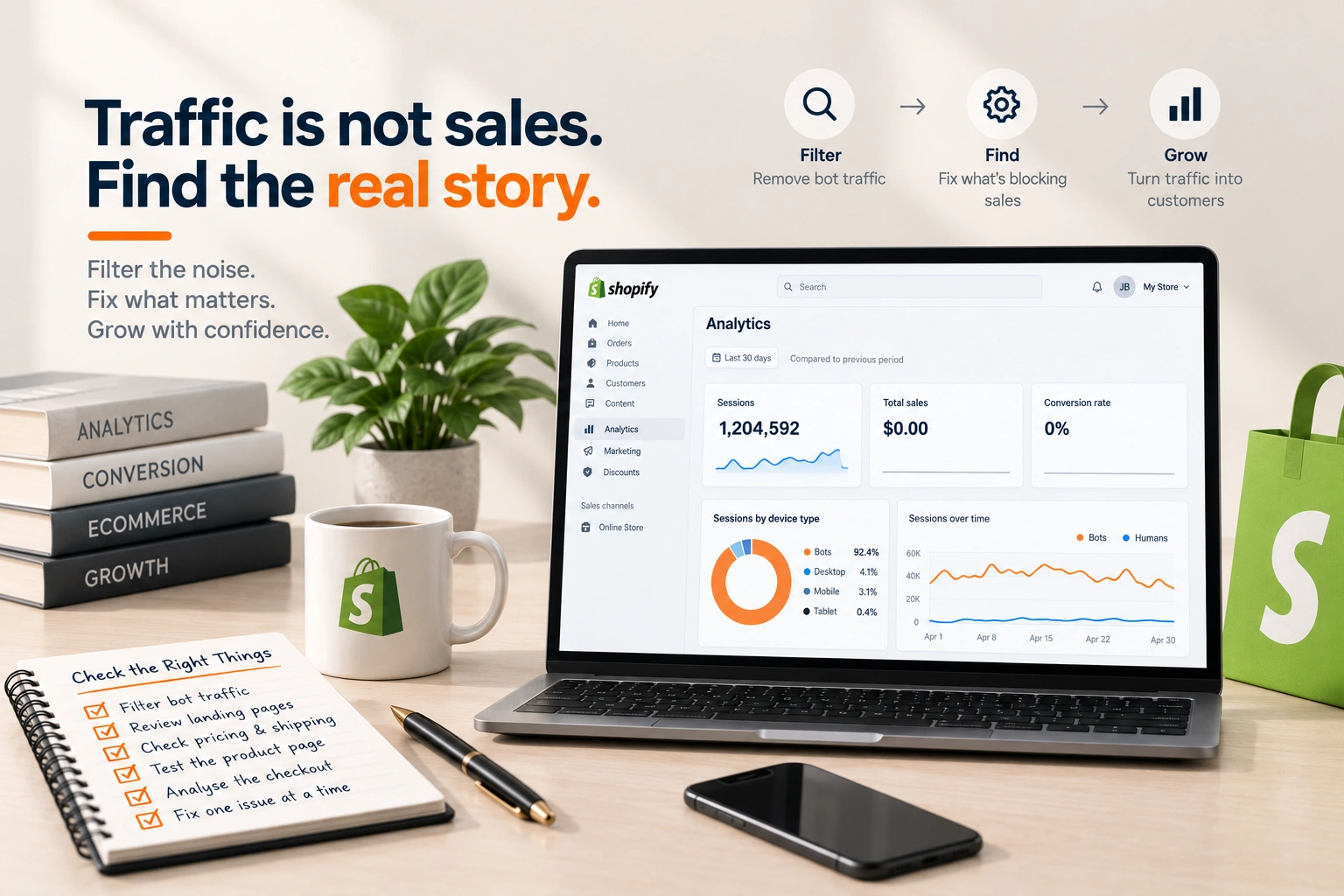
My website had 1.2 million sessions this month but no orders, a merchant wrote on the Shopify Community this week. The replies split the way they always do: half explaining that the sessions are not people, half offering conversion advice for a store that has not yet been shown to a person. Both halves are right in order, and the order matters. First find out how many of the sessions are human. Then, and only then, ask why the humans did not buy.
This is that order. The first half is Shopify's own counting and its filter; the second is the checklist we run on a store with real traffic and no sales, in the sequence the losses happen.
How Shopify counts a session
Shopify's help defines it: a session ends after thirty minutes of no activity, and at midnight UTC. Sessions are tracked with a cookie on the visitor's device, one cookie per device, so a visitor can have many sessions and the session count runs higher than the visitor count. A crawler that requests a thousand pages in an hour without a cookie can be many sessions or one, depending on how it behaves, and a scraper that accepts cookies is a visitor.
The filter is in the analytics. Shopify lets a merchant filter the data by human and bot traffic, and a store with a million sessions and no orders should open that filter before opening anything else. The sessions by referrer report and the sessions by location report finish the picture: bot traffic arrives direct or from an unknown referrer, from a country the store does not sell to, at hours the store's customers are asleep, on a handful of pages. A real audience arrives from search, social and email, from the countries the store ships to, across the day, and lands on products.
What a million bot sessions means, and what to do
Usually nothing sinister. Price scrapers, SEO crawlers, AI training crawlers and the occasional vulnerability scanner visit every store, and a store that recently appeared in a feed or a directory gets a wave of them. It costs bandwidth, not sales, and the fix is to stop counting it: filter to human traffic in analytics, and if the load is a problem, a bot rule at the edge. It does not need an app, and the apps that promise to block it are the kind that slow a store down, as the site speed article sets out.
What it does need is a corrected baseline. A store whose real traffic is four thousand human sessions a month with no orders has a conversion problem worth solving. A store whose real traffic is forty has a traffic problem, and conversion work on it is work on a store nobody sees. The number to write down is the human sessions, by referrer, on product pages.
The six places a store with real traffic loses the sale
In the order the visitor meets them. The landing page: a visitor from an ad or a post who lands on the home page, or on a collection page with forty products and no order, has to find the thing they came for, and most do not try. Send the traffic to the product it was promised, and make the collection pages work for the ones who browse, which is the subject of the collection pages article.
The offer: a product the visitor can buy on Amazon tomorrow at the same price with a delivery promise the store cannot match is a product the store loses, and the store has to say what is different in the first screen, in words the visitor recognises. The price: shown with shipping, in the visitor's currency, before the cart. A price that grows at checkout is the single most common reason a cart is abandoned, and Shopify's reports show it as a checkout drop.
The product page: the images the visitor needs to decide, the description written for a buyer rather than copied from the supplier, the reviews, the size or fit information, and the answers to the three questions every buyer of this product asks. The product descriptions article is the rewrite. Shipping: when it arrives and what it costs, on the product page, not discovered later. And checkout: express payment buttons in the first row, a discount that applies without a code where the offer allows it, and a path that has been tested on a phone by somebody who was not the developer.
Reading the funnel once the count is right
Shopify's conversion report gives the three steps: sessions that added to cart, reached checkout, and purchased. With bot sessions filtered out, the shape of the funnel says which of the six places above is the leak. Almost no adds to cart is a landing page, offer, price or product page problem. Adds to cart with few checkouts is shipping or price at the cart. Checkouts without purchases is the checkout itself, and the payment and shipping options on it.
The merchant with 1.2 million sessions, once filtered, is usually a merchant with a few hundred human sessions and a normal store. The next step is more of the right traffic, and the step after that is the conversion work above, which is what we do under conversion rate optimisation for the stores we run: the count corrected first, the funnel read, and the one leak fixed before the next one is looked at. A store that sells on marketplaces as well has the same funnel to read on each, and the eCommerce SEO versus marketplace optimisation article is where the two sides meet.
Frequently asked questions
The questions that come up most often on this subject.
Most often because the sessions are not people. Filter Shopify analytics to human traffic, then read sessions by referrer and location. Bot traffic arrives direct or from unknown referrers, from countries you do not sell to, at odd hours, on a few pages. Judge the store on the human sessions that remain.
A session is tracked with a cookie on the visitor's device and ends after thirty minutes of no activity, and at midnight UTC. One visitor can have many sessions, so sessions run higher than visitors.
It costs bandwidth and distorts the analytics; it does not cost sales. Filter it out in analytics and, if the load matters, block it at the edge rather than with an app, which adds weight to every real visitor's page.
It depends on the traffic source and the product, so the useful comparison is the store's own funnel: sessions that add to cart, reach checkout and purchase, with bots filtered. The shape of that funnel says where the leak is, which matters more than a benchmark.
At six places in order: a landing page that is not the product promised, an offer that does not say what is different, a price that grows at checkout, a product page that does not answer the buyer's questions, shipping cost and time hidden until the cart, and a checkout untested on a phone.