Answer Engine Optimization for Shopify Stores
Assistants answer the question rather than listing ten links. A store that only competes for the click is competing for something fewer people press.


Loading Article banner
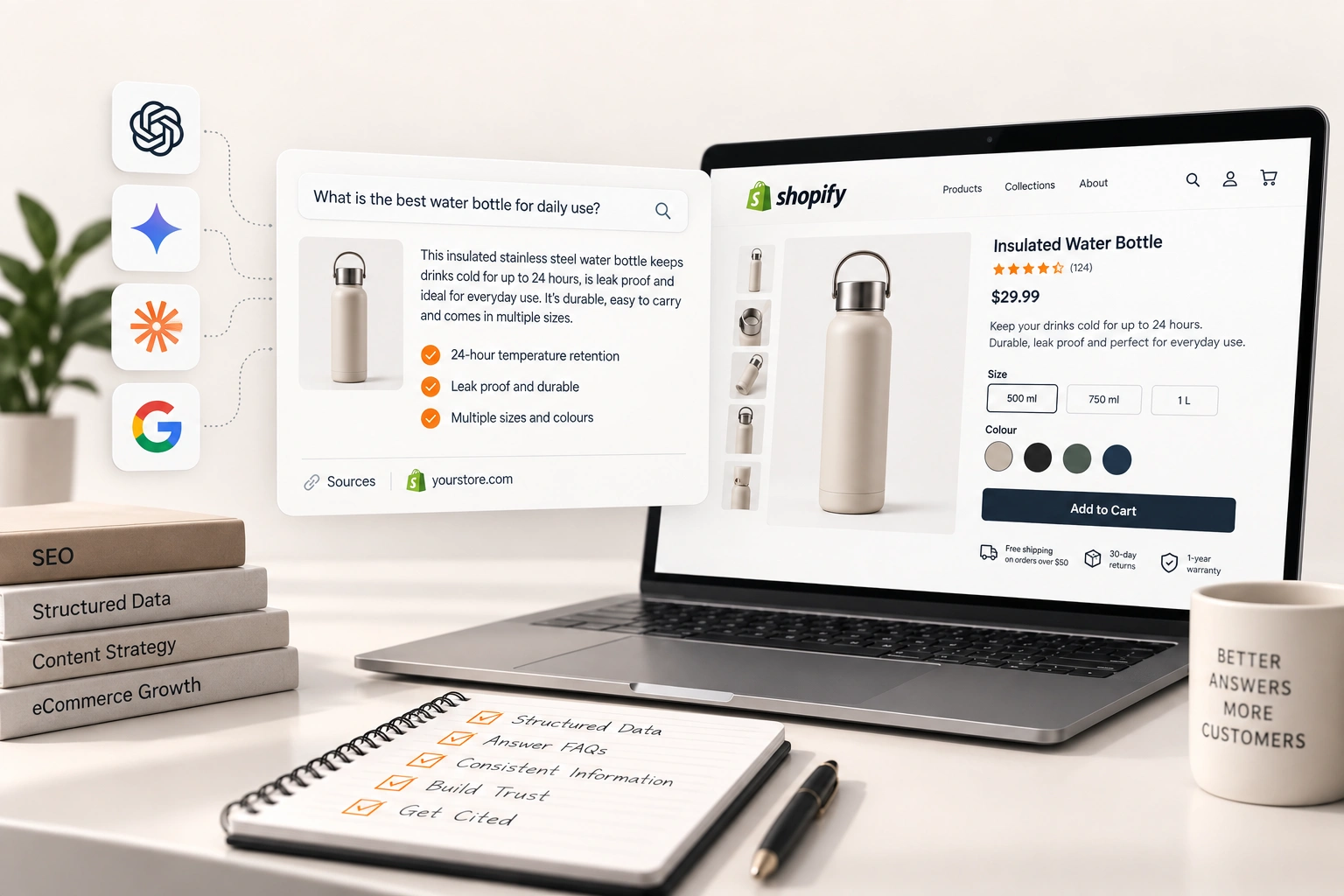
Search results increasingly answer the question rather than pointing at ten pages that might. For a store, that changes what a page has to do: it has to be the source the answer is drawn from, and it has to be recognisable as a source at all.
Most of the work is unglamorous and most of it also improves the page for a human, which is the reason to do it whatever happens to the interface.
What an answer engine needs from a page
A question, answered in a sentence, near the top. Not buried in a paragraph three screens down and not implied by a feature list.
Facts stated plainly and consistently: dimensions, materials, compatibility, delivery, returns. An assistant summarising your product page can only be as accurate as the page, and a page that contradicts itself produces an answer that does the same.
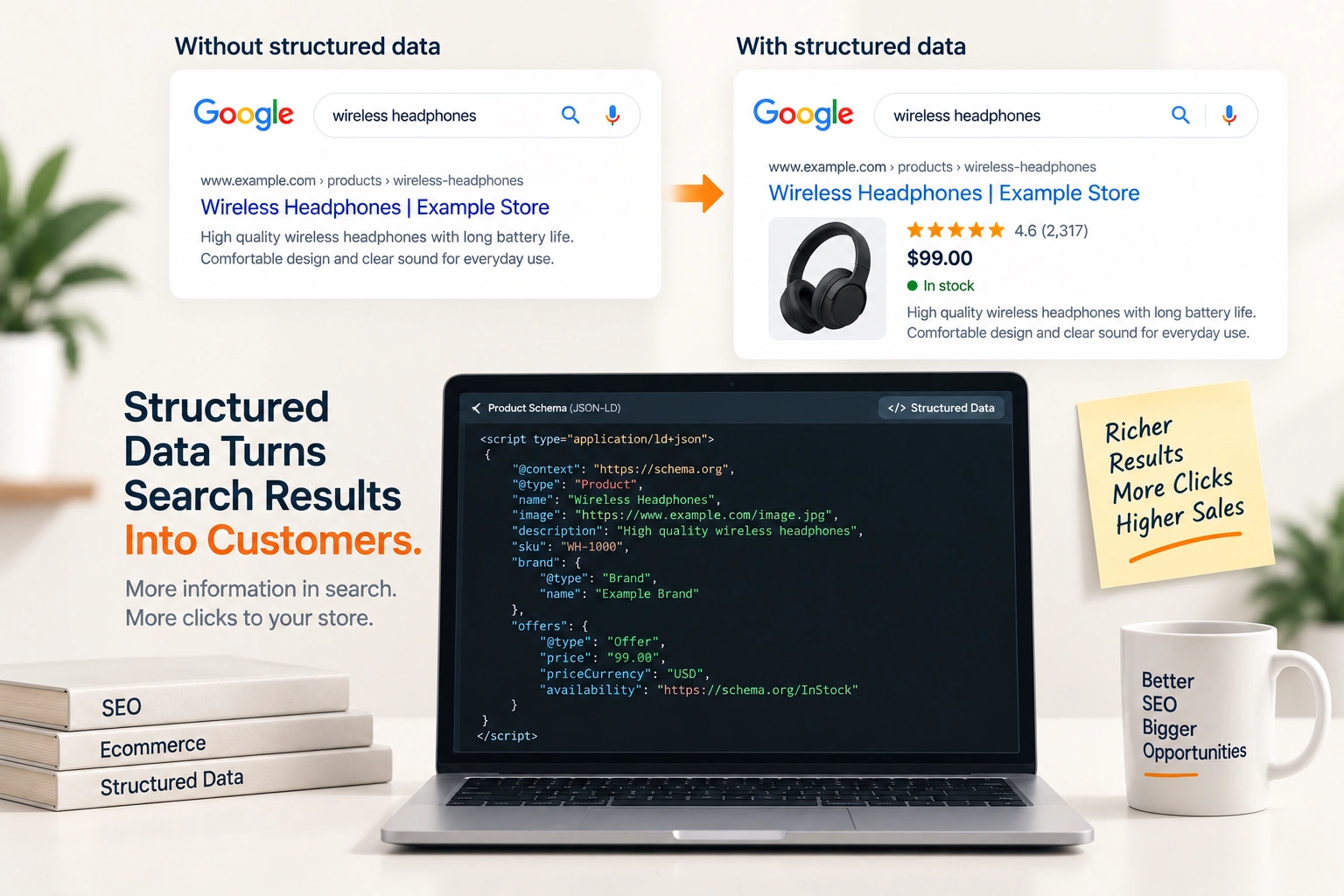
And enough structure that a machine can tell which part of the page is the answer, which is what structured data is for.
Structured data is the cheapest work here
Product markup with price, availability and identifiers. FAQ markup on the questions the page genuinely answers. Breadcrumbs so the position in the catalogue is explicit. Organisation markup so the brand is an entity rather than a word.
Shopify themes emit some of this and rarely all of it, and apps frequently emit it twice, which is worse than not emitting it. Checking what a page actually outputs is a five minute job and it is skipped almost universally.
We cover the wider version of this in structured data for online stores.
Write the questions people actually ask
The support inbox is the best keyword tool a store owns. Every question asked twice is a question the product page should answer, and answering it there removes a ticket and feeds an answer engine at the same time.
Write the answer as an answer. One sentence that stands alone, then the detail. An assistant lifting a sentence from your page should produce something that reads correctly with no context around it.
Consistency across the store
If the product page, the FAQ page and the delivery page disagree about the returns window, the page that gets quoted is arbitrary and one of your answers is wrong.
Pick the page that owns each fact, and have the others link to it rather than restating it. That is good information architecture and it happens to be exactly what a machine reading the site needs.
Being cited requires being credible
Answer engines lean on sources that other sources agree with. A store whose claims appear nowhere else is a weaker source than one whose products are reviewed, listed and referenced elsewhere.
That is not a trick to perform. It is the ordinary work of being a real brand: reviews, mentions, a consistent name and address, and product data that matches wherever it appears, including on the marketplaces.
What to change first
Audit what one product page actually emits, fix the structured data, and put a plain answer to the three commonest questions near the top of the page. That is a morning's work and it is most of the available gain.
Then do it at template level rather than page by page, because a store with four hundred products cannot be fixed one page at a time and does not need to be.
What we do with this
This is part of Shopify store management rather than a separate discipline, because the same product data feeds the store, the marketplaces and the advertising, and fixing it once fixes all three.
The same facts have to be right on Amazon and Walmart, where the catalogue is the source and the rules differ.
If you want the audit rather than the theory, ask for it.
Related reading: Shopify SEO: The Complete Guide for a Store That Has to Rank, Structured Data for Online Stores, and Why Your Results Look Plain, Shopify Script Tags Are Being Switched Off: The Two Dates and What Breaks and Shopify's New Collections: Multi-Source, Variant-Level and Nested, and What to Rebuild.
Frequently asked questions
The questions that come up most often on this subject.
Making a page the source an assistant draws its answer from, rather than one of ten links a searcher might click. In practice it means answering questions plainly and near the top, keeping facts consistent across the site, and emitting structured data so a machine can tell which part of the page is the answer.
It overlaps heavily and the emphasis differs. Classic SEO competes for a position in a list; AEO competes to be the sentence that gets quoted. Almost everything that helps the second also helps the first, which is why it is not a separate programme of work.
Product markup with price, availability and identifiers; FAQ markup where the page genuinely answers questions; breadcrumbs; and organisation markup so the brand reads as an entity. Themes emit some of it, apps sometimes emit it twice, and duplicated markup is worse than none.
Both, and product pages are where most stores have the most to gain. A product page that states dimensions, materials, compatibility, delivery and returns plainly is answerable; one that lists features and hides the facts in a table image is not.
From the support inbox, the reviews and the marketplace question sections. Anything asked twice belongs on the page. That source beats a keyword tool because it is your own buyers using their own words.
Apps can emit markup, and they cannot decide which facts matter or write an answer that reads well. They also frequently duplicate markup the theme already emits. Use them for the mechanical part and check the output.
Yes. Clear answers, consistent facts and correct structured data are what rich results and featured snippets have always rewarded. The change is that the same qualities now decide whether an assistant quotes you, not just whether a snippet appears.
Structured data fixes are picked up within days to weeks. Being quoted more often is slower and harder to measure, because there is no rank position to watch. Track branded search and direct traffic alongside the usual metrics rather than expecting a single number to move.
It helps, provided the facts agree. Answer engines favour sources corroborated elsewhere, and a product whose specification matches across your store and every marketplace is more credible than one that contradicts itself between channels.
Facts that live only inside an image. A specification table saved as a picture is invisible to everything that reads the page, and it is the commonest reason a well built product page cannot be quoted.